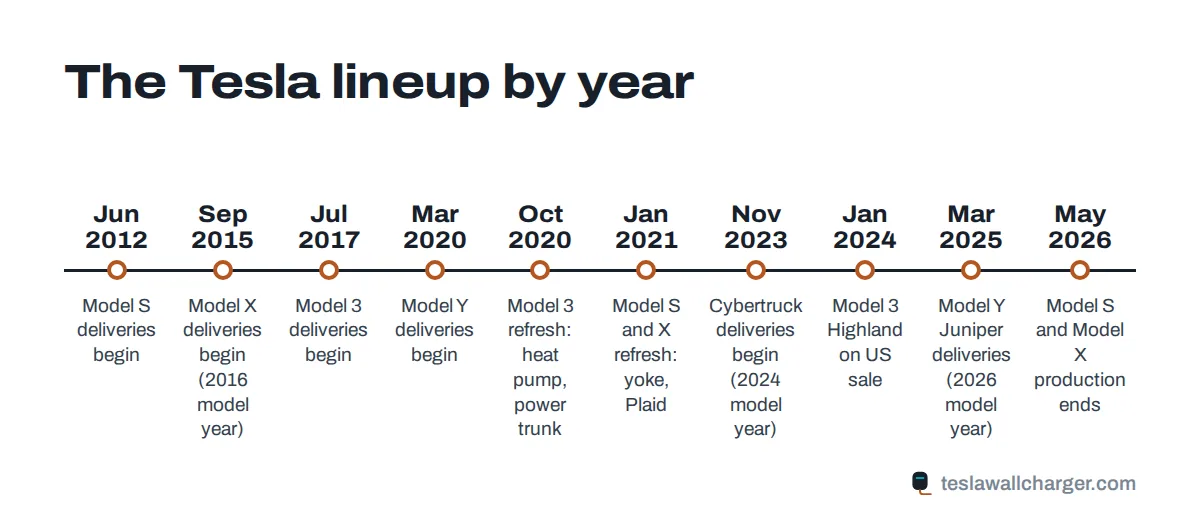
Tesla has sold five models in the US across 46 model years: the Model S from 2012, the Model X from 2016, the Model 3 from 2017, the Model Y from 2020 and the Cybertruck from 2024. Two of them are now finished, with Model S and Model X production ending in May 2026, so this grid covers every Tesla model year a US buyer can find.
Every Tesla model year in one grid
Each cell opens a page for one model year. If you are still deciding between years, start with the model's guide, which ranks the years and explains what changed:
| Model | US model years | Count | Major updates | Model guide |
|---|---|---|---|---|
| Model S | 2012 to 2026 | 15 | 2016 facelift, 2019 Raven, 2021 refresh, 2026 final update | Tesla Model S years |
| Model X | 2016 to 2026 | 11 | 2019 Raven, late-2021 refresh, 2026 final update | best year for the Model X |
| Model 3 | 2017 to 2026 | 10 | Late-2020 refresh (2021 model year), 2024 Highland | Model 3 years to avoid |
| Model Y | 2020 to 2026 | 7 | 2026 Juniper refresh | Model Y model-year changes |
| Cybertruck | 2024 to 2026 | 3 | 2026 Dual Motor AWD | Tesla Cybertruck years |
How to use a year page
Every year page follows the car, not a template, but each one gives you the same core facts so you can compare like with like:
- Trims and specs: EPA range, efficiency, battery chemistry where known, launch price and onboard charger size for each trim sold that year.
- Recalls: the full NHTSA campaign list for that model year, updated automatically from NHTSA, with the over-the-air fixes separated from the ones that need a service visit.
- Owner complaints: the NHTSA complaint count and the components owners report most.
- Crash ratings: NHTSA's star ratings where published, or a plain note where NHTSA has not rated that year.
- Home charging: the most the car accepts, the breaker that suits it, and how many miles each hour of charging adds.
- What changed and what to check: the mid-year hardware changes and the buying checks specific to that year.
For a used car, the order that saves the most time: read the model guide, shortlist two or three years, then open those year pages and compare the recall lists against the seller's service records.
Where the numbers come from
- Recalls come from NHTSA's recall API, queried by make, model and model year. Counts include software recalls that Tesla fixed over the air, which is why Teslas often show more campaigns than other brands.
- Owner complaints come from NHTSA's complaint API. They are unverified reports filed by owners, not confirmed defects, and they rise with the number of cars sold and the years on the road.
- Crash ratings come from NHTSA's 5-Star Safety Ratings. Many Tesla years carry only a rollover rating; we say so rather than borrowing a rating from another year.
- Range and efficiency come from EPA ratings published on fueleconomy.gov.
- Charging rates come from Tesla's Wall Connector support page and onboard charger documentation. Full-charge times are our own arithmetic from pack size and charger output, labeled as estimates.
- Model changes come from Tesla announcements and established outlets: Edmunds, InsideEVs, Electrek, TechCrunch, Drive Tesla Canada and Not a Tesla App.
Where a number was never published, such as the usable battery size of some trims or the exact date an option ended, the page says it is unknown instead of guessing.
The biggest changes across the Tesla lineup
Most of the differences between Tesla years are not styling. They are hardware swaps that happened across several models at once, often mid-year.
Autopilot hardware
HW1 (one camera, radar, ultrasonic sensors) arrived on Model S builds from about September 2014. HW2 with eight cameras replaced it on S and X in October 2016, and HW2.5 followed in August 2017. HW3, Tesla's own computer, entered production around April 2019 for S, X and Model 3. HW4 began shipping on Model S and X in early 2023 and on Model Y from about May 2023.
Sensors removed
Radar left North American Model 3 and Model Y built from about late April 2021, and Model S and X from mid-February 2022. Ultrasonic parking sensors were dropped from Model 3 and Model Y from October 2022 and from S and X during 2023. Cars without them rely on camera-based Park Assist.
Heat pumps
The Model Y launched in 2020 as the first Tesla with a heat pump. The Model 3 got one with its October 2020 refresh, and the Model S and X with their 2021 refresh. A Tesla built before those dates heats its cabin with resistive heaters, which costs more winter range.
Touchscreen computers
Model S and X used MCU1, whose 8 GB eMMC memory wears out, until MCU2 replaced it from March 2018 builds. The 2021 refreshed S and X launched with an AMD Ryzen computer, and Model 3 and Model Y switched to it from about late December 2021.
Battery chemistry and the box contents
LFP (lithium iron phosphate) cells appeared in Standard Range Plus Model 3 cars from around August 2021 and became standard on the base Model 3 for 2022. Tesla recommends charging LFP packs to 100% routinely, unlike NCA packs. Separately, Tesla stopped including the Mobile Connector with new cars ordered from late April 2022; our page on whether a new Tesla includes a charger covers the details.
Model year vs build date
On a Tesla, the build date tells you more than the model year, because Tesla changes parts when they are ready rather than at a model-year boundary. Read it on the label in the driver's door pillar. Three model-year labels catch buyers out:
- Model 3, late 2020. The refreshed car with the heat pump went on sale in October 2020; most are titled 2021, but some are 2020.
- Model Y Juniper. The refreshed Model Y delivered from March 2025 is a 2026 model year car. A true 2025 is the old design. The 10th VIN character settles it: S for 2025, T for 2026.
- Model S and X, 2026. The June 2025 update with the front bumper camera and new lighting is sold as the 2026.
Home charging across the lineup
| Model and era | Most the car accepts | Breaker for full speed | Wall Connector range added per hour |
|---|---|---|---|
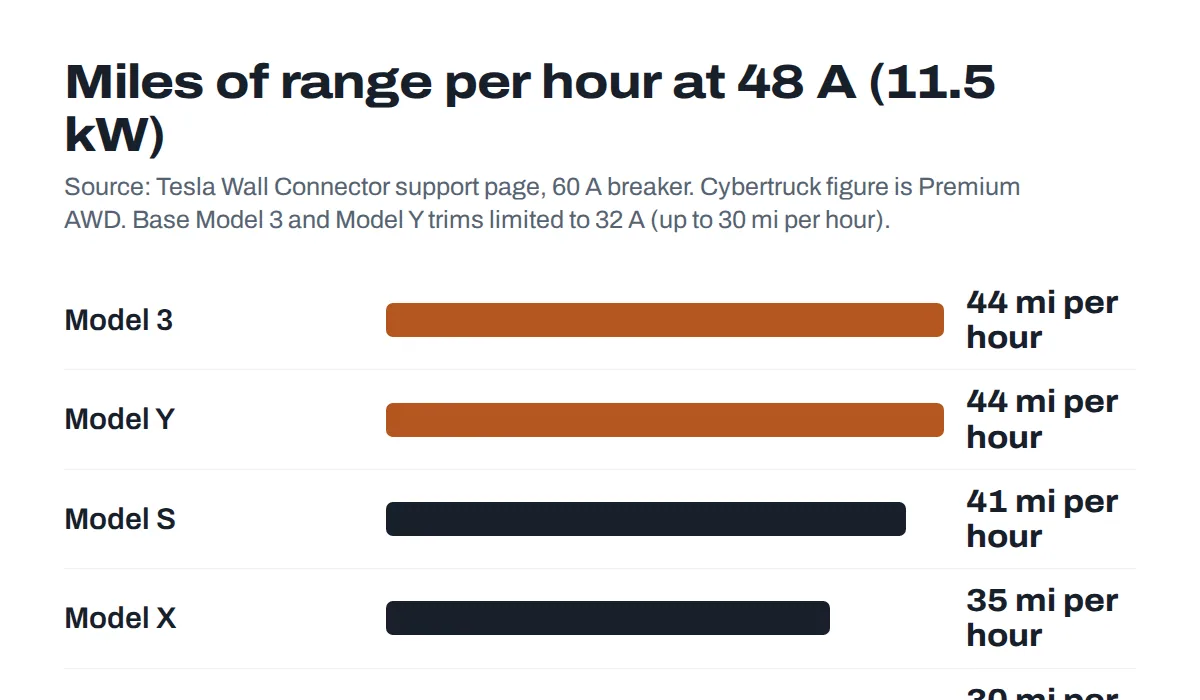
| Model 3 Long Range, Premium, Performance; all 2025 trims | 48 A, 11.5 kW | 60 A | Up to 44 mi |
| Model 3 Standard Range, RWD and 2026 Standard | 32 A, 7.7 kW | 40 A | Up to 30 mi |
| Model Y Long Range, Premium, Performance | 48 A, 11.5 kW | 60 A | Up to 44 mi |
| Model Y 2026 Standard RWD and AWD | 32 A, 7.7 kW | 40 A | Up to 30 mi |
| Model S, April 2016 onward | 48 A (72 A option on some cars from April 2016; end date not documented) | 60 A (90 A on a Gen 2 for 72 A) | Up to 41 mi |
| Model S, 2012 to early 2016 | 40 A (80 A with dual chargers) | 50 A (100 A on a Gen 2 for 80 A) | Varies by pack |
| Model X | 48 A (72 A option on some early cars; end date not documented) | 60 A (90 A on a Gen 2 for 72 A) | Up to 35 mi |
| Cybertruck | 48 A, 11.5 kW | 60 A | Up to 30 mi |
Most current Teslas fill from empty overnight on a 48 A Wall Connector; a Cybertruck needs 11 to 12 hours. Before you size a circuit for a used car, read its charging screen; then see charging times by circuit and what a home charger install costs. Owners of 72 A and 80 A cars should read which generation supports over 48 A first, and anyone weighing battery age across years will find degradation figures in our guide to Tesla battery life.
Common questions
How many Tesla model years are there?
Counting US model years through 2026, there are 46: fifteen for the Model S (2012 to 2026), eleven for the Model X (2016 to 2026), ten for the Model 3 (2017 to 2026), seven for the Model Y (2020 to 2026) and three for the Cybertruck (2024 to 2026). Each has its own page on this site with recall, complaint, rating and charging data.
Which Tesla models are still made?
As of October 2026, Tesla builds the Model 3, Model Y and Cybertruck for the US. Model S and Model X production ended around May 2026 after Tesla announced the decision on its fourth-quarter 2025 earnings call. Tesla's compare page now lists only the three remaining models, and it says it will keep servicing S and X.
What is the best Tesla year to buy used?
It depends on the model, but a pattern holds: the year after a big change is usually better than the change year itself. Our picks are the 2023 and 2025 Model 3, the 2024 and 2025 Model Y, the 2020 Model S Long Range Plus, the 2020 Model X and the 2025 Cybertruck. Each model's hub explains why.
Where does the recall and complaint data come from?
Recalls, owner complaints and crash ratings come from NHTSA's public APIs and are rechecked about once a week on each year page. EPA range and efficiency come from fueleconomy.gov. Charging rates come from Tesla's own support pages, and model changes from Tesla announcements and established outlets such as Edmunds, InsideEVs, Electrek and TechCrunch. Where a figure is not published, we say so.
What is the difference between model year and build date on a Tesla?
Tesla changes hardware whenever it is ready, not at a model-year boundary, so the build date printed on the driver's door pillar tells you more. The 10th VIN character gives the model year (S is 2025, T is 2026). Three traps: Model 3 refresh cars from October 2020, Model Y Juniper cars titled 2026, and 2026 Model S and X.
Which Tesla charges fastest at home?
On a Gen 3 Wall Connector at 48 A, the Model 3 and Model Y add the most range per hour, up to 44 miles, because they use the least energy per mile. Model S adds 41, Model X 35 and Cybertruck 30. Some older Model S and X with 72 A or 80 A chargers can go faster, but only on an older Gen 2 unit.
Sources
- NHTSA recalls API, api.nhtsa.gov
- NHTSA 5-Star Safety Ratings API, api.nhtsa.gov
- fueleconomy.gov: find and compare cars, fueleconomy.gov
- Tesla support: Wall Connector charging rates, tesla.com
- Tesla support: onboard charger, tesla.com
- Tesla: compare models, tesla.com
- CarPro: Tesla ending production of Model S and Model X, carpro.com
- InsideEVs: Tesla Autopilot hardware history, insideevs.com