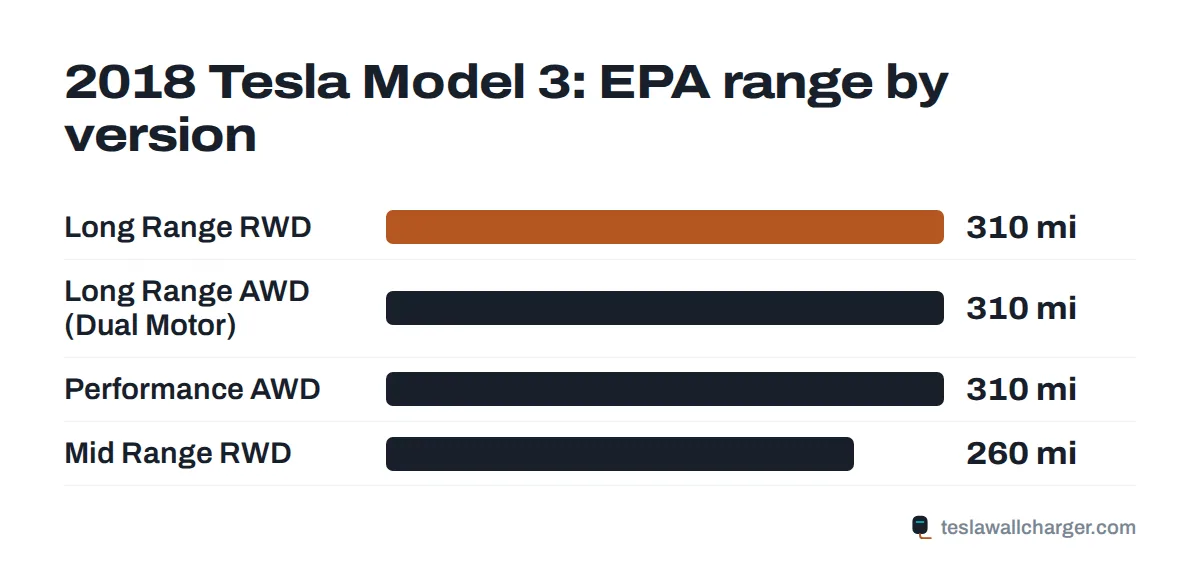
The 2018 Tesla Model 3 is really four different cars: a Long Range RWD, a Long Range Dual Motor AWD, a Performance AWD and, from October, a cheaper Mid Range RWD. Three of them are rated at 310 miles and charge at 48 A; the Mid Range gives up 50 miles of range, so the first job on any listing is working out which one it is.
2018 was the year Model 3 production finally ramped, and the lineup changed almost every quarter. That makes listing titles unreliable. "Long Range" alone can mean either drive layout, and some sellers describe a Mid Range as Long Range by mistake.
How to tell which 2018 you are looking at
Start with the paperwork. The original window sticker or the Tesla app build details name the exact version. On the car, the touchscreen's Software screen shows the variant, and the specs below show what each one should deliver.
| Trim | EPA range | Efficiency | Home AC max | Price (USD) |
|---|---|---|---|---|
| Long Range RWD | 310 mi | 26 kWh/100 mi | 11.5 kW | n/a |
| Long Range AWD (Dual Motor) | 310 mi | 29 kWh/100 mi | 11.5 kW | $54,000 |
| Performance AWD | 310 mi | 29 kWh/100 mi | 11.5 kW | $78,000 |
| Mid Range RWD | 260 mi | 27 kWh/100 mi | n/a | $45,000 |
A few quick tells while you wait for paperwork:
- Range at 100%: new, a Long Range was rated at 310 miles and a Mid Range at 260. A Mid Range should show clearly less when full, but battery wear on an old Long Range narrows the gap, so do not rely on this alone.
- Efficiency: the RWD Long Range is the most efficient 2018 at 130 MPGe (about 26 kWh per 100 miles). The dual-motor cars use about 29 kWh per 100 miles.
- Acceleration: Tesla quoted 5.1 seconds to 60 mph for the RWD Long Range, 4.5 for the AWD and 3.5 for the Performance, which also has a 155 mph top speed.
Prices moved all year
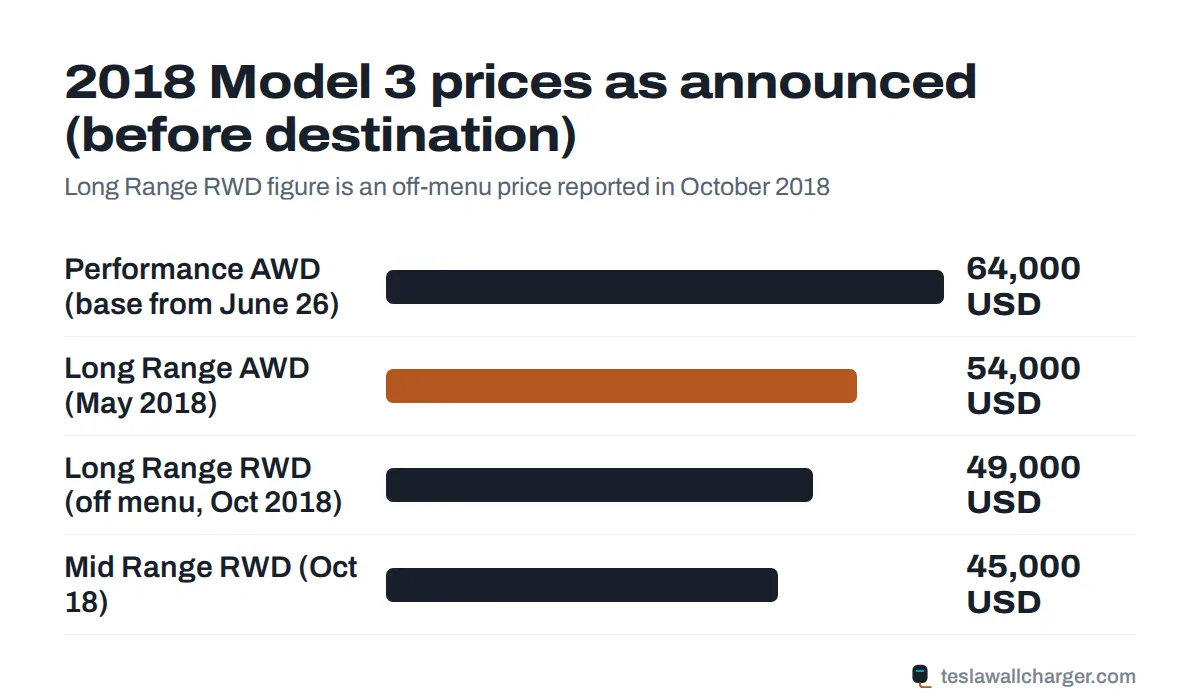
Tesla announced the Dual Motor AWD at $54,000 in May 2018 and the Performance at $78,000 with every option except Autopilot. On June 26 it unbundled options, dropping the Performance base to $64,000 and briefly cutting the Dual Motor option to $4,000, then raised it back to $5,000 on August 2. The Mid Range arrived on October 18 at $45,000. Compare used prices against condition and mileage, not against the original sticker.
The Mid Range: cheaper, shorter, less certain
The Mid Range RWD was on sale for only a few months, from October 2018 until around March 2019, and it is uncommon on the used market. It has a smaller pack of roughly 62 kWh and an EPA rating of 260 miles at 123 MPGe.
Its onboard charger rating is not confirmed in Tesla's published tables, which only state 48 A for cars with the Long Range battery. Before you pay for a 60 A circuit, plug the car in and tap the lightning bolt on the touchscreen: it shows the maximum current the car will accept. If it tops out at 32 A, a 40 A breaker does the same job as a 60 A one.
For most buyers the Mid Range only makes sense at a clear discount to a Long Range RWD.
Problems owners report most
NHTSA holds 1,030 complaints for the 2018 Model 3, against 26 for 2017, largely a reflection of how many more 2018 cars were built. In the first 80 or so records, suspension leads, followed by airbags, forward collision avoidance and steering.
1030 owner complaints filed with NHTSA for the 2018 Model 3. Most frequent areas (approximate order): suspension; air bags; forward collision avoidance; steering; unknown or other; electrical system. Source: NHTSA complaints database.
Suspension complaints line up with the front lateral link fastener recall described below, so listen for clunks over bumps on the test drive and check the steering tracks straight. Early Model 3s also drew paint, trim and body hardware complaints, which led Consumer Reports to drop its recommendation in February 2019. Inspect door latches, rear glass and paint edges with the same care you would give a 2017.
Recalls that still need a VIN check
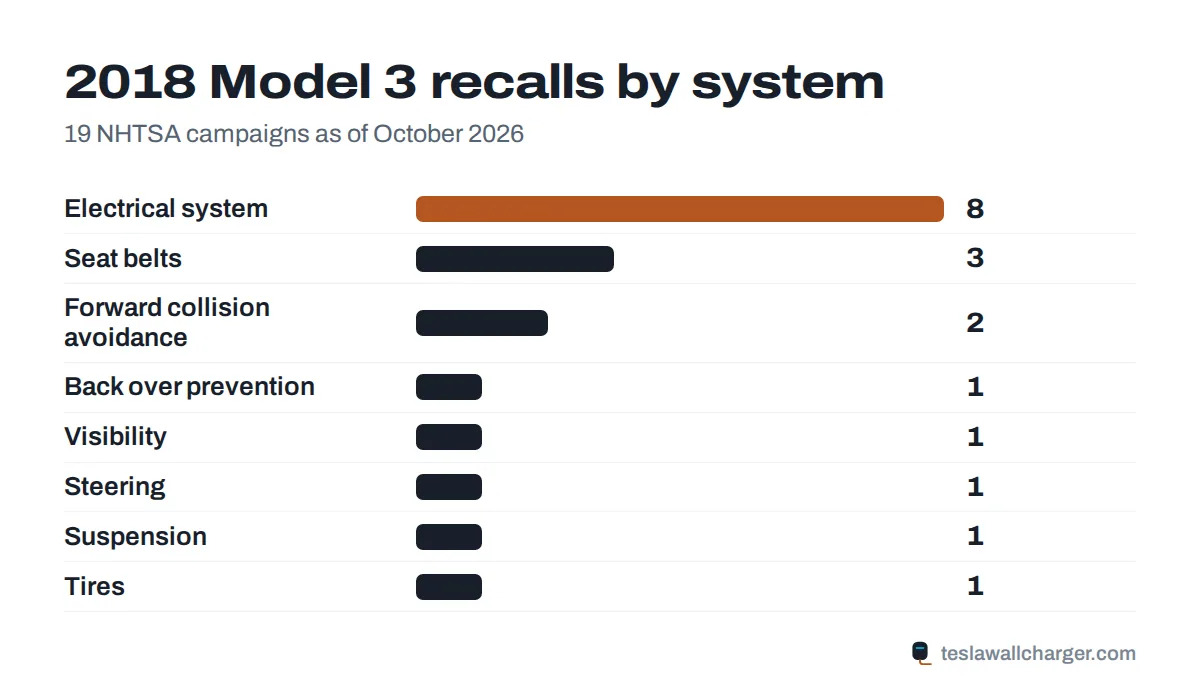
As of October 2026 NHTSA lists 19 recall campaigns for 2018. Fourteen were remedied over the air. The five that require a Tesla Service visit are the ones to confirm:
| Campaign | Issue | Why it matters to a buyer |
|---|---|---|
| 23V235000 | Front suspension lateral link fasteners may loosen and let the link separate | Steering control; the most serious open item on any early car |
| 21V389000 | Front shoulder belt fasteners at the B-pillar may not be attached properly | Belt may not restrain properly in a crash |
| 21V00D000 | Trunk use can damage the rearview camera harness | Lost reversing image |
| 22V798000 | Rear belt anchors may have been refitted wrongly after service | Only if the rear seat was removed before |
| 26V507000 | Low-beam headlights may exceed the maximum allowed brightness | New in August 2026, so many cars will not have had it done yet |
The software recalls include a false forward collision warning fix (21V846000), a Track Mode speedometer fix that matters mainly for Performance cars (22V263000), and FSD-only items. Check open campaigns by VIN on NHTSA's recall site.
- 21V389000May 25, 2021Seat beltsService visit
Front shoulder belt fasteners at the B-pillar may not be properly attached - 21V846000October 29, 2021Forward collision avoidance, sensing system, cameraSoftware update
Communication error may cause false forward collision warnings or unexpected automatic emergency braking - 21V00D000December 21, 2021Electrical system, wiring, rear compartment/trunkService visit
Opening and closing the trunk can damage the rearview camera cable harness (campaign number as given by the API) - 22V037000January 27, 2022Electrical system, adas, autonomous/self driving, softwareSoftware update
FSD Beta 'rolling stop' could let the car pass through all-way stops without stopping - 22V045000February 1, 2022Electrical system, softwareSoftware update
Seat belt chime may not sound at startup for an unbelted driver - 22V063000February 4, 2022Electrical system, softwareSoftware update
Boombox sounds may mask Pedestrian Warning System sounds (superseded by 22V235000)
Show all 19 recalls
- 22V169000March 18, 2022Back over prevention, display functionSoftware update
Rearview camera image may not display immediately when reversing - 22V235000April 12, 2022Electrical system, softwareSoftware update
Boombox sounds may mask Pedestrian Warning System sounds; replaces 22V063000 - 22V263000April 18, 2022Electrical system, instrument cluster/panelSoftware update
Speed unit (mph or km/h) may not display on the speedometer in Track Mode - 22V702000September 19, 2022Visibility, power window devices and controlsSoftware update
Window automatic reversal may not react correctly after detecting an obstruction (pinch risk) - 22V798000October 21, 2022Seat belts, rear/other, anchorageService visit
Second-row left buckle and center belt anchor may have been reassembled incorrectly during service - 23V085000February 15, 2023Steering, automated/adaptive steeringSoftware update
FSD Beta may act unsafely at intersections and respond poorly to speed limit changes - 23V235000March 31, 2023Suspension, frontService visit
Front suspension lateral link fasteners may loosen and allow separation (expansion of 21V835000) - 23V838000December 12, 2023Electrical system, adas, autonomous/self driving, softwareSoftware update
Autosteer controls may not be sufficient to prevent driver misuse - 24V051000January 30, 2024Electrical system, instrument cluster/panelSoftware update
Brake, park and ABS warning lights shown in a font smaller than required - 24V153000February 27, 2024Forward collision avoidance, warnings, external/pedestrian alertSoftware update
A factory reset could mute Pedestrian Warning System sounds - 24V376000May 28, 2024Seat belts, front, warning light/devicesSoftware update
Unbelted-driver warning light and chime may not activate - 24V935000December 17, 2024Tires, pressure monitoring and regulating systemsSoftware update
TPMS warning light may not stay on between drive cycles - 26V507000August 5, 2026Exterior lighting, headlightsService visit
Low-beam headlights may be too bright, exceeding the maximum allowed light output
Source: NHTSA recalls API. A recall only applies if your VIN is listed.
Crash test scores differ by drive layout
NHTSA gave the rear-wheel-drive 2018 five stars overall, five for frontal and side crashes and five for rollover, with a 6.6% rollover risk. The all-wheel-drive car has five-star side and rollover scores, but NHTSA lists its overall and frontal ratings as Not Rated for 2018. That is a gap in testing, not a poor result.
| NHTSA test | Rating |
|---|---|
| Overall | 5 stars |
| Frontal crash | 5 stars |
| Side crash | 5 stars |
| Rollover | 5 stars |
| Rollover risk | 6.6% |
Home charging for each 2018 version
Every Long Range and Performance 2018 accepts 48 A, so a Gen 3 Wall Connector on a 60 A breaker adds up to 44 miles of range an hour, by Tesla's Model 3 table, and fills an empty 75 kWh pack in about 7 hours by our estimate. Learn the circuit options in our guide to which breaker and wire gauge to use, and see what electricians charge for the job.
| How you charge | Speed |
|---|---|
| Wall Connector at 48 A (11.5 kW, 60 A breaker) | up to 44 mi of range per hour |
| NEMA 14-50 outlet, Mobile Connector at 32 A | about 30 mi per hour |
| Regular 120 V outlet | 2 to 3 mi per hour |
| Empty to full, largest pack (about 75 kWh) | about 7 hours at 11.5 kW |
Rates scale Tesla's published Wall Connector table for this model; older cars and cold batteries charge slower. Times are estimates.
Cost per mile follows the efficiency gap. At the US average of 18.31 cents per kWh (EIA, July 2026), 1,000 miles costs about $47 in a RWD Long Range and about $53 in a Dual Motor or Performance, based on EPA consumption. Plug your own rate into our home charging cost calculator for a closer number.
Tesla included the Mobile Connector with cars ordered before late April 2022, so a 2018 should come with one. It charges at about 30 miles per hour from a NEMA 14-50 outlet, which is enough for most commuters; our Mobile Connector vs Wall Connector comparison covers when the upgrade pays off.
Which 2018 to buy
- Long Range RWD: the efficiency pick, and the cheapest Long Range to run. Choose it in mild climates.
- Long Range AWD: the one to have if you see snow. Same 310 miles, more traction.
- Performance: worth it only if you want the speed and the seller can show tire, brake and suspension records.
- Mid Range: only at a real discount, and only after you confirm its charging current.
Every 2018 predates the HW3 computer, which reached Model 3 production around April 2019, and none has a heat pump or power trunk. If those matter, compare with a 2019 Tesla Model 3 built after mid-April. If budget is the main driver, a 2017 Model 3 is the same Long Range RWD car with less warranty left. See every year compared on our Tesla Model 3 years hub.
2018 Model 3 questions from used buyers
What trims did the 2018 Tesla Model 3 come in?
Four: the Long Range rear-wheel drive carried over from 2017, the Long Range Dual Motor all-wheel drive (deliveries from July 2018), the Performance all-wheel drive, and from October 18, 2018, a Mid Range rear-wheel drive. The three Long Range cars share a roughly 75 kWh battery; the Mid Range has a smaller pack of roughly 62 kWh.
What is the range of a 2018 Tesla Model 3?
The EPA rated the Long Range RWD, Long Range AWD and Performance at 310 miles each. The Mid Range RWD is rated at 260 miles. Efficiency differs more than range: the RWD Long Range is rated at 130 MPGe, the two dual-motor cars at 116 MPGe and the Mid Range at 123 MPGe.
Is the 2018 Model 3 Performance worth buying used?
If you want the acceleration, yes: Tesla quoted 0 to 60 mph in 3.5 seconds and a 155 mph top speed. It uses about 12% more energy per mile than the RWD Long Range by EPA figures, and performance cars are more likely to have worn tires, brakes and suspension bushings, so inspect them carefully and check the service history.
Is the 2018 Model 3 battery still under warranty?
Only on later deliveries, and not for long. The battery and drive unit warranty lasts 8 years from the in-service date, capped at 120,000 miles for Long Range cars under Tesla's current terms. A car first delivered in March 2018 lost coverage in March 2026; one delivered in December 2018 keeps it until December 2026.
Does the 2018 Model 3 have any service recalls I should check?
Five of its 19 recalls need a service visit: front suspension lateral link fasteners (23V235000), B-pillar shoulder belt fasteners (21V389000), the trunk camera harness (21V00D000), rear belt anchors refitted after service (22V798000) and low beams that are too bright (26V507000, August 2026). Run the VIN through NHTSA to see which apply.
Sources
- NHTSA recalls API, 2018 Tesla Model 3 (queried October 13, 2026), api.nhtsa.gov
- NHTSA complaints API, 2018 Tesla Model 3, api.nhtsa.gov
- NHTSA safety ratings, 2018 Tesla Model 3, api.nhtsa.gov
- Electrek: Tesla updates Model 3 options and pricing (June 26, 2018), electrek.co
- Electrek: Tesla increases Model 3 Dual Motor option price (August 2, 2018), electrek.co
- Engadget: Model 3 Mid Range for $45,000 (October 18, 2018), engadget.com
- The Drive: 2018 Tesla Model 3 Performance (May 20, 2018), thedrive.com
- TechCrunch: Consumer Reports pulls Model 3 recommendation (February 21, 2019), techcrunch.com
- Tesla support: onboard charger, tesla.com
- Tesla support: vehicle warranty, tesla.com
Independent site. Not affiliated with or endorsed by Tesla, Inc. Tesla, Wall Connector and Supercharger are trademarks of Tesla, Inc.