A used 2023 Tesla Model 3 is worth buying over a 2024 when it saves you real money: it has more EPA range in Long Range (358 miles) and Performance (315) form, a full 5-star NHTSA rating and conventional stalks, while the 2024 Highland refresh brings a quieter, better-equipped cabin. Mechanically, the 2023 is the 2022 car with a few more months of production fixes.
How the 2023 compares with the 2022 and 2024
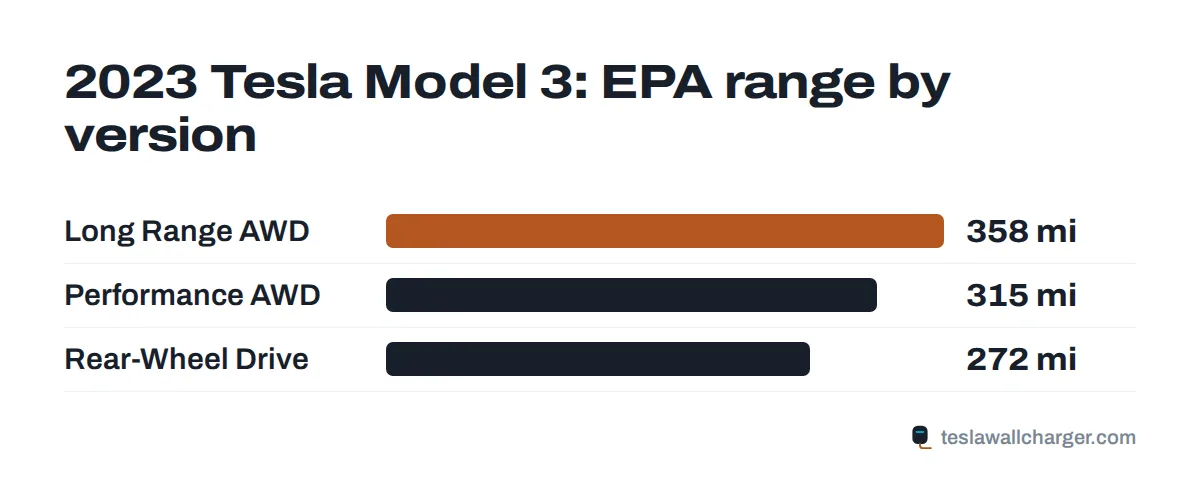
Tesla changed almost nothing for 2023. The EPA figures match the 2022 Tesla Model 3 exactly: 272 miles and 132 MPGe for Rear-Wheel Drive, 358 miles and 131 MPGe for Long Range AWD, 315 miles and 113 MPGe for Performance. Tesla showed the redesigned car for other markets on September 1, 2023, but US buyers did not get it until the 2024 model year went on sale in January 2024.
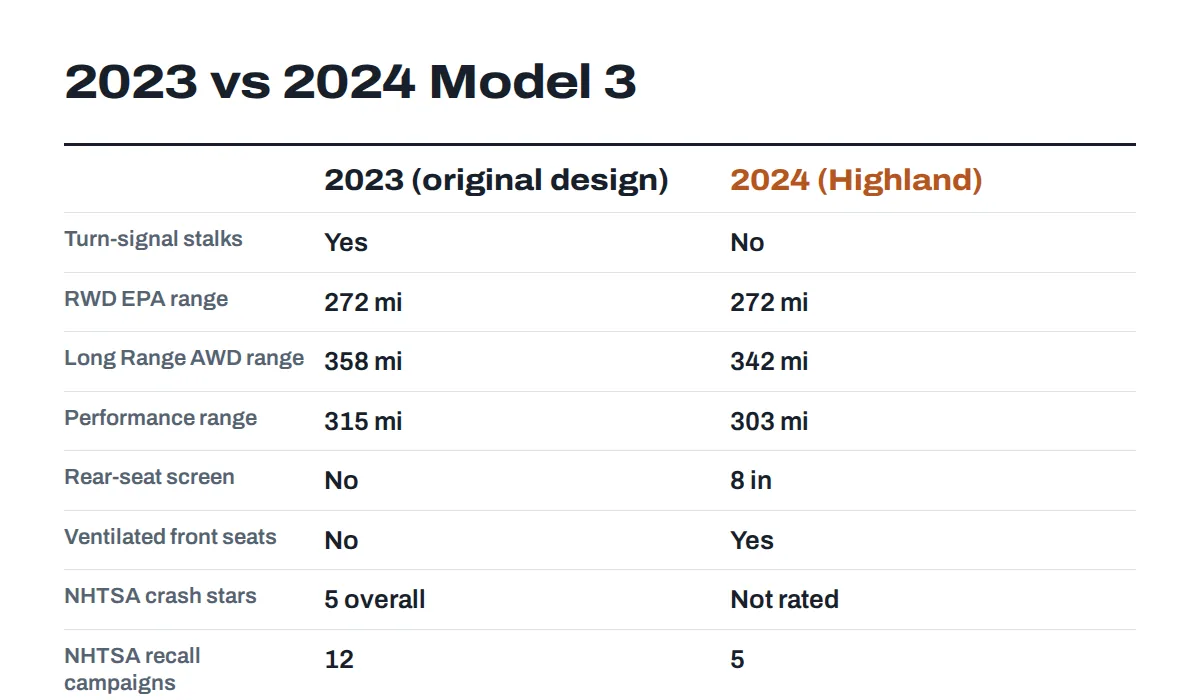
That makes the decision mostly about cabin versus cost. The 2024 Model 3 adds ventilated front seats, an 8-inch rear screen and a quieter ride, but it also removed the turn-signal and drive-selector stalks, and its Long Range AWD is rated 16 miles shorter. Some drivers count the stalks as a reason to prefer the 2023.
| Trim | EPA range | Efficiency | Home AC max | Price (USD) |
|---|---|---|---|---|
| Rear-Wheel Drive | 272 mi | 26 kWh/100 mi | 7.7 kW | n/a |
| Long Range AWD | 358 mi | 26 kWh/100 mi | 11.5 kW | n/a |
| Performance AWD | 315 mi | 30 kWh/100 mi | 11.5 kW | n/a |
Tesla changed 2023 prices so often that no single launch price is meaningful; compare listings against 2022 and 2024 cars with similar mileage instead.
What a 2023 has, and what it lacks
- Heat pump: yes, standard since the late-2020 refresh.
- Screen computer: AMD Ryzen. Driver-assistance hardware is HW3.
- Radar: none (camera-only Tesla Vision).
- Ultrasonic parking sensors: absent on nearly all 2023 builds. Tesla dropped them from October 2022 production.
- Battery: LFP in the Rear-Wheel Drive car, nickel-based NCA in Long Range and Performance. An LFP car's charge screen recommends a 100% daily limit.
- Mobile Connector: not in the box. Tesla stopped including it in April 2022.
- Interior: the original layout, with no rear screen and no seat ventilation.
The steering-assist recall and other fixes to confirm
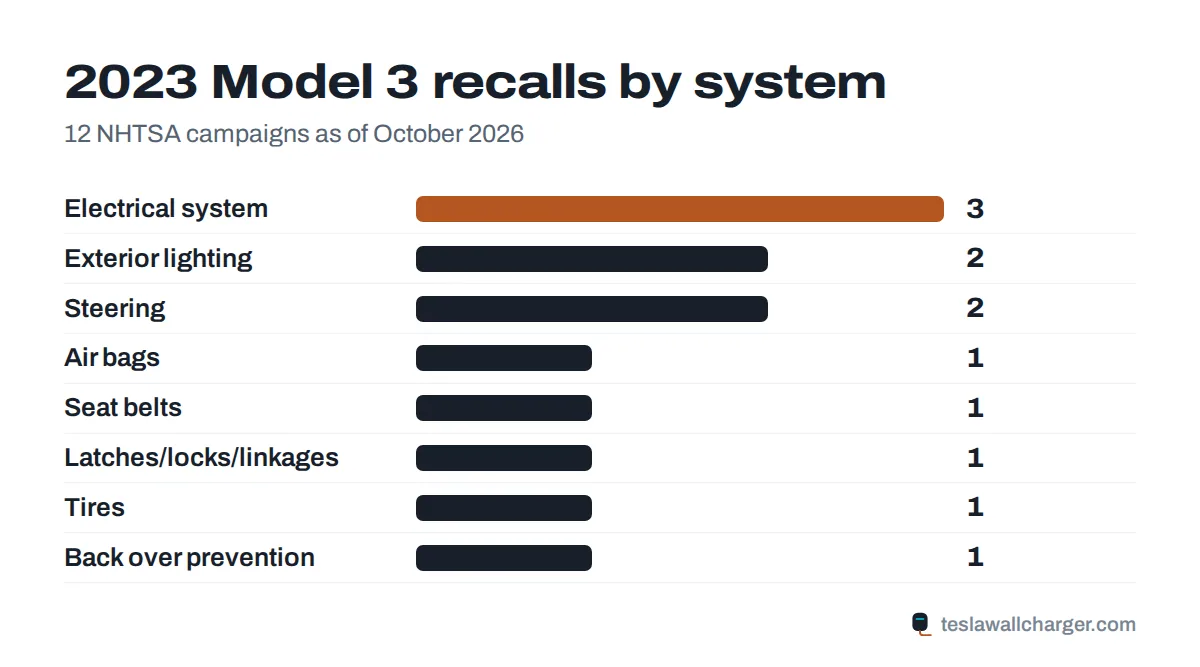
The 2023 has 12 NHTSA recall campaigns, fewer than the 2022, and one story that is specific to this year.
In July 2023 NHTSA opened a preliminary evaluation (PE23-014) into 2023 Model 3 and Model Y cars losing steering control, with owners reporting reduced-assist warnings. It became Engineering Analysis EA24-001 on February 1, 2024, covering an estimated 334,569 vehicles. Tesla's remedy, recall 25V092000 in February 2025, is an over-the-air update that addresses power steering assist dropping out after the car stops and pulls away again. Any 2023 on current software should have it, but confirm it on the VIN.
Two campaigns need a shop:
- 23V434000: the pyrotechnic battery disconnect, which isolates the high-voltage pack in a crash, may be defective. Tesla Service replaces it free.
- 26V507000: low-beam headlights may exceed the federal brightness limit. This one is from August 2026, so expect many cars to still have it open.
The rest, including a taillight fault (22V844000), FSD Beta behavior (23V085000) and the Autosteer controls recall (23V838000), were software updates. Run the VIN through NHTSA's recall search and ask Tesla Service for the car's history if the seller cannot show it.
- 21V834000October 25, 2021Air bags, side/window, curtainService visit
Side curtain airbag may be improperly secured to the roof rail and twist when deployed - 22V844000November 15, 2022Exterior lighting, tail lightsSoftware update
One or both taillights may intermittently fail to illuminate - 23V085000February 15, 2023Steering, automated/adaptive steeringSoftware update
FSD Beta may act unsafely at intersections and respond poorly to speed limit changes - 23V434000June 19, 2023Electrical system, propulsion system, traction batteryService visit
Pyrotechnic battery disconnect may be defective and fail to isolate the high-voltage battery - 23V838000December 12, 2023Electrical system, adas, autonomous/self driving, softwareSoftware update
Autosteer controls may not be sufficient to prevent driver misuse - 24V051000January 30, 2024Electrical system, instrument cluster/panelSoftware update
Brake, park and ABS warning lights shown in a font smaller than required
Show all 12 recalls
- 24V376000May 28, 2024Seat belts, front, warning light/devicesSoftware update
Unbelted-driver warning light and chime may not activate - 24V554000July 24, 2024Latches/locks/linkages, hood, latchSoftware update
Hood latch may fail to detect an unlatched hood after it was opened - 24V935000December 17, 2024Tires, pressure monitoring and regulating systemsSoftware update
TPMS warning light may not stay on between drive cycles - 25V092000February 14, 2025Steering, electric power assist systemSoftware update
Power steering assist may be lost after stopping and accelerating again - 26V283000May 5, 2026Back over prevention, softwareSoftware update
Rearview camera image may be delayed when shifting to reverse on software 2026.8.6; remedy text says OTA (API OTA flag: false) - 26V507000August 5, 2026Exterior lighting, headlightsService visit
Low-beam headlights may be too bright, exceeding the maximum allowed light output
Source: NHTSA recalls API. A recall only applies if your VIN is listed.
Charging cost and home setup
Rear-Wheel Drive and Long Range cars use about 26 kWh per 100 miles by EPA's measurement, which is taken at the wall and so includes charging losses. A driver covering 40 miles a day, about 1,200 miles a month, uses roughly 312 kWh. At 18.31 cents per kWh, EIA's US residential average for July 2026, that is about $57 a month. A Performance at 30 kWh per 100 miles comes to about $66.
| Trim | Max home rate | Circuit that gets full speed | Range added per hour |
|---|---|---|---|
| Rear-Wheel Drive | 32 A / 7.7 kW | 40 A breaker, or a 50 A NEMA 14-50 with Mobile Connector | about 30 mi |
| Long Range AWD | 48 A / 11.5 kW | 60 A breaker with a Wall Connector | up to 44 mi |
| Performance AWD | 48 A / 11.5 kW | 60 A breaker with a Wall Connector | slightly under 44 mi |
The Rear-Wheel Drive car can't use more than 32 A, so Tesla's portable charger on an existing 14-50 outlet charges it as fast as a Wall Connector would. Long Range owners get the full 44 miles per hour only from a hardwired unit on a 60 A circuit; an electrician should pull the permit, and Tesla's estimate for the job is $750 to $1,500 (our breakdown of Tesla charger installation costs covers panel upgrades and long runs). The Tesla charger amps and breaker guide explains why 48 A needs a 60 A circuit. For overnight timing by trim, see our Tesla charging time guide.
| How you charge | Speed |
|---|---|
| Wall Connector at 48 A (11.5 kW, 60 A breaker) | up to 44 mi of range per hour |
| Wall Connector at 32 A (7.7 kW, 40 A breaker) | up to 29 mi of range per hour |
| NEMA 14-50 outlet, Mobile Connector at 32 A | about 30 mi per hour |
| Regular 120 V outlet | 2 to 3 mi per hour |
| Empty to full, largest pack (about 82 kWh) | about 8 hours at 11.5 kW |
Rates scale Tesla's published Wall Connector table for this model; older cars and cold batteries charge slower. Times are estimates.
Safety scores and owner complaints
NHTSA tested the 2023 and gave both the RWD and AWD versions five stars overall, frontal, side and rollover, with a 6.6% rollover risk. The 2024 has no NHTSA rating, which matters to some insurers and buyers.
| NHTSA test | Rating |
|---|---|
| Overall | 5 stars |
| Frontal crash | 5 stars |
| Side crash | 5 stars |
| Rollover | 5 stars |
| Rollover risk | 6.6% |
Owners have filed 427 complaints, fewer than for 2021 or 2022. Forward collision avoidance leads, which usually means phantom braking or false alerts, followed by electrical and speed-control reports.
427 owner complaints filed with NHTSA for the 2023 Model 3. Most frequent areas (approximate order): forward collision avoidance; unknown or other; electrical system; vehicle speed control; service brakes; steering. Source: NHTSA complaints database.
Before you buy a used 2023 Tesla Model 3: a checklist
- Recall 25V092000 (steering assist) shows complete and the car runs current software.
- Recall 23V434000 (battery disconnect) and 26V507000 (headlights) are closed, or you have booked them.
- Check battery warranty time left: 8 years from the in-service date, with 100,000 miles for Rear-Wheel Drive and 120,000 for Long Range and Performance under Tesla's current terms.
- Charge to 100% on an LFP car and compare the displayed range with 272 miles; on Long Range, check at 90% or 100% against 358.
- Drive on the highway with Traffic-Aware Cruise Control to check for false braking.
- Price it against a Model 3 from any other year with similar miles before you commit.
Used 2023 Model 3 questions
Is the 2023 Tesla Model 3 a good used car?
It is one of the safer bets in the Model 3 line. The design had been in production since 2017, it earned five NHTSA stars in every crash category, and nearly all of its 12 recalls were software fixes. The main hardware items to confirm are the pyrotechnic battery disconnect replacement and the newer headlight recall, both handled free at Tesla Service.
Does the 2023 Model 3 have a steering problem?
Some cars did. NHTSA investigated about 334,569 2023 Model 3 and Model Y vehicles for loss of power steering assist, upgrading the case to Engineering Analysis EA24-001 in February 2024. Tesla answered with recall 25V092000 in February 2025, a free over-the-air update. Check that the car runs current software and that the recall shows as complete for its VIN.
Does the 2023 Model 3 have ultrasonic parking sensors?
Most do not. Tesla removed the ultrasonic sensors from Model 3 production starting in October 2022, so nearly all 2023 cars park with cameras only (Tesla Vision Park Assist). A very early 2023 build may still have them. Look for small round caps in the bumpers, which are the sensors, or ask the seller for the build date.
How much does it cost to charge a 2023 Model 3 at home?
About $57 a month for 1,200 miles at the July 2026 US average of 18.31 cents per kWh, using the EPA rating of roughly 26 kWh per 100 miles for Rear-Wheel Drive and Long Range cars. The Performance uses about 30 kWh per 100 miles, which works out near $66. Time-of-use rates can cut either figure sharply.
Should I buy a 2023 or a 2022 Model 3?
They share trims, EPA ratings and the HW3 computer, so let price and condition decide. A late-2022 build may still have ultrasonic sensors, which helps in tight garages. The 2023 is newer, has more battery warranty time left and was not part of the 2021 to 2022 phantom braking probe, but it carries its own steering-assist recall.
Sources
- NHTSA recalls API, 2023 Model 3 (queried 2026-10-13), api.nhtsa.gov
- NHTSA ODI resume EA24-001 (loss of steering, 2023 Model 3/Y), static.nhtsa.gov
- NHTSA recall document 25V092 (power steering assist), static.nhtsa.gov
- NHTSA safety ratings API, 2023 Model 3, api.nhtsa.gov
- Not a Tesla App: Tesla is removing ultrasonic sensors (2022-10-04), notateslaapp.com
- TechCrunch: Tesla refreshed Model 3 on sale in US (2024-01-10), techcrunch.com
- fueleconomy.gov: 2023 Tesla Model 3, fueleconomy.gov
- Tesla support: onboard charger, tesla.com
- Tesla support: vehicle warranty, tesla.com
- EIA Electric Power Monthly: average residential price (July 2026), eia.gov
Independent site. Not affiliated with or endorsed by Tesla, Inc. Tesla, Wall Connector and Supercharger are trademarks of Tesla, Inc.