There are ten Tesla Model 3 years on US roads, 2017 through 2026, and they are not equal. The best used buys are the 2023 (the most sorted version of the original design) and the 2025 (Highland, with 48 A home charging on every trim); the years that need the hardest look are the 2017 to 2019 early builds and the 2021 transition year.
What separates one year from the next is rarely the badge. It is the build date, the computer behind the dashboard and the onboard charger, which sets how fast the car fills up on a Tesla wall charger in your garage.
Two designs and one big refresh
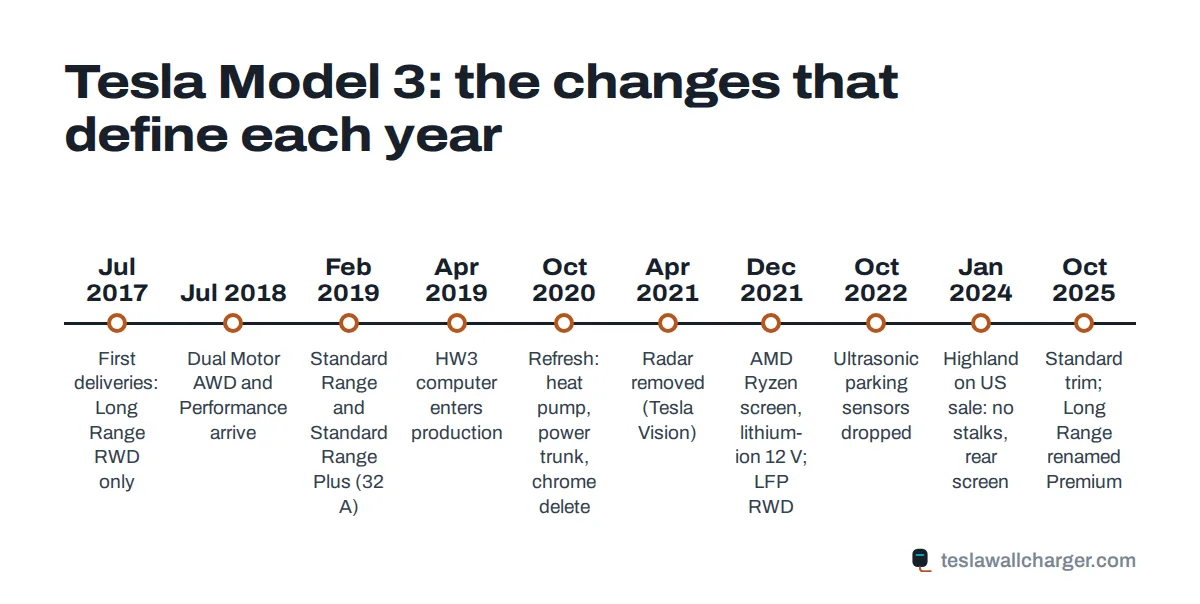
The Model 3 has had two body designs, with a substantial update partway through the first.
- Original, 2017 to 2020. Long Range RWD only at launch in July 2017, then Dual Motor AWD and Performance from mid-2018, and the $35,000 Standard Range in February 2019. Radar, ultrasonic sensors, resistive cabin heating, chrome window trim.
- Original, refreshed, 2021 to 2023. The update that appeared on Tesla's order page on October 16, 2020 added a heat pump, a power trunk, double-pane windows, a new console and black trim. Radar went in April 2021, the AMD Ryzen touchscreen computer arrived around late December 2021, and the ultrasonic sensors went in October 2022.
- Highland, 2024 to 2026. On US sale from January 10, 2024: new nose and lights, a quieter cabin, ventilated front seats, an 8-inch rear screen and no steering-column stalks. The 2026 brought a cheaper Standard trim, renamed the Long Range cars Premium, and put a turn-signal stalk back.
The trap is the October 2020 changeover. A car built around then can carry either a 2020 or 2021 title, so if the heat pump matters to you, read the build date on the driver's door pillar rather than trusting the listing.
Every Model 3 year side by side
2017 Tesla Model 3: judging a launch-year car in 2026
Launch year (original Model 3); first customer deliveries July 2017, Long Range RWD only
- Top EPA range
- 310 mi
- Recalls
- 15
- Complaints
- 26
2018 Tesla Model 3 buyer's guide: four versions under one badge
Original Model 3, first full production year; Dual Motor AWD, Performance and Mid Range added
- Top EPA range
- 310 mi
- Recalls
- 19
- Complaints
- 1030
2019 Tesla Model 3: range, specs, recalls and the mid-April HW3 split
Original Model 3; $35,000 Standard and Standard Range Plus arrive; HW3 computer from about April 2019
- Top EPA range
- 310 mi
- Recalls
- 22
- Complaints
- 615
2020 Tesla Model 3: the last pre-refresh year, and how it stacks up
Original Model 3 (pre-refresh); cars built from about October 2020 carry the 2021 refresh and are usually MY2021
- Top EPA range
- 330 mi
- Recalls
- 21
- Complaints
- 450
2021 Tesla Model 3: the refresh, its mid-year changes and what to check on a used one
First refresh of the original Model 3 (on sale October 2020): heat pump, power trunk, chrome delete
- Top EPA range
- 353 mi
- Recalls
- 22
- Complaints
- 666
2022 Tesla Model 3: trims, range, recalls and the build-date checks
Refreshed original Model 3; base car renamed Rear-Wheel Drive with LFP battery; AMD Ryzen infotainment
- Top EPA range
- 358 mi
- Recalls
- 18
- Complaints
- 765
2023 Tesla Model 3: the last original-design car, judged against its neighbors
Last model year of the original (pre-Highland) Model 3 design in the US
- Top EPA range
- 358 mi
- Recalls
- 12
- Complaints
- 427
2024 Tesla Model 3 (Highland): what changed, which trim, what to check
Highland refresh (second generation styling), US sales from 2024-01-10
- Top EPA range
- 363 mi
- Recalls
- 5
- Complaints
- 216
2025 Tesla Model 3: prices, range and how it compares with the 2026
Highland; Long Range RWD becomes the entry trim after the standard RWD was dropped
- Top EPA range
- 363 mi
- Recalls
- 3
- Complaints
- 113
2026 Tesla Model 3: prices, trims and which one to buy
Highland; new Standard trim, Long Range renamed Premium, turn-signal stalk returns
- Top EPA range
- 363 mi
- Recalls
- 1
- Complaints
- 20
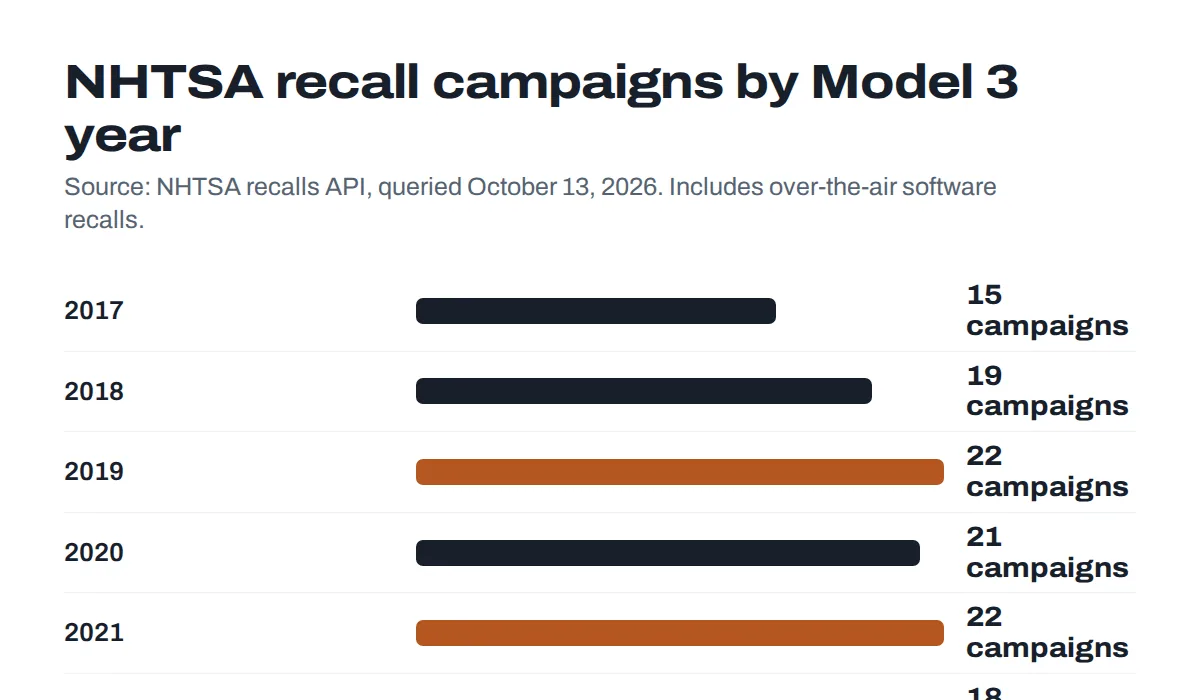
The table below pulls the numbers that matter from each year's NHTSA record and EPA rating. Complaint totals are owner reports filed with NHTSA, not verified defects, and they track how many cars were sold as much as how good they were.
| Model year | NHTSA recalls | Owner complaints | Overall crash rating |
|---|---|---|---|
| 2017 Tesla Model 3 | 15 | 26 | Not rated |
| 2018 Model 3 | 19 | 1,030 | 5 stars (RWD) |
| 2019 Model 3 guide | 22 | 615 | 5 stars |
| 2020 Model 3 | 21 | 450 | 5 stars |
| 2021 Tesla Model 3 | 22 | 666 | 5 stars |
| 2022 Model 3 | 18 | 765 | 5 stars |
| 2023 Tesla Model 3 | 12 | 427 | 5 stars |
| 2024 Model 3 | 5 | 216 | Not rated |
| 2025 Model 3 guide | 3 | 113 | Not rated |
| 2026 Model 3 guide | 1 | 20 | 5 stars |
| Model year | Longest EPA range | In one line |
|---|---|---|
| 2017 Tesla Model 3 | 310 mi | Rare launch car, Long Range RWD only |
| 2018 Model 3 | 310 mi | Most complaints of any year; suspension leads |
| 2019 Model 3 | 310 mi | Recall peak; HW3 from about April |
| 2020 Model 3 | 330 mi (LR RWD) | Last pre-refresh year, HW3 throughout |
| 2021 Tesla Model 3 | 353 mi | Heat pump arrives, radar leaves |
| 2022 Model 3 | 358 mi | Ryzen screen, LFP base car |
| 2023 Tesla Model 3 | 358 mi | Best of the original design |
| 2024 Model 3 | 363 mi | Highland launch year |
| 2025 Model 3 | 363 mi | 48 A on every trim |
| 2026 Model 3 | 363 mi | Standard trim, stalk returns |
Recall counts include over-the-air software campaigns, and a 2019 car has had seven years to collect them while a 2026 car has had one. Use the count as a guide to how much paperwork to check, not as a reliability score. The full campaign list for any car is on NHTSA's recall lookup, and the EPA figures come from fueleconomy.gov.
Best year for a Tesla Model 3, and why
2023: the original design with the kinks worked out
The 2023 gets everything the refresh brought (heat pump, power trunk, double glazing) plus the Ryzen screen computer and lithium-ion 12 V battery that arrived around the end of 2021. It also has the fewest recalls of any original-design year at 12. Two need checking: 25V092000, an over-the-air fix for loss of power steering assist after NHTSA's EA24-001 probe into 2023 Model 3 and Model Y, and 23V434000, a service-visit replacement of the pyrotechnic battery disconnect. No car this year has ultrasonic parking sensors, so parking relies on cameras.
2025: Highland without the 32 A base car
The 2024 Highland launched with a Rear-Wheel Drive base car limited to 32 A. For 2025 that trim was dropped, leaving Long Range RWD (363 mi EPA), Long Range AWD (346 mi) and Performance, all with 48 A onboard charging. Three recalls list it so far; the one to confirm is 25V690000, a service replacement of battery-pack contactors that could cut drive power. NHTSA had not published star ratings for the 2024 or 2025 Model 3 as of October 2026.
2022: the value pick if the price is right
A 2022 has the Ryzen computer (on cars built from about late December 2021), 358 miles of EPA range in Long Range form and no radar. Two catches: it sits inside NHTSA's phantom braking investigation PE22-002, and cars built from October 2022 may lack ultrasonic sensors. A highway test drive on adaptive cruise tells you more than the spec sheet.
Tesla Model 3 years to avoid, or inspect hardest
2017 and 2018: early-build quality
Consumer Reports withdrew its Model 3 recommendation in February 2019 after its survey showed paint, trim and body hardware problems on early cars. The 2018 also has the largest NHTSA complaint file of any Model 3 year, 1,030 reports, led by suspension. These cars predate the HW3 computer, have no heat pump and, at eight to nine years old, are at or past the end of the 8-year battery warranty that started at first delivery. Look closely at panel gaps, trim and door hardware, and confirm recall 23V235000 (front suspension lateral link fasteners) where the VIN is covered.
2019: the recall peak
Twenty-two campaigns list the 2019, tied for the most of any Model 3 year. Most are software, but several needed a service visit: front lateral link fasteners (21V835000 and 23V235000), brake caliper bolts (21V387000) and B-pillar seat belt fasteners (21V389000). Cars built before about mid-April 2019 also predate HW3. A late-2019 Long Range with every service recall signed off is a reasonable car; an early one with gaps in its records is not.
2021: a good car once you know the build date
The 2021 is the first refreshed year and one of the better used Model 3 years, but it shifts underneath you: radar on cars built before about April 27, 2021 and not after, Intel Atom screens until December, and some Standard Range Plus cars switched to LFP cells (253 mi instead of 263) from around August. It also shares the 22-recall peak with 2019 and sits in the phantom braking probe. Know exactly which build you are looking at before you agree a price.
The 2020 sits between these groups: HW3 throughout and 21 recalls, but no heat pump unless it is a late refreshed build, and a complaint file led by suspension.
Hardware changes by year
The equipment a used Model 3 carries depends on when it was built. Confirm any of this on the car under Controls, Software, Additional Vehicle Information.
| Model year | Autopilot computer | Radar | Ultrasonic sensors |
|---|---|---|---|
| 2017 to 2018 | Pre-HW3 | Yes | Yes |
| 2019 | HW3 from about April 2019 | Yes | Yes |
| 2020 | HW3 | Yes | Yes |
| 2021 | HW3 | Until about late April 2021 | Yes |
| 2022 | HW3 | No | Until about October 2022 |
| 2023 | Check the car | No | No |
| 2024 to 2026 | Check the car | No | No |
| Model year | Touchscreen computer | Heat pump |
|---|---|---|
| 2017 to 2018 | Intel Atom | No |
| 2019 | Intel Atom | No |
| 2020 | Intel Atom | Only on late refreshed builds |
| 2021 | Intel Atom (Ryzen from about late December) | Yes |
| 2022 | AMD Ryzen | Yes |
| 2023 | AMD Ryzen | Yes |
| 2024 to 2026 | AMD Ryzen | Yes |
Battery chemistry follows trim, not year. Some Standard Range Plus cars from late 2021 and the base Rear-Wheel Drive from 2022 use LFP cells, and Tesla recommends charging those to 100% routinely and fully at least once a week. Long Range and Performance packs are NCA, and Tesla's guidance for those is a daily limit around 80%.
Home charging capability by year
This is where Model 3 years differ most for anyone with a garage, and it is what most "years to avoid" lists skip. The onboard charger decides the ceiling; the wall unit cannot push past it.
| Model year | 32 A trims (7.7 kW, 40 A breaker is enough) | 48 A trims (11.5 kW, needs a 60 A breaker) |
|---|---|---|
| 2017 | None | Long Range RWD |
| 2018 | None confirmed (Mid Range amps unverified) | Long Range RWD, Long Range AWD, Performance |
| 2019 to 2021 | Standard Range, Standard Range Plus | Long Range, Performance |
| 2022 to 2023 | Rear-Wheel Drive (LFP) | Long Range AWD, Performance |
| 2024 | Rear-Wheel Drive | Long Range RWD, Long Range AWD, Performance |
| 2025 | None | All trims |
| 2026 | Standard | Premium RWD, Premium AWD, Performance |
On a Gen 3 Wall Connector, a 48 A Model 3 adds up to 44 miles of range per hour and a 32 A car up to 30, per Tesla's own table. Working from pack sizes, a 75 kWh Long Range goes from empty to full in about 7.2 hours at 48 A, and a 2022 LFP Rear-Wheel Drive takes about 8.3 hours at 32 A. Both finish overnight, which is why a 32 A car is no hardship for most commuters.
Practical consequences:
- A 32 A Model 3 gains nothing from a 60 A circuit. A 40 A breaker with suitable wire covers it, which can trim what an electrician charges for the job when the panel is tight.
- A 48 A car on a NEMA 14-50 outlet with the Mobile Connector is held to 32 A, about 30 miles per hour.
- Cars ordered before late April 2022 came with a Mobile Connector. Later ones did not, so check whether the seller still has it. The guide to choosing a 40 A or 60 A circuit covers what each breaker size delivers.
If you are planning a 60 A install for a future 48 A car, size the wire for that now. Our guide to charging time per breaker size has the full table.
How to pick a used Model 3
- Decide the design first. Original (2017 to 2023) or Highland (2024 on). Highland is quieter and has ventilated seats; 2024 and 2025 cars have no stalks, which some drivers dislike.
- Pin the build date. It tells you heat pump, radar, HW3 and touchscreen computer more reliably than the model year.
- Run the VIN through NHTSA. Separate OTA recalls (done automatically) from service-visit ones (suspension fasteners, brake caliper bolts, seat belts, pyrotechnic disconnect, contactors) and ask for proof of the latter.
- Read the charging screen. It shows the maximum amps the car accepts, which confirms the trim and tells your electrician what to plan for.
- Check the charge limit Tesla recommends. An LFP car shows 100% as normal daily use; an NCA car recommends lower.
- Test on the highway. Use adaptive cruise for a few miles on 2021 and 2022 cars, and listen for front suspension knocks on 2018 to 2020 cars.
For running costs once it is home, see how much it costs to charge a Tesla. The Tesla Model Y years guide covers the crossover built on the same platform, and the Tesla year-by-year guide puts every model on one grid.
Common questions
What is the best year for a used Tesla Model 3?
For the original body style, the 2023 is the safest bet: it has the heat pump, the faster AMD Ryzen touchscreen computer and 12 NHTSA recall campaigns, against 18 to 22 for 2018 to 2022. If you want the quieter Highland design, the 2025 is the one to target because every trim accepts 48 A at home and only three recalls list it so far.
Which Tesla Model 3 years should you avoid?
No year is a write-off, but 2017 to 2019 cars need the hardest inspection: Consumer Reports pulled its recommendation in February 2019 over paint, trim and body hardware, and these years carry front suspension and brake caliper bolt recalls. The 2021 is a mixed bag because radar disappeared mid-year and it sits inside NHTSA's phantom braking probe.
When did the Model 3 get a heat pump?
The heat pump arrived with the refresh that went on Tesla's order page on October 16, 2020. Most of those cars are titled 2021, but some late-2020 builds are titled 2020. Every Model 3 after that has one. If a 2020 car is advertised with a heat pump, check the build date on the door-pillar label to confirm.
Which Model 3 years have a 32 amp onboard charger?
The Standard Range and Standard Range Plus (2019 to 2021), the LFP Rear-Wheel Drive (2022 to 2024) and the 2026 Standard all top out at 32 A, or about 7.7 kW. Long Range, Premium and Performance cars take 48 A. All 2025 trims take 48 A. Tap the charging icon on the touchscreen to see the car's maximum.
How do I tell if a used Model 3 has HW3?
Open Controls, then Software, then Additional Vehicle Information on the touchscreen. It lists the Autopilot computer. Model 3 cars built from about April 2019 left the factory with the HW3 computer. Earlier cars need Tesla's computer swap, which was offered to owners who bought Full Self-Driving, not to subscribers.
Is a 2021 Model 3 a refresh car?
Almost always yes. The refreshed design (heat pump, power trunk, black trim) went on sale in October 2020 and nearly all of those cars carry 2021 titles. What changes within 2021 is radar: cars built before about late April 2021 have it, later cars are camera-only. The Intel Atom touchscreen computer stays until roughly late December 2021.
Sources
- NHTSA recalls API, Tesla Model 3 by model year, api.nhtsa.gov
- fueleconomy.gov: 2021 Tesla Model 3, fueleconomy.gov
- Tesla support: onboard charger, tesla.com
- Tesla support: Wall Connector charging rates, tesla.com
- Electrek: Tesla launches Model 3 2021 refresh (2020-10-16), electrek.co
- TechCrunch: Tesla's computer is now in all new cars (2019-04-22), techcrunch.com
- TechCrunch: Consumer Reports pulls Model 3 recommendation (2019-02-21), techcrunch.com
- TechCrunch: refreshed Model 3 on sale in the US (2024-01-10), techcrunch.com
- InsideEVs: Tesla recommends charging LFP Model 3 to 100%, insideevs.com
- InsideEVs: 2026 Tesla Model 3 Standard, insideevs.com