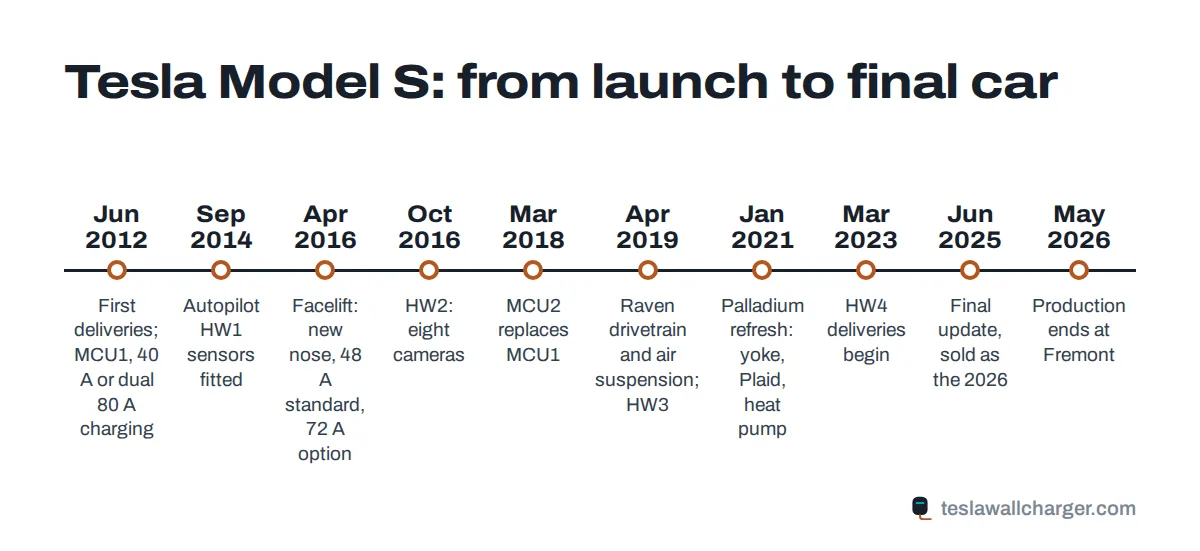
The Tesla Model S had one platform but five distinct generations in practice: the 2012 classic, the April 2016 facelift, the 2019 Raven update, the 2021 Palladium refresh and the June 2025 final update sold as the 2026. Production ended in May 2026, so every Model S you buy now is used or leftover stock.
Knowing the era matters more on a Model S than on any other Tesla, because the hardware gap between a 2013 and a 2023 is enormous: different touchscreen computer, different Autopilot sensors, even a different onboard charger that changes which Tesla Wall Connector setup makes sense at home.
Five Model S eras at a glance
| Era | Model years | What defines it | Home charging (onboard) |
|---|---|---|---|
| Classic | 2012 to early 2016 | Black nose cone, MCU1, 60 to 90 kWh packs, dual motors from 2015 | 40 A standard, dual 80 A optional |
| Facelift | April 2016 to early 2019 | Grille-less nose, 75 and 100 kWh packs, HW2 then HW2.5, MCU2 from March 2018 | 48 A standard, 72 A optional |
| Raven | April 2019 to 2020 | Permanent-magnet front motor, adaptive air suspension, HW3, up to 402 mi | 48 A |
| Palladium refresh | 2021 to 2025 | Yoke and horizontal screen, Plaid, heat pump, AMD Ryzen, HW4 from 2023 | 48 A |
| Final update | 2026 | Front bumper camera, adaptive driving beams, quieter cabin | 48 A |
The Model S refresh years in detail
April 2016 facelift. Announced April 12, 2016: the black nose cone gave way to a body-color front, a HEPA filter with Bioweapon Defense Mode became an option, and the base price rose from $70,000 to $71,500. The change owners notice in the garage is charging: the 40 A single charger and 80 A dual-charger option were replaced by 48 A standard and 72 A optional. The 2016 model year straddles this change, so a 2016 can be either car.
April 2019 Raven update. On April 23, 2019 the Model S got a permanent-magnet front motor and fully adaptive air suspension. Long Range was rated 370 miles, and in June 2020 the Long Range Plus became the first EV rated over 400 miles (402). HW3 entered production around the same time.
2021 Palladium refresh. Revealed in January 2021: a new interior with a yoke and no stalks, a 17-inch horizontal screen, an 8-inch rear screen, a heat pump, an AMD Ryzen computer and the tri-motor Plaid (about 1,020 hp, a Tesla-claimed 1.99-second 0 to 60 with 1 ft of rollout). Long Range was rated 405 miles. A round wheel came back as a no-cost option for 2023.
June 2025 final update. Sold as the 2026: Frost Blue paint, new wheels, a quieter cabin, revised bushings, a front bumper camera, adaptive driving beams and ambient lighting. Tesla said Model S and Model X production ended around May 10, 2026, closing with 250 Signature Series cars at $159,420.
Every Model S year and its record
2012 Tesla Model S: what a launch-year car is like to own now
Launch year (first deliveries June 22, 2012); classic pre-refresh body, MCU1 (NVIDIA Tegra 3), no Autopilot hardware
- Top EPA range
- 265 mi
- Recalls
- 8
- Complaints
- 59
2013 Tesla Model S: battery versions, recalls and home charging
Classic pre-refresh Model S, second model year; MCU1, no Autopilot hardware
- Top EPA range
- 265 mi
- Recalls
- 11
- Complaints
- 459
2014 Tesla Model S: early builds, late builds and what to check
Classic pre-refresh Model S; Autopilot HW1 (Mobileye) introduced on builds from mid-September 2014; dual-motor 'D' announced October 2014
- Top EPA range
- 265 mi
- Recalls
- 9
- Complaints
- 365
2015 Tesla Model S: picking the right version from nine
Classic pre-refresh body; dual-motor 'D' year, Autopilot HW1, 90 kWh pack and Ludicrous mode
- Top EPA range
- 270 mi
- Recalls
- 9
- Complaints
- 646
2016 Tesla Model S: pre-facelift, facelift and HW2 cars compared
Mid-cycle: April 2016 facelift (grille-less nose); Autopilot HW1 until Oct 2016, then HW2; MCU1
- Top EPA range
- 315 mi
- Recalls
- 10
- Complaints
- 604
2017 Tesla Model S: the value pick between the facelift and MCU2
Refreshed (post-April 2016) body; Autopilot HW2, then HW2.5 from about August 2017; MCU1
- Top EPA range
- 335 mi
- Recalls
- 9
- Complaints
- 379
2018 Tesla Model S: recalls, the MCU2 switch and buying advice
Refreshed body; Autopilot HW2.5; MCU2 (Intel Atom) from builds starting about March 2018
- Top EPA range
- 335 mi
- Recalls
- 11
- Complaints
- 128
2019 Tesla Model S: Raven vs early-2019 cars, range, recalls and charging
Raven update (April 23, 2019): permanent-magnet front motor, adaptive air suspension, Standard/Long Range/Performance; HW3 from about March/April 2019; MCU2
- Top EPA range
- 370 mi
- Recalls
- 10
- Complaints
- 32
2020 Tesla Model S: Long Range Plus, Performance and what to check used
Pre-refresh 'Raven' Model S (dual motor, permanent-magnet front motor from 2019); last full model year before the 2021 'Palladium' refresh
- Top EPA range
- 402 mi
- Recalls
- 11
- Complaints
- 80
2021 Tesla Model S: pre-refresh or Plaid era, and the 24 recalls
'Palladium' refresh (revealed January 2021): new interior with yoke, Long Range and tri-motor Plaid
- Top EPA range
- 405 mi
- Recalls
- 24
- Complaints
- 176
2022 Tesla Model S: mid-year changes, recalls and range by wheel size
Second year of the 'Palladium' refresh
- Top EPA range
- 405 mi
- Recalls
- 20
- Complaints
- 139
2023 Tesla Model S: HW3 or HW4, sensors or not, yoke or wheel
Refresh era; Hardware 4 and ultrasonic-sensor removal year
- Top EPA range
- 405 mi
- Recalls
- 13
- Complaints
- 120
2024 Tesla Model S: a carryover year with the fewest recalls since the refresh
Refresh era carryover (HW4, no USS, no radar)
- Top EPA range
- 402 mi
- Recalls
- 6
- Complaints
- 38
2025 Tesla Model S: the 410-mile car before the June 2025 update
Refresh era; carryover year before the June 2025 update
- Top EPA range
- 410 mi
- Recalls
- 2
- Complaints
- 6
2026 Tesla Model S: final-year changes, range and buying one now
Final model year: June 2025 update; production ended at Fremont in May 2026
- Top EPA range
- 410 mi
- Recalls
- 0
- Complaints
- 6
| Model year | Era | NHTSA recalls | Owner complaints | Longest EPA range |
|---|---|---|---|---|
| 2012 Tesla Model S | Classic | 8 | 59 | 265 mi |
| 2013 Model S | Classic | 11 | 459 | 265 mi |
| Tesla Model S 2014 | Classic | 9 | 365 | 265 mi |
| 2015 Model S | Classic | 9 | 646 | 270 mi |
| 2016 Tesla Model S | Classic, then facelift | 10 | 604 | 315 mi |
| 2017 Model S | Facelift | 9 | 379 | 335 mi |
| Tesla Model S 2018 | Facelift | 11 | 128 | 335 mi |
| 2019 Model S | Facelift, then Raven | 10 | 32 | 370 mi |
| 2020 Tesla Model S | Raven | 11 | 80 | 402 mi |
| 2021 Model S | Palladium refresh | 24 | 176 | 405 mi |
| Tesla Model S 2022 | Palladium | 20 | 139 | 405 mi |
| 2023 Model S | Palladium | 13 | 120 | 405 mi |
| 2024 Tesla Model S | Palladium | 6 | 38 | 402 mi |
| 2025 Model S | Palladium | 2 | 6 | 410 mi |
| Tesla Model S 2026 | Final update | 0 | 6 | 410 mi |
Recall counts come from the NHTSA API as of October 2026 and include software fixes sent over the air. NHTSA published 5-star overall ratings for some 2013 to 2016 versions; from 2017 on, Model S records carry at most a rollover rating (5 stars), so crash ratings do not help you choose between later years.
Hardware and charger by model year
The touchscreen computer (MCU), the Autopilot hardware and the onboard charger are the three things that age a Model S fastest. Confirm any of them on the car: Controls, Software, Additional Vehicle Information for the computers, and the charging screen for maximum amps.
| Model year | Autopilot hardware | Touchscreen computer | Onboard charger (standard / optional) | Heat pump |
|---|---|---|---|---|
| 2012 to 2013 | None | MCU1 | 40 A / dual 80 A | No |
| 2014 | HW1 from about mid-September 2014 | MCU1 | 40 A / dual 80 A | No |
| 2015 | HW1 | MCU1 | 40 A / dual 80 A | No |
| 2016 | HW1, then HW2 from about October 2016 | MCU1 | 40 A / 80 A before April 2016; 48 A / 72 A after | No |
| 2017 | HW2, then HW2.5 from about August 2017 | MCU1 | 48 A / 72 A | No |
| 2018 | HW2.5 | MCU1, then MCU2 from about March 2018 | 48 A / 72 A (option reported dropped late 2018) | No |
| 2019 | HW2.5, then HW3 from about March to April 2019 | MCU2 | 48 A (72 A status not confirmed) | No |
| 2020 | HW3 | MCU2 | 48 A | No |
| 2021 | HW3 | MCU2 (pre-refresh) or AMD Ryzen (refresh) | 48 A | Refreshed cars only |
| 2022 | HW3 | AMD Ryzen | 48 A | Yes |
| 2023 | HW3, then HW4 from about March 2023 | AMD Ryzen | 48 A | Yes |
| 2024 to 2026 | HW4 | AMD Ryzen | 48 A | Yes |
Two sensor changes are not in the table. Radar left North American Model S builds from mid-February 2022, and ultrasonic parking sensors were dropped during 2023.
Charging an older Model S at home
The Model S home charging ceiling fell twice, from 80 A to 72 A to 48 A, which is why an older one can be worth more to a buyer who already owns a high-amp Gen 2 unit.
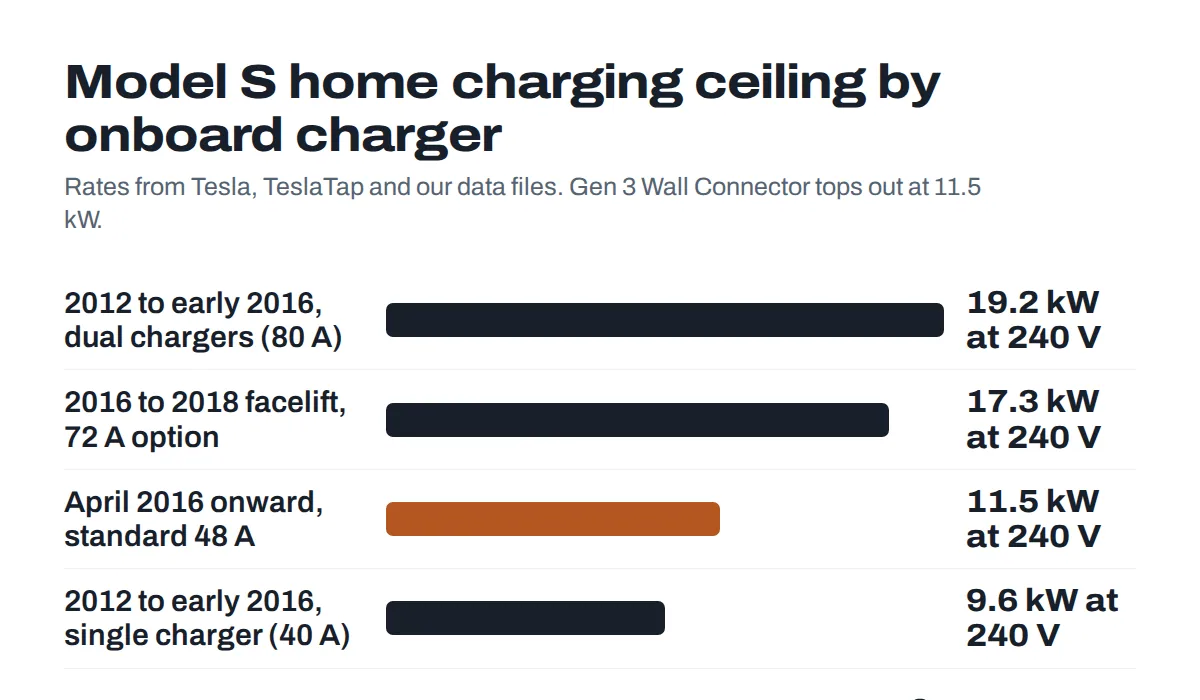
- Classic cars with a single charger take 40 A (9.6 kW). EPA quoted about 12 hours for a full 85 kWh charge at 240 V on this charger. A 50 A breaker covers it; a 60 A Gen 3 Wall Connector works but the car still draws 40 A.
- Classic cars with dual chargers take 80 A (19.2 kW), about 5 hours for a full 85 kWh charge. Only a Gen 2 Wall Connector set for a 100 A breaker can supply that. If you have the 80 A car and a Gen 3 unit, you are paying for hardware you cannot use; see why the older Gen 2 matters.
- Facelift cars with the 72 A option take about 17.3 kW, but only on a Gen 2 unit on a 90 A breaker.
- Everything else, including all Raven and refreshed cars, takes 48 A. Tesla lists the Model S at up to 41 miles of range per hour on a 60 A circuit, and about 9 to 9.5 hours from empty to full for a roughly 95 to 98 kWh pack by our math.
A breaker above 60 A and the heavier wire it needs is a job for a licensed electrician with a permit; our Wall Connector wiring guide walks through what is involved, and the amp setting guide covers the standard Gen 3 options. On a 14-50 outlet with today's Mobile Connector, any Model S is limited to 32 A.
Best and worst Model S years
Best value: 2020 Long Range Plus. 402 miles EPA, HW3, MCU2, radar and parking sensors still fitted, adaptive air suspension, 11 recalls and just 80 owner complaints. No heat pump and the older interior are the trade-offs. Supercharging peak varies by build (200, 225 or 250 kW), so ask.
Best newer car: 2023 or 2024. HW4 (2023 builds from about March), a round-wheel option, 405 or 402 miles. The 2024 has six recalls; check 25V002000, a computer board short that can kill the rearview camera and may need a computer replacement, and the driver air bag recall 24V967000.
Approach with care:
- 2012 to 2014. Out of the 8-year battery and drive unit warranty. MCU1 eMMC failure (recall 21V035), early drive unit failures (Edmunds' long-term 2013 had three replacements in about 18 months), Bosch power steering bolt corrosion (18V204), Takata inflators, and 3G-only modems on cars built before June 2015 that need a $200 LTE retrofit. No Autopilot hardware before mid-September 2014.
- 2015 and 2016. The two largest NHTSA complaint files of any Model S year. Consumer Reports dropped its recommendation in October 2015 over drivetrain, door handle and touchscreen faults. Still MCU1.
- 2021. Twenty-four recall campaigns, including service-visit air bag fixes (21V868000, 22V104000, 24V967000) and front belt anchors (23V488000). Edmunds also reported brake fade on a Plaid after repeated hard runs.
Some 2012 to 2019 cars also lost range to a 2019 battery-management update (NHTSA petition DP19-005); a 2021 class settlement paid affected owners. A battery health check before purchase answers more than any year guide.
What to check on a used Model S
- Decode the era from the build date, not the title, especially for 2016, 2019 and 2021.
- Read the computers screen. MCU1 cars should show the 21V035 repair or the paid MCU2 upgrade.
- Read the charging screen. 40, 48, 72 or 80 A tells you which Wall Connector and breaker make sense.
- Confirm the modem. Pre-June 2015 cars without LTE lost connectivity when AT&T shut down 3G in 2022.
- Search the VIN at NHTSA and get receipts for service recalls: Takata, steering bolts, air bags, seat belts, camera alignment.
- Check software-limited packs. Cars badged 40, 60 or 60D may have larger packs held back in software; range on the screen tells you what was paid for.
- Verify charging adapters. Older S may need a $380 retrofit plus adapter for CCS fast charging; see charging a Tesla at a non-Tesla station.
The Tesla Model X years guide covers the SUV built alongside it, and the Tesla by model year index lines up every Tesla on one grid.
Common questions
What are the Tesla Model S generations?
Tesla sold one Model S platform from 2012 to 2026 but updated it heavily. Owners usually split it into the classic car (2012 to early 2016), the April 2016 facelift, the 2019 Raven drivetrain update, the 2021 Palladium refresh with the yoke and Plaid, and the June 2025 update sold as the 2026. Each step changed hardware, charging or both.
When was the Tesla Model S refreshed?
There were three major refreshes. In April 2016 the nose lost its black grille and the onboard charger went to 48 A. In April 2019 the Raven update brought a permanent-magnet front motor and adaptive air suspension. In January 2021 Tesla revealed the Palladium refresh with a new interior, yoke steering, a heat pump and the tri-motor Plaid. A smaller June 2025 update followed.
What is the best year for a used Model S?
For value, a 2020 Long Range Plus: 402 miles of EPA range, HW3, MCU2 and radar, with 11 recall campaigns and few owner complaints. For the newest hardware, a 2023 with HW4 or a 2024, which has six recalls and 402 miles. Avoid paying a premium for a 2021 unless every air bag and seat belt recall is documented.
Which Model S years should you avoid?
The 2012 to 2014 cars carry the most age risk: MCU1 screens with failing eMMC memory, early drive units, 3G-only modems and an expired 8-year battery warranty. The 2015 and 2016 cars have the largest NHTSA complaint files of any Model S year (646 and 604). The 2021 has 24 recall campaigns, the most of any Model S year.
What is the difference between MCU1 and MCU2 in a Model S?
MCU1 is the original NVIDIA Tegra 3 touchscreen computer with 8 GB of eMMC memory that wears out, covered by recall 21V035 for the rearview camera. MCU2, an Intel Atom unit with 5 GHz Wi-Fi, replaced it from about March 2018 builds. Tesla sold an MCU2 upgrade for older cars; the refreshed 2021 cars moved to an AMD Ryzen computer.
Can an older Model S charge faster than 48 amps at home?
Only if it has the optional charger and you use a Gen 2 Wall Connector. Classic cars with dual chargers accept 80 A on a 100 A breaker, and facelift cars with the 72 A option accept 72 A on a 90 A breaker. The current Gen 3 Wall Connector caps every car at 48 A. Check the max amps on the car's charging screen.
Sources
- NHTSA recalls API, Tesla Model S by model year, api.nhtsa.gov
- TeslaTap: onboard chargers (classic Model S 40 A, dual 80 A), teslatap.com
- TeslaTap: Autopilot processors and hardware (MCU/HW) demystified, teslatap.com
- Tesla support: 3G network retirement and LTE upgrade, tesla.com
- Electrek: new Model S/X drivetrain, adaptive suspension (2019-04-23), electrek.co
- InsideEVs: Model S official EPA range (Long Range Plus), insideevs.com
- InsideEVs: refreshed Model S/X, everything we know, insideevs.com
- Drive Tesla Canada: Model S/X deliveries with HW4 (2023-03-06), driveteslacanada.ca
- Edmunds: 2026 Tesla Model S, edmunds.com
- Tesla support: Wall Connector charging rates, tesla.com