The 2015 Tesla Model S is the dual-motor year: 70D, 85D, 90D, P85D and P90D joined the rear-drive 60, 70, 85 and 90, with EPA ranges from 208 to 270 miles. Every 2015 car has Autopilot hardware 1, but the 3G modem, the MCU1 screen and a battery past its 8-year warranty still need checking. For most buyers the 70D or 85D is the version to find.
Nine versions in one model year
Tesla kept changing the line-up through 2015, which is why listings for the same model year look so different.
- Carried over from 2014: the rear-drive 60 kWh car (208 miles) and 85 kWh car (265 miles), plus the P85D, whose deliveries began in December 2014.
- April 8, 2015: the 70D replaced the 60 as the entry car at $75,000, with 240 miles of EPA range, 5.2 seconds to 60 mph and Supercharging included as standard.
- July 17, 2015: a 90 kWh pack arrived for $3,000 over the 85, along with Ludicrous mode. The P90D listed at $119,200 and Tesla quoted 0 to 60 in 2.8 seconds with the Ludicrous upgrade.
| Trim | EPA range | Efficiency | Home AC max | Price (USD) |
|---|---|---|---|---|
| 60 kWh | 208 mi | 35 kWh/100 mi | 9.6 kW | $69,900 |
| 70 (RWD) | n/a | n/a | 9.6 kW | $70,000 |
| 70D | 240 mi | 33 kWh/100 mi | 9.6 kW | $75,000 |
| 85 kWh | 265 mi | 38 kWh/100 mi | 9.6 kW | $80,000 |
| 85D | 270 mi | 34 kWh/100 mi | 9.6 kW | $85,000 |
| 90 kWh | 265 mi | 38 kWh/100 mi | 9.6 kW | n/a |
| 90D | 270 mi | 34 kWh/100 mi | 9.6 kW | n/a |
| P85D | 253 mi | 36 kWh/100 mi | 9.6 kW | $105,000 |
| P90D | 253 mi | 36 kWh/100 mi | 9.6 kW | $119,200 |
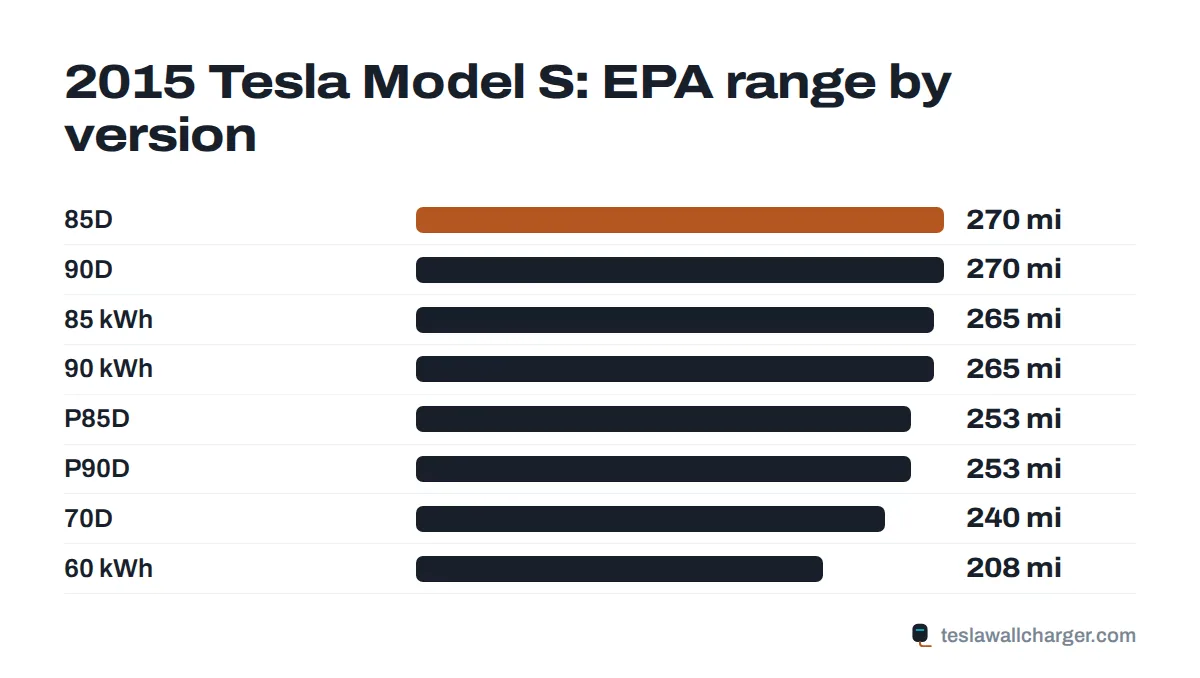
Two things stand out in the EPA numbers. First, the second motor made the car more efficient, not less: the 85D used about 34 kWh per 100 miles against 38 for the rear-drive 85, and went 5 miles further. Second, the 90 kWh pack did not change the ratings on paper. EPA's 2015 listings show the 90 and 90D with the same figures as the 85 and 85D, so pay for a 90 badge only if the car's own range at 100% backs it up.
A rear-drive "70" also shows up in price guides at $70,000, but EPA has no 2015 rating for it (the 2016 version was rated at 234 miles).
Autopilot: fitted on every car, enabled on some
Autopilot hardware 1 (one forward camera, a radar and 12 ultrasonic sensors) went into production in September 2014, so all 2015 cars have it. Buyers paid separately for the Autopilot software, and it only became useful in October 2015, when an over-the-air update brought Autosteer and automatic lane changes to HW1 cars.
Two cars that look identical can therefore drive very differently. During a test drive, open the Autopilot settings and confirm Autosteer can be switched on. HW1 is the end of the line for these cars: they cannot move to the later camera suite, so if you want the newer system, wait for a late-2016 Model S built in October or later.
The June 2015 modem cut-off
Tesla's own support page says Model S cars built before June 2015 without an LTE modem are 3G only. When AT&T retired 3G in February 2022, those cars lost their cellular features. Tesla offered a $200 LTE retrofit taking 1 to 1.5 hours, and the paid Infotainment Upgrade also includes LTE. A late-2015 build avoids the question.
The screen is a separate problem. Every 2015 car still runs MCU1, whose 8 GB eMMC memory wears out over time; NHTSA's investigation led to recall 21V035, which swaps the memory board. Ask for that record or for the MCU2 upgrade invoice. The 2018 Model S is the first year where later builds left the factory with MCU2.
Recalls, crash rating and the complaint count
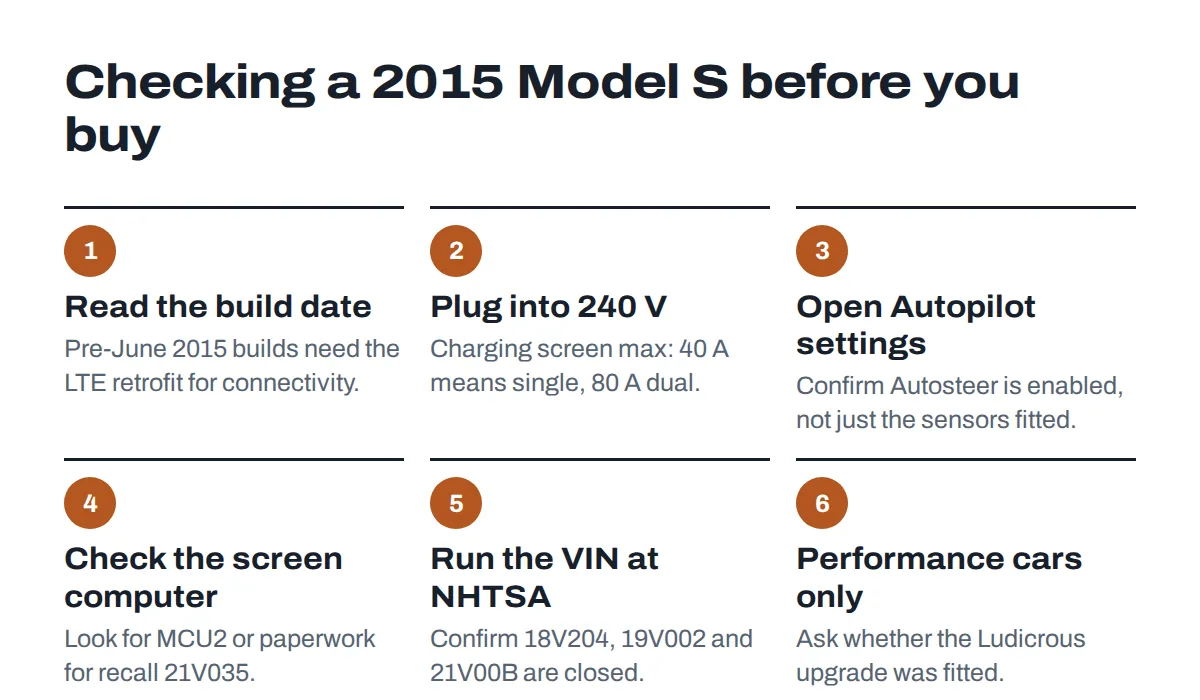
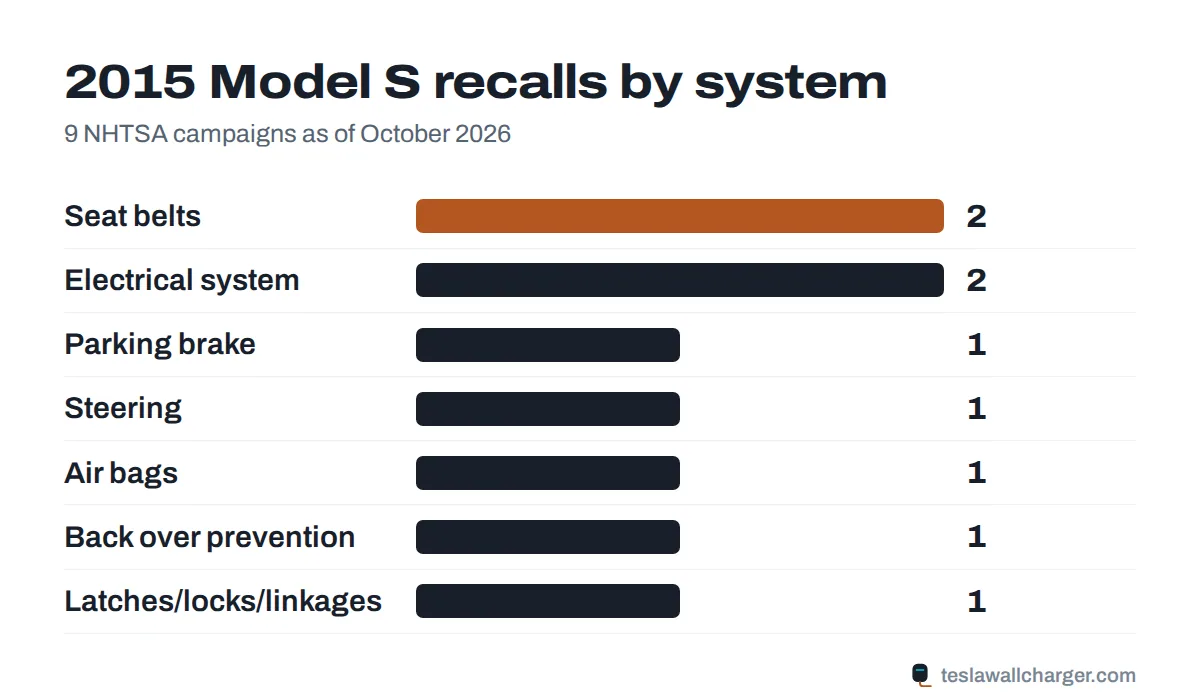
NHTSA lists 9 recall campaigns. The service-visit ones to confirm are the steering assist motor bolts (18V204), the Takata passenger airbag inflator (19V002), the MCU memory board (21V035), the frunk latch (21V00B), the parking brake calipers (17V260) and the November 2015 seat-belt pretensioner check (15V780).
- 15V780000November 23, 2015Seat belts, frontService visit
Front seat belts may not be correctly attached to the outboard lap pretensioner - 17V260000April 19, 2017Parking brakeService visit
Electric parking brake caliper internal gear may break, leaving the car immobile or unable to hold position - 18V204000March 29, 2018Steering, electric power assist systemService visit
Aluminum bolts holding the power steering assist motor (Bosch rack) can corrode and break, reducing or removing power assist - 19V002000January 7, 2019Air bags, frontal, passenger side, inflator moduleService visit
Passenger frontal air bag inflator may rupture on deployment due to propellant degradation (Takata) - 21V035000January 29, 2021Back over prevention, softwareService visit
MCU1 touchscreen eMMC memory wear can cause loss of rearview camera, defrost/defog controls and exterior turn signal lighting; VCM daughterboard replaced (firmware 2020.48.48.12+ also advised) - 21V00B000December 21, 2021Latches/locks/linkages, hood, latchService visit
Front trunk (frunk) latch may be misaligned so the secondary latch does not engage; hood could open unexpectedly
Show all 9 recalls
- 23V838000December 12, 2023Electrical system, adas, autonomous/self driving, softwareSoftware update
Autosteer driver-engagement controls may be insufficient to prevent misuse (followed NHTSA EA22-002) - 24V051000January 30, 2024Electrical system, instrument cluster/panelSoftware update
Brake, park and ABS warning lights shown in a font too small to meet FMVSS 105/135 - 24V376000May 28, 2024Seat belts, front, warning light/devicesSoftware update
Driver seat belt warning light and chime may not activate when unbelted (FMVSS 208)
Source: NHTSA recalls API. A recall only applies if your VIN is listed.
At 646, the 2015 car has more owner complaints on file with NHTSA than any other classic Model S year. That partly reflects how many were sold, but it lines up with Consumer Reports' October 2015 decision to drop its recommendation over drivetrain faults, door handles that failed to extend, screen faults, leaks and coolant pumps.
Crash ratings depend on the version. NHTSA rated the rear-drive 85 kWh car 5 stars overall. The 85D was not given an overall or frontal score; it has 5 stars for side impact and rollover (5.7% rollover risk).
| NHTSA test | Rating |
|---|---|
| Overall | 5 stars |
| Frontal crash | 5 stars |
| Side crash | 5 stars |
| Rollover | 5 stars |
| Rollover risk | 5.7% |
Charging a 2015 at home, with real numbers
Every 2015 Model S has a 40 A (9.6 kW) onboard charger, and the optional second charger raises that to 80 A (19.2 kW). Because the D cars are more efficient, they add range faster from the same outlet.
Worked example for an 85D (about 34 kWh per 100 miles from the wall):
- 40 A Wall Connector: 9.6 kW / 0.34 kWh per mile = about 28 miles of range per hour.
- A 60-mile round-trip commute: 60 / 28 = a little over 2 hours of charging each night.
- On a 14-50 outlet with Tesla's current Mobile Connector at 32 A (7.7 kW): about 23 miles per hour, so under 3 hours.
For a single-charger car, a Wall Connector on a 50 A breaker covers everything the car can draw. A dual-charger car plugged into today's Gen 3 Wall Connector gets 48 A, about 34 miles per hour for an 85D. Only a Gen 2 unit can be set to 80 A for the full 50 to 58 miles per hour, and that needs a 100 A breaker and heavier copper. Read our Wall Connector amp settings and Gen 2 vs Gen 3 comparison before deciding, and use a licensed electrician with a permit. Our charging time calculator guide has the numbers for other setups.
For public charging, the J1772 adapter works at Level 2 stations, and Tesla sells a CCS1 adapter for fast chargers ($300). Older Model S may also need a retrofit ($380 with adapter for S/X, as of October 2026); the Tesla app shows whether your VIN qualifies. More in our guide to non-Tesla stations.
The 8-year battery and drive unit cover ended in 2023 or 2024 for most 2015 cars. The 2019 battery-management updates that cut usable capacity on some older Model S packs, later reviewed by NHTSA under petition DP19-005, are another reason to get a health report. If the price of a good 2015 looks high, compare it with the Tesla Model S 2014 or the full Model S year-by-year guide.
Questions about buying a 2015 Model S
What is the range of a 2015 Tesla Model S?
EPA ratings for 2015 run from 208 miles (60 kWh) to 270 miles (85D and 90D). The 70D was rated at 240 miles, the rear-drive 85 and 90 at 265, and the P85D and P90D at 253. Those are new-car numbers. Ask the seller to show the range estimate at 100% to judge how much the pack has lost.
Does every 2015 Model S have Autopilot?
Every 2015 car has Autopilot hardware 1 (forward camera, radar and ultrasonic sensors), because it went into production in September 2014. The software features were a paid option, though. Autosteer and auto lane change arrived by update in October 2015 only on cars where Autopilot was bought. Check the Autopilot settings menu to confirm.
What is the difference between the 2015 Model S 85 and 85D?
The 85D adds a front motor for all-wheel drive. It was also more efficient: EPA rated it at 270 miles and about 34 kWh per 100 miles, against 265 miles and 38 kWh for the rear-drive 85. In April 2015 Tesla listed the 85D at 4.4 seconds to 60 mph. On a cold or wet commute, the 85D is the easier car to live with.
Does the 2015 Model S have LTE?
Only later builds. Tesla says Model S cars built before June 2015 without an LTE modem are 3G only, and they lost cellular service when AT&T shut its 3G network down in February 2022. Tesla offered a $200 LTE modem retrofit, or the Infotainment Upgrade also solves it. Ask which one the car has.
How fast does a 2015 Model S charge at home?
With the standard 40 A charger on a Wall Connector, a 70D or 85D adds about 28 to 29 miles of range per hour and a rear-drive 85 about 25. A NEMA 14-50 with the current Mobile Connector gives about 20 to 23. Cars with the optional dual chargers can reach about 50 to 58 miles per hour, but only on an 80 A Gen 2 Wall Connector.
Is the 2015 Model S reliable?
It is better understood than it is reliable. Consumer Reports dropped its Model S recommendation in October 2015, and 2015 has the most NHTSA owner complaints of any classic Model S year (646). The common faults are known and fixable, so a car with records for the screen, drive unit and recalls is a far safer bet than one without.
Sources
- NHTSA recalls API, 2015 Tesla Model S, api.nhtsa.gov
- NHTSA SafetyRatings API, 2015 Model S 85 kWh RWD (VehicleId 9832), api.nhtsa.gov
- NHTSA SafetyRatings API, 2015 Model S 85D AWD (VehicleId 9834), api.nhtsa.gov
- Electrek: Tesla announces $75,000 Model S 70D (Apr 8, 2015), electrek.co
- Consumer Guide: 2015 Tesla Model S, consumerguide.com
- Tesla support: 3G cellular network retirement and LTE upgrade, tesla.com
- Manufacturing.net: Consumer Reports retracts Model S recommendation (Oct 21, 2015), manufacturing.net
- ENERGY STAR / EPA data, 2015 Model S 85D (34 kWh/100 mi; 80 A dual charger option), energystar.gov
Independent site. Not affiliated with or endorsed by Tesla, Inc. Tesla, Wall Connector and Supercharger are trademarks of Tesla, Inc.