The 2016 Tesla Model S is three cars under one badge. Early 2016 builds have the original nose and a 40 A charger, the April 2016 facelift brought the grille-less nose and a 48 A charger (72 A optional), and cars built from late October 2016 swapped Autopilot hardware 1 for HW2. EPA ranges run from 210 to 315 miles across 13 versions. Work out which build you are looking at before comparing prices.
Telling the three 2016 builds apart
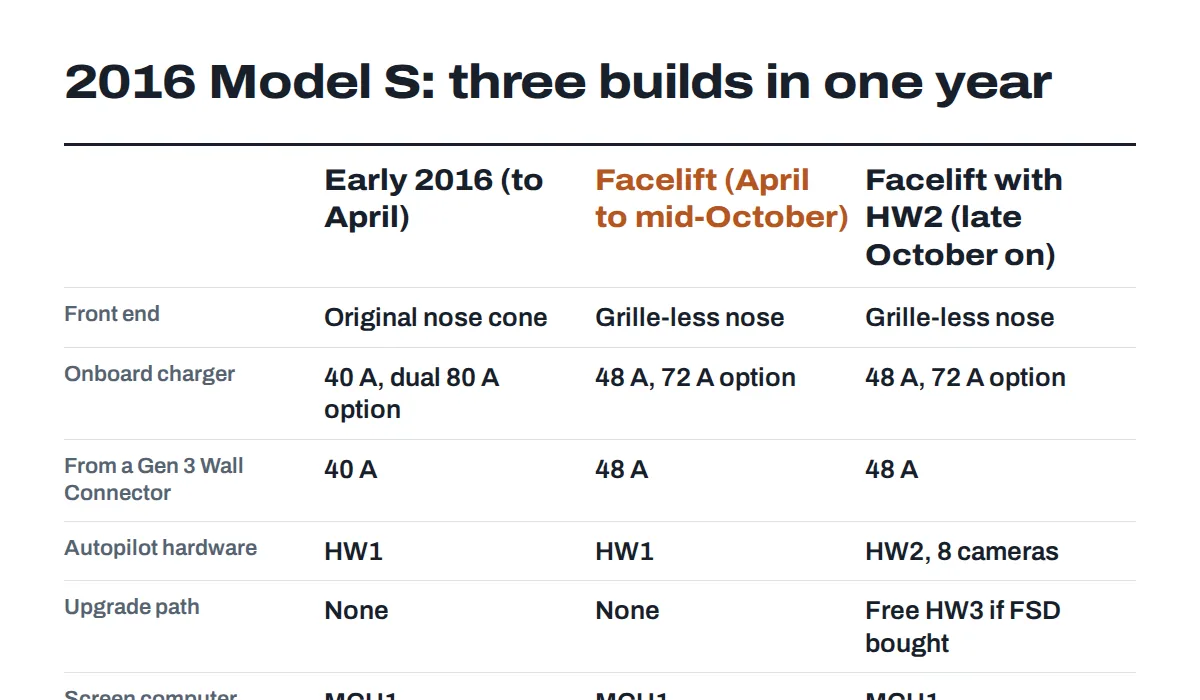
The nose is the obvious clue. Tesla announced the refresh on April 12, 2016, replacing the original nose cone with a grille-less front. The same update added an optional HEPA filter with Bioweapon Defense Mode and a center console borrowed from the Model X, and the base price moved from $70,000 to $71,500.
The less obvious change is under the floor. The refresh replaced the 40 A onboard charger with a 48 A unit and swapped the 80 A dual-charger option for a single 72 A option. The charging screen will not settle it on its own: it shows the lower of the car's and the charger's limit, so a dual-charger or 72 A car still reads 48 A on a Gen 3 Wall Connector and 32 A on a 14-50 outlet. Only a Gen 2 Wall Connector set above 48 A reveals the extra capacity; otherwise ask Tesla to confirm the charger by VIN.
Autopilot is the third split. From mid to late October 2016, every Model S was built with hardware 2: eight cameras, 12 updated ultrasonic sensors, a forward radar and an NVIDIA computer. Tesla shipped those cars before the software had caught up, so for a while some HW1 safety features were missing on HW2 cars until they were validated. That is long fixed. What still matters is the upgrade path: a HW2 car whose owner bought Full Self-Driving qualifies for a free HW3 computer swap, while a subscription does not count. HW1 cars cannot move to the newer system.
48 A charging and the 72 A option at home
This is the first Model S year that lines up neatly with today's Wall Connector. The Gen 3 unit tops out at 48 A on a 60 A breaker, exactly what a standard facelifted 2016 accepts.
| Your 2016 car | Best home setup | Range added per hour (approx.) |
|---|---|---|
| Pre-facelift, 40 A | Gen 3 Wall Connector at 40 A, 50 A breaker | about 25 to 29 mi |
| Pre-facelift, dual 80 A | Gen 2 Wall Connector at 80 A, 100 A breaker | about 50 to 58 mi |
| Facelift, 48 A | Gen 3 Wall Connector at 48 A, 60 A breaker | about 35 mi (75D, 90D) |
| Facelift, 72 A option | Gen 2 Wall Connector at 72 A, 90 A breaker | about 52 mi |
| Any version, NEMA 14-50 | Current Mobile Connector, 32 A | about 20 to 24 mi |
Estimates use EPA consumption, which includes charging losses. At 48 A, a full charge takes roughly 7 hours for a 75 kWh pack and about 9.5 hours for a 100 kWh pack, by our calculation.
If your facelifted car has the 72 A charger, getting the extra speed means finding a Gen 2 Wall Connector and setting its rotary switch to position C (90 A breaker, 72 A output). A circuit that size needs heavier copper and, under NEC 625.43, a readily accessible disconnect because the charger is rated over 60 A. For most people charging overnight, 48 A on a standard 60 A circuit already refills a day's driving in a couple of hours, so the 72 A option is a nice-to-have. Our rundown of Wall Connector generations and breaker size guide for a Tesla charger go deeper, and how long a Tesla takes to charge compares every option. As always, a licensed electrician should do the work under a permit.
The 60 and 60D: 75 kWh packs held back by software
On June 9, 2016, Tesla brought back a cheaper car: the Model S 60 at $66,000 and 60D at $71,000. Both used the new 75 kWh pack with software limiting it to 60 kWh. Owners could pay $8,500 at order or $9,000 later to raise it to 75.
For a used buyer that creates a simple test. EPA rated the 60 at 210 miles and the 60D at 218; a 75 and 75D were rated at 249 and 259. If a car badged 60 shows range at 100% in the 75 territory, it has been upgraded. If the seller claims it has but the numbers say otherwise, ask Tesla to confirm by VIN.
| Trim | EPA range | Efficiency | Home AC max | Price (USD) |
|---|---|---|---|---|
| 60 | 210 mi | 34 kWh/100 mi | 11.5 kW | $66,000 |
| 60D | 218 mi | 32 kWh/100 mi | 11.5 kW | $71,000 |
| 70 (RWD) | 234 mi | 38 kWh/100 mi | n/a | $70,000 |
| 70D | 240 mi | 33 kWh/100 mi | n/a | $75,000 |
| 75 | 249 mi | 34 kWh/100 mi | 11.5 kW | n/a |
| 75D | 259 mi | 33 kWh/100 mi | 11.5 kW | n/a |
| 85 | 265 mi | 38 kWh/100 mi | 9.6 kW | n/a |
| 85D | 270 mi | 34 kWh/100 mi | 9.6 kW | n/a |
| 90 | 265 mi | 38 kWh/100 mi | n/a | n/a |
| 90D | 294 mi | 33 kWh/100 mi | n/a | $85,000 |
| P85D | 253 mi | 36 kWh/100 mi | 9.6 kW | n/a |
| P90D | 270 mi | 35 kWh/100 mi | n/a | $108,000 |
| P100D | 315 mi | 34 kWh/100 mi | 11.5 kW | $134,500 |
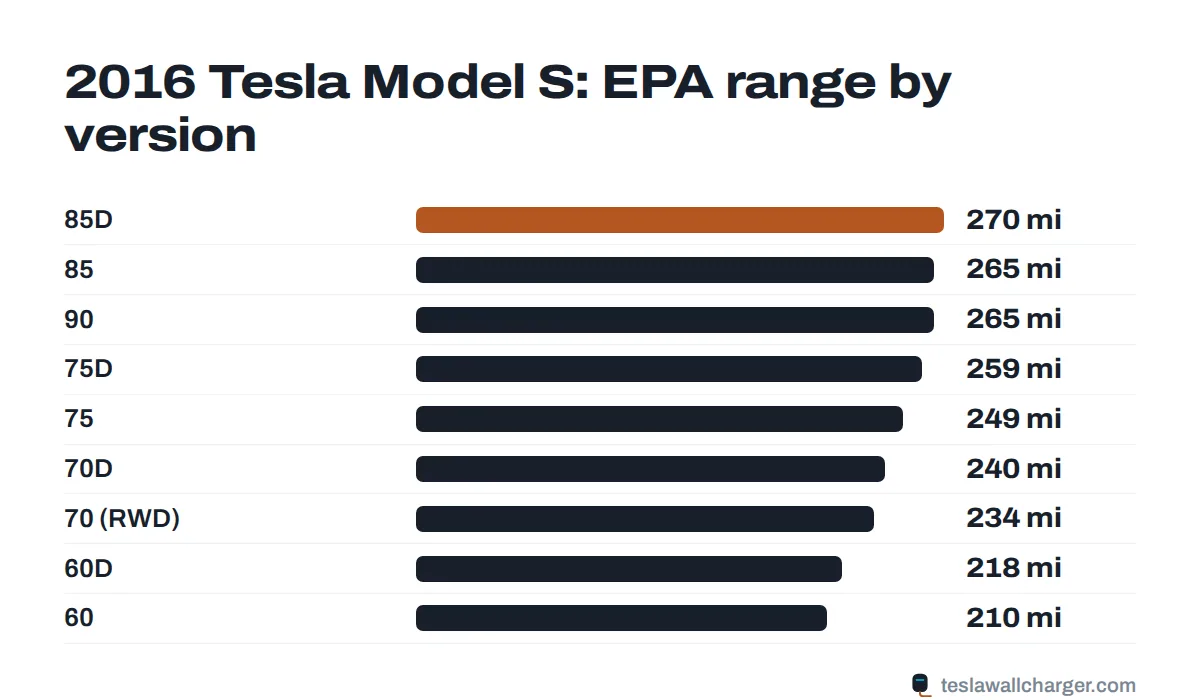
The top of the range moved too. The P100D with Ludicrous mode arrived on August 23, 2016, at $134,500, with 315 miles of EPA range and a claimed 2.5-second sprint to 60 mph.
Recalls, screen and crash ratings
NHTSA lists 10 campaigns for the 2016 Model S. Two are new compared with the 2015 Tesla Model S, and both concern Full Self-Driving software on HW2 cars: 22V037 disabled the "rolling stop" behavior at all-way stops, and 23V085 changed how FSD Beta handled intersections and speed-limit changes. Both were over-the-air fixes. The steering-bolt recall 18V204 only reaches early 2016 builds with the older Bosch rack.
- 17V260000April 19, 2017Parking brakeService visit
Electric parking brake caliper internal gear may break, leaving the car immobile or unable to hold position - 18V204000March 29, 2018Steering, electric power assist systemService visit
Aluminum bolts holding the power steering assist motor (Bosch rack) can corrode and break, reducing or removing power assist - 19V002000January 7, 2019Air bags, frontal, passenger side, inflator moduleService visit
Passenger frontal air bag inflator may rupture on deployment due to propellant degradation (Takata) - 21V035000January 29, 2021Back over prevention, softwareService visit
MCU1 touchscreen eMMC memory wear can cause loss of rearview camera, defrost/defog controls and exterior turn signal lighting; VCM daughterboard replaced (firmware 2020.48.48.12+ also advised) - 21V00B000December 21, 2021Latches/locks/linkages, hood, latchService visit
Front trunk (frunk) latch may be misaligned so the secondary latch does not engage; hood could open unexpectedly - 22V037000January 27, 2022Electrical system, adas, autonomous/self driving, softwareSoftware update
FSD (Beta) 'rolling stop' could let the car roll through all-way stop intersections; feature disabled
Show all 10 recalls
- 23V085000February 15, 2023Steering, automated/adaptive steeringSoftware update
FSD Beta may act unsafely around intersections and respond poorly to speed limit changes - 23V838000December 12, 2023Electrical system, adas, autonomous/self driving, softwareSoftware update
Autosteer driver-engagement controls may be insufficient to prevent misuse (followed NHTSA EA22-002) - 24V051000January 30, 2024Electrical system, instrument cluster/panelSoftware update
Brake, park and ABS warning lights shown in a font too small to meet FMVSS 105/135 - 24V376000May 28, 2024Seat belts, front, warning light/devicesSoftware update
Driver seat belt warning light and chime may not activate when unbelted (FMVSS 208)
Source: NHTSA recalls API. A recall only applies if your VIN is listed.
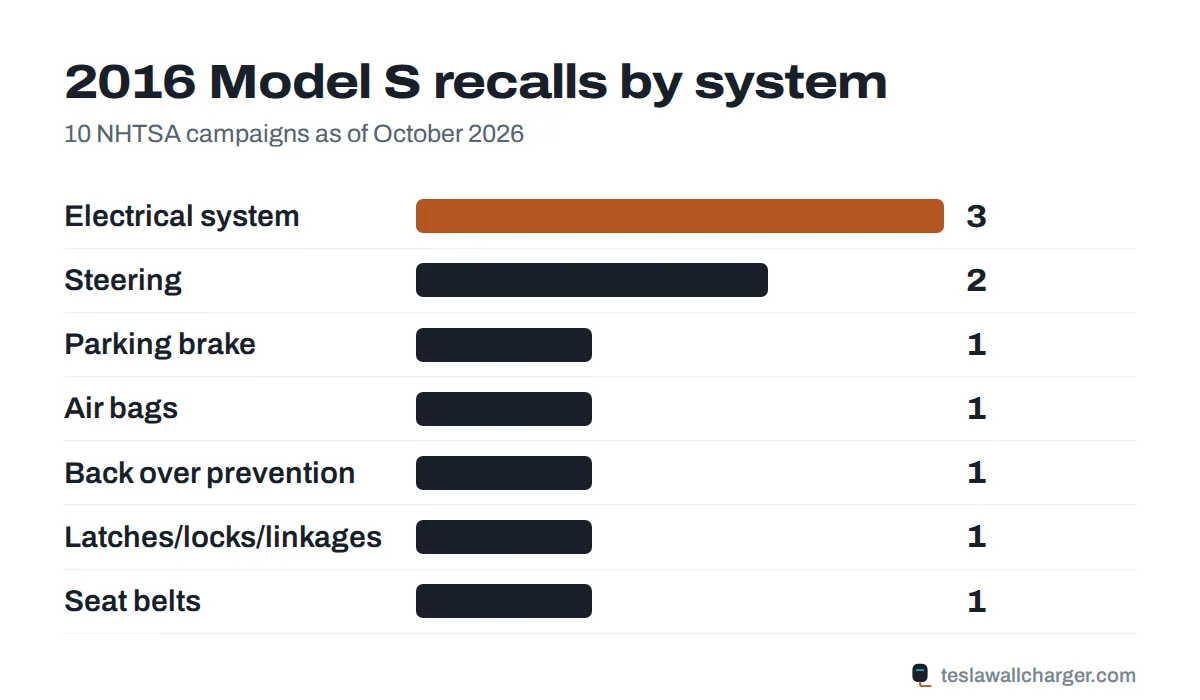
All 2016 cars still use MCU1, so the eMMC memory wear that led to recall 21V035 applies here as much as on a 2012. Tesla's Infotainment Upgrade to MCU2 cost about $1,500 to $2,500 in 2020 and 2021 press reports; check today's price with a service center.
Owners filed 604 complaints with NHTSA for this year. Crash data is patchy: NHTSA rated the early-release 75 RWD at 5 stars overall, but later-release 75 and 75D cars were only rated for rollover (5 stars).
| NHTSA test | Rating |
|---|---|
| Overall | 5 stars |
| Frontal crash | 5 stars |
| Side crash | 5 stars |
| Rollover | 5 stars |
| Rollover risk | 5.7% |
Which 2016 to buy
- Want driver assistance that keeps improving? Late-October-on builds with HW2, ideally with FSD already purchased so the HW3 swap is free.
- Want the easiest home charging? Any facelift car; a standard 60 A Wall Connector circuit gives it everything it can take.
- Want the lowest price? An early 2016 classic-nose car drives and charges like the previous year and should be priced like a Tesla Model S 2015.
- Shopping a 60 or 60D? Confirm whether the 75 kWh upgrade was bought.
The 8-year battery warranty on 2016 cars ended in 2023 or 2024, depending on delivery date, so a battery health check is non-negotiable. For a year with HW2.5 and the 100D, see the 2017 Model S, or compare every Tesla Model S year.
2016 Model S questions, answered
When did the 2016 Model S facelift happen?
Tesla announced the refreshed Model S on April 12, 2016. It brought the grille-less front end, an optional HEPA cabin filter with Bioweapon Defense Mode, a Model X-style center console and a new 48 A onboard charger. Base price rose from $70,000 to $71,500. Cars built earlier in the 2016 model year keep the original nose and 40 A charging.
Does the 2016 Model S have HW1 or HW2?
Both, depending on build date. Cars built until about mid-October 2016 have Autopilot hardware 1 with a single forward camera. From mid to late October 2016 every car got hardware 2: eight cameras, updated ultrasonic sensors, a forward radar and an NVIDIA computer. Some HW1 safety features were missing on early HW2 cars until Tesla validated them by software.
Can a 2016 Model S 60 be upgraded to 75 kWh?
Yes. The 60 and 60D sold from June 2016 carry a 75 kWh battery held back by software. Tesla charged $8,500 to raise it at the time of order or $9,000 later. A car that has had the upgrade should show range consistent with a 75 or 75D (249 or 259 miles EPA when new). Confirm the current status with Tesla by VIN.
What charger does a 2016 Model S have?
Pre-facelift cars have a 40 A onboard charger, with an optional second unit for 80 A. Facelifted cars from April 2016 have a 48 A charger as standard and an optional 72 A charger. The charging screen shows the lower of the car's and the charger's limit, so only a Gen 2 Wall Connector set above 48 A will reveal a 72 A or 80 A car; otherwise ask Tesla by VIN.
What is the range of a 2016 Tesla Model S?
EPA ratings span 210 miles for the software-limited 60 up to 315 miles for the P100D. Popular versions sit in between: 75D at 259 miles, 85D at 270 and 90D at 294. These are new-car figures; a 10-year-old pack will show less, so compare the car's range at 100% with the rating for its badge.
Sources
- NHTSA recalls API, 2016 Tesla Model S, api.nhtsa.gov
- CleanTechnica: Tesla refreshes Model S (Apr 12, 2016), cleantechnica.com
- HotHardware: Model S refresh with 48 A onboard charger, hothardware.com
- CleanTechnica: $66,000 Model S 60 and $71,000 60D (Jun 9, 2016), cleantechnica.com
- AutoGuide: P100D, $134,500, 315 mi, 0-60 2.5 s (Aug 23, 2016), autoguide.com
- PCWorld: Tesla cars to have full self-driving hardware (Oct 2016), pcworld.com
- NHTSA SafetyRatings API, 2016 Model S 75 RWD Early Release (VehicleId 10928), api.nhtsa.gov
- Drive Tesla Canada: Infotainment Upgrade price drop (Jan 21, 2021), driveteslacanada.ca
- Tesla Gen 2 Wall Connector installation manual, digitalassets.tesla.com
Independent site. Not affiliated with or endorsed by Tesla, Inc. Tesla, Wall Connector and Supercharger are trademarks of Tesla, Inc.