The 2020 Tesla Model S is the last full year of the original body and interior, and the year the Long Range Plus became the first electric car rated by the EPA at more than 400 miles (402). It is also a year that changed halfway through, so two cars with the same model-year badge can differ in range and Supercharging speed.
Long Range or Long Range Plus: which 2020 is it?
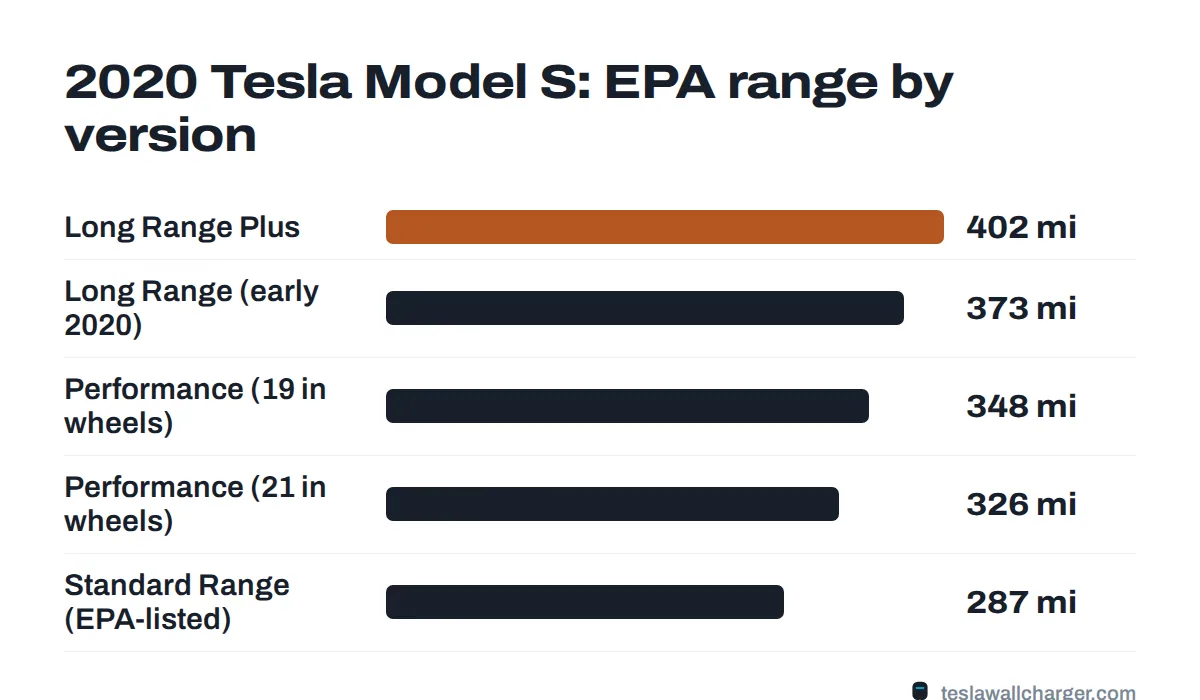
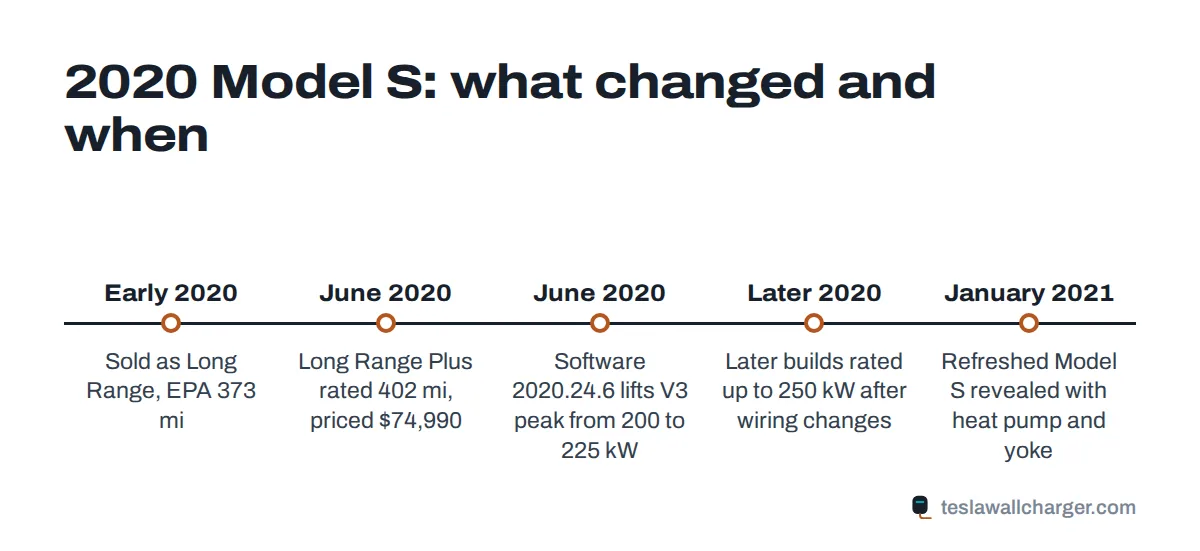
Tesla sold the dual-motor car as the Long Range at the start of the model year, rated 373 miles and 111 MPGe. In June 2020 it became the Long Range Plus at $74,990, rated 402 miles and 117 MPGe. The gain did not come from a bigger battery. Tesla credited more aerodynamic wheels, lower rolling-resistance tires, a more efficient rear drive unit with an electric oil pump, revised regen and weight savings.
The Performance stayed at the top: 348 miles on 19 in wheels, 326 on 21 in wheels, with a Tesla-claimed 2.3 s to 60 mph. The EPA also lists a 2020 Standard Range at 287 miles, but Tesla dropped that trim during 2019, so you are unlikely to meet one.
The quickest way to tell versions apart is the original window sticker or the build date in the Tesla app. Wheel design is a hint, not proof, because owners swap wheels.
Supercharging speed varies car to car
Raven-era cars launched at a 200 kW peak on V3 Superchargers. Software 2020.24.6 raised eligible cars to 225 kW, and builds ordered later with thicker internal wiring were rated up to 250 kW. All three exist under the 2020 badge. If you road-trip often, ask for a recent session screenshot from a V3 or V4 site showing the peak.
CCS1 fast charging is less simple. Older Model S cars can need a Tesla retrofit before the CCS Combo 1 adapter works; Tesla sells the S/X retrofit plus adapter for $380 (as of October 2026). Check eligibility in the Tesla app before you count on charging a Tesla at non-Tesla stations.
What a 2020 does without, next to a 2021
The 2021 Model S Palladium refresh is the line most shoppers weigh this car against. Here is what stays on the older side of it:
| Item | 2020 Model S | Refreshed 2021 Model S |
|---|---|---|
| Cabin heating | Resistive, no heat pump | Heat pump |
| Screen and controls | Portrait screen, stalks, round wheel | Horizontal 17 in screen, yoke, no stalks |
| Infotainment computer | MCU2 | AMD Ryzen |
| Autopilot computer | HW3 (confirm) | HW3 |
| Forward radar | Fitted | Fitted on early builds |
| Parking sensors | Ultrasonic sensors fitted | Ultrasonic sensors fitted |
| Best EPA range | 402 mi | 405 mi |
For some buyers the older layout is a plus: real stalks, a normal wheel and a familiar screen. The missing heat pump matters most in cold states. You can confirm both computers under Controls > Software > Additional Vehicle Information.
The recall list, sorted by what needs a visit
NHTSA lists 11 recall campaigns for this year. Ten were software updates pushed over the air, so a car that has been online and updated already has them. One needs hands on the car.
- 22V037000January 27, 2022Electrical system, adas, autonomous/self driving, softwareSoftware update
FSD Beta 'rolling stop' could let the car roll through an all-way stop - 21V00B000December 21, 2021Latches/locks/linkages, hood, latchService visit
Misaligned front trunk (frunk) latch may stop the secondary latch engaging, so the hood could open while driving - 21V846000October 29, 2021Forward collision avoidance, sensing system, cameraSoftware update
Software communication error could cause false forward collision warnings or unexpected automatic emergency braking - 22V063000February 4, 2022Electrical system, softwareSoftware update
Boombox could obscure Pedestrian Warning System sounds (superseded by 22V235000) - 22V235000April 12, 2022Electrical system, softwareSoftware update
Boombox could obscure Pedestrian Warning System sounds; Boombox disabled in Drive, Neutral and Reverse - 22V818000November 1, 2022Steering, electric power assist systemSoftware update
Electric power steering assist could be lost on rough roads or after a pothole impact
Show all 11 recalls
- 23V085000February 15, 2023Steering, automated/adaptive steeringSoftware update
FSD Beta could act unsafely at intersections and respond poorly to speed limit changes - 23V838000December 12, 2023Electrical system, adas, autonomous/self driving, softwareSoftware update
Autosteer driver-engagement controls may not be enough to prevent misuse - 24V051000January 30, 2024Electrical system, instrument cluster/panelSoftware update
Brake, Park and ABS warning lights used too small a font - 24V153000February 27, 2024Forward collision avoidance, warnings, external/pedestrian alertSoftware update
A factory reset could mute the Pedestrian Warning System sound - 24V376000May 28, 2024Seat belts, front, warning light/devicesSoftware update
Seat belt warning light and chime might not activate for an unbelted driver
Source: NHTSA recalls API. A recall only applies if your VIN is listed.
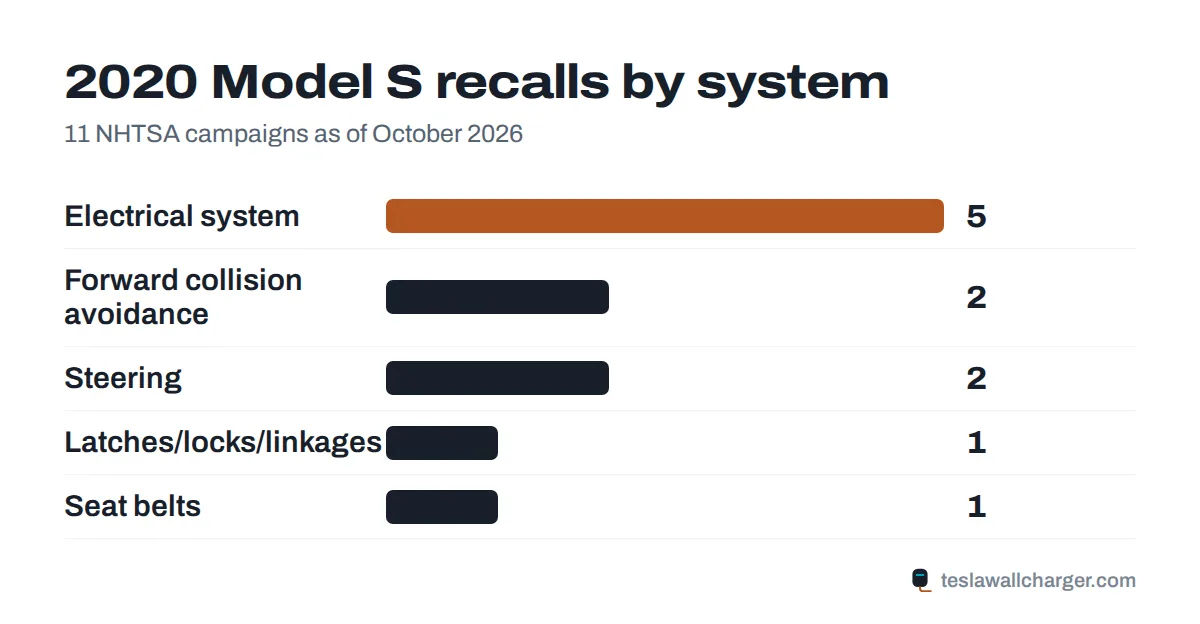
The one to chase is 21V00B000: the frunk latch could be misaligned so the secondary catch does not engage, and the hood could open while driving. A service center inspects and repositions the latch for free. The other campaign worth reading is 22V818000, where power steering assist could drop after a pothole; the fix was an OTA recalibration. Run the VIN at nhtsa.gov/recalls to see what is still open.
Owner complaints to NHTSA are modest for a car this old:
80 owner complaints filed with NHTSA for the 2020 Model S. Most frequent areas (approximate order): forward collision avoidance; suspension; unknown or other; steering; vehicle speed control; electrical system. Source: NHTSA complaints database.
NHTSA did not publish a crash rating for the 2020 Model S, so there is no star score to quote.
Charging a 2020 Model S at home
The onboard charger takes 48 A, which is 11.5 kW. TeslaTap reports Tesla dropped the 72 A charger option in late 2018, so a 2020 should show 48 A as the maximum on the car's charging screen. That also means an older Gen 2 Wall Connector set to 80 A gives this car nothing extra.
| How you charge | Speed |
|---|---|
| Wall Connector at 48 A (11.5 kW, 60 A breaker) | up to 41 mi of range per hour |
| NEMA 14-50 outlet, Mobile Connector at 32 A | about 27 mi per hour |
| Regular 120 V outlet | 2 to 3 mi per hour |
| Empty to full, largest pack (about 98 kWh) | about 9.5 hours at 11.5 kW |
Rates scale Tesla's published Wall Connector table for this model; older cars and cold batteries charge slower. Times are estimates.
Speeds by circuit, from Tesla's Model S figures:
| Breaker | Wall Connector output | Range added per hour |
|---|---|---|
| 60 A | 48 A (11.5 kW) | about 41 mi |
| 50 A | 40 A (9.6 kW) | about 34 mi |
| 40 A | 32 A (7.7 kW) | about 27 mi |
| 30 A | 24 A (5.7 kW) | about 21 mi |
A worked example: a 50-mile daily commute on a 60 A circuit takes about 50 / 41 = 1.2 hours to put back. Even a 30 A circuit refills it in about 2.4 hours overnight. If you already have a dryer-style outlet, see NEMA 14-50 vs a Wall Connector before paying for a new circuit; a 14-50 with a Mobile Connector gives about 27 mi/hr. If you do want the hardwired route, Wall Connector installation labor runs $750 to $1,500 on Tesla's own estimate, before the charger.
Running cost is low. At the EPA's 117 MPGe (about 29 kWh per 100 miles) and the July 2026 US average of 18.31 cents/kWh, 1,000 miles costs about 290 x $0.1831 = $53. More on what a full charge costs at home.
Pre-purchase checklist for a 2020
- Build date and trim: Long Range (373 mi) or Long Range Plus (402 mi).
- Supercharging peak the car is set to: 200, 225 or 250 kW.
- Frunk latch recall 21V00B000 completed.
- Autopilot computer shows HW3; infotainment shows MCU2.
- Max charging current on the screen reads 48 A.
- Battery warranty end date in the Tesla app (8 years from first delivery under Tesla's current Model S terms).
- Whether the CCS1 retrofit was done, if you plan to fast-charge off the Tesla network.
The Tesla Model S 2019 offers the same Raven hardware for less if you can live without the 402-mile rating. For every year side by side, see the Tesla Model S years hub.
Questions owners ask about the 2020 Model S
What is the range of a 2020 Tesla Model S?
It depends on the build. Cars sold early in 2020 as Long Range carry a 373-mile EPA rating. From June 2020 the Long Range Plus was rated 402 miles. The Performance is 348 miles on 19 in wheels and 326 miles on 21 in wheels. Expect less in winter and at steady highway speeds, and less again on an older pack.
Does the 2020 Model S have a heat pump?
No. The heat pump arrived with the refreshed Model S in 2021. A 2020 car heats the cabin with resistive heating, so cold-weather range loss is larger than on a 2021 or later refresh car. Preconditioning while still plugged in at home helps, because the energy for warming the cabin and battery comes from the wall rather than the pack.
How fast does a 2020 Model S Supercharge?
Somewhere between 200 and 250 kW at a V3 or V4 site, depending on when it was built. Raven cars started at 200 kW, software 2020.24.6 raised eligible cars to 225 kW, and later-ordered builds with wiring changes were rated up to 250 kW. Older V2 Superchargers are slower. Ask the seller for a recent Supercharging session screenshot if peak speed matters to you.
Is a 2020 Model S still under battery warranty?
Probably, for a while. Tesla's current Model S terms are 8 years or 150,000 miles with at least 70% capacity retained, and the clock starts at the original delivery date. A car delivered in mid-2020 runs to about mid-2028 if it is under the mileage cap. Confirm the exact terms for that VIN in the Tesla app or with Tesla service.
What breaker does a 2020 Model S need for full-speed home charging?
A 60 A two-pole breaker feeding a Wall Connector set to 48 A. That gives about 41 miles of range per hour. A 50 A circuit caps the Wall Connector at 40 A (about 34 mi/hr), and a NEMA 14-50 outlet with a Mobile Connector gives 32 A (about 27 mi/hr). A licensed electrician should size the wire and pull the permit.
Sources
- NHTSA recalls API, 2020 Tesla Model S, api.nhtsa.gov
- Motor Authority: 2020 Tesla Model S becomes first EV rated by EPA at over 400 miles, motorauthority.com
- Electrek: Model S/X Supercharging rate increase to 225 kW, electrek.co
- Tesla support: Wall Connector charging speeds, tesla.com
- Tesla support: Vehicle warranty, tesla.com
Independent site. Not affiliated with or endorsed by Tesla, Inc. Tesla, Wall Connector and Supercharger are trademarks of Tesla, Inc.