The 2018 Tesla Model S is an all-wheel-drive, facelifted car with Autopilot HW2.5, a 48 A onboard charger and 259 to 335 miles of EPA range. NHTSA lists 11 recalls for it, nine of them fixed by over-the-air software. The detail that separates good 2018 cars from merely fine ones is the build date: from about March 5, 2018, Tesla fitted the faster MCU2 media computer instead of MCU1.
The 11 recalls, sorted by what you need to do
A long list is not the same as a troubled car. Sort the 2018 campaigns by the action they need and the picture gets simpler.
Needs a service visit (check paperwork):
- 21V035: replaces the memory daughterboard on MCU1 cars whose eMMC chip is wearing out. Only applies to early-2018 builds with MCU1.
- 21V00B: the front trunk latch could be misaligned so its secondary catch fails to engage, allowing the frunk lid to open while driving. Tesla realigns it.
Fixed by software, worth confirming the car is up to date:
- 21V846: a communication error could set off false forward-collision warnings or unexpected automatic emergency braking.
- 22V169: the rearview camera image could lag when the car starts reversing.
- 22V818: power steering assist could drop out on rough roads or after a pothole; the steering was recalibrated.
Driver-assistance software: 22V037 removed the FSD Beta "rolling stop" behavior, 23V085 changed FSD Beta handling at intersections and speed-limit changes, and 23V838 added Autosteer driver-engagement checks after NHTSA's engineering analysis EA22-002.
Compliance fixes: warning-light font size (24V051), the pedestrian warning sound muted after a factory reset (24V153) and the driver seat-belt chime (24V376).
- 21V035000January 29, 2021Back over prevention, softwareService visit
MCU1 touchscreen eMMC memory wear can cause loss of rearview camera, defrost/defog controls and exterior turn signal lighting; VCM daughterboard replaced (firmware 2020.48.48.12+ also advised) - 21V846000October 29, 2021Forward collision avoidance, sensing system, cameraSoftware update
Software communication error may cause false forward-collision warnings or unexpected automatic emergency braking - 21V00B000December 21, 2021Latches/locks/linkages, hood, latchService visit
Front trunk (frunk) latch may be misaligned so the secondary latch does not engage; hood could open unexpectedly - 22V037000January 27, 2022Electrical system, adas, autonomous/self driving, softwareSoftware update
FSD (Beta) 'rolling stop' could let the car roll through all-way stop intersections; feature disabled - 22V169000March 18, 2022Back over prevention, display functionSoftware update
Rearview camera image may be delayed when the car starts reversing - 22V818000November 1, 2022Steering, electric power assist systemSoftware update
Power steering assist may be lost on rough roads or after a pothole; EPAS recalibrated
Show all 11 recalls
- 23V085000February 15, 2023Steering, automated/adaptive steeringSoftware update
FSD Beta may act unsafely around intersections and respond poorly to speed limit changes - 23V838000December 12, 2023Electrical system, adas, autonomous/self driving, softwareSoftware update
Autosteer driver-engagement controls may be insufficient to prevent misuse (followed NHTSA EA22-002) - 24V051000January 30, 2024Electrical system, instrument cluster/panelSoftware update
Brake, park and ABS warning lights shown in a font too small to meet FMVSS 105/135 - 24V153000February 27, 2024Forward collision avoidance, warnings, external/pedestrian alertSoftware update
A factory reset could mute the Pedestrian Warning System sounds (fixed in 2023.44.30.14) - 24V376000May 28, 2024Seat belts, front, warning light/devicesSoftware update
Driver seat belt warning light and chime may not activate when unbelted (FMVSS 208)
Source: NHTSA recalls API. A recall only applies if your VIN is listed.
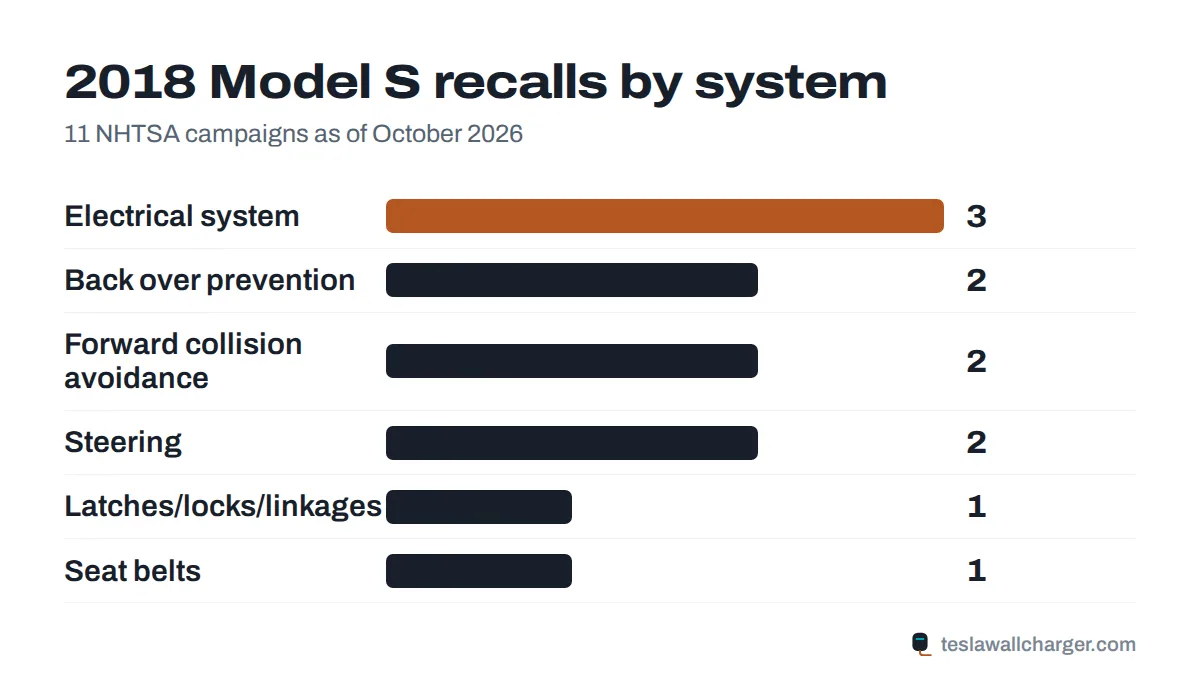
Run the VIN on NHTSA's recall search before you buy. A car that has sat offline for a long time may not have received the software remedies.
MCU1 or MCU2: the March 2018 split
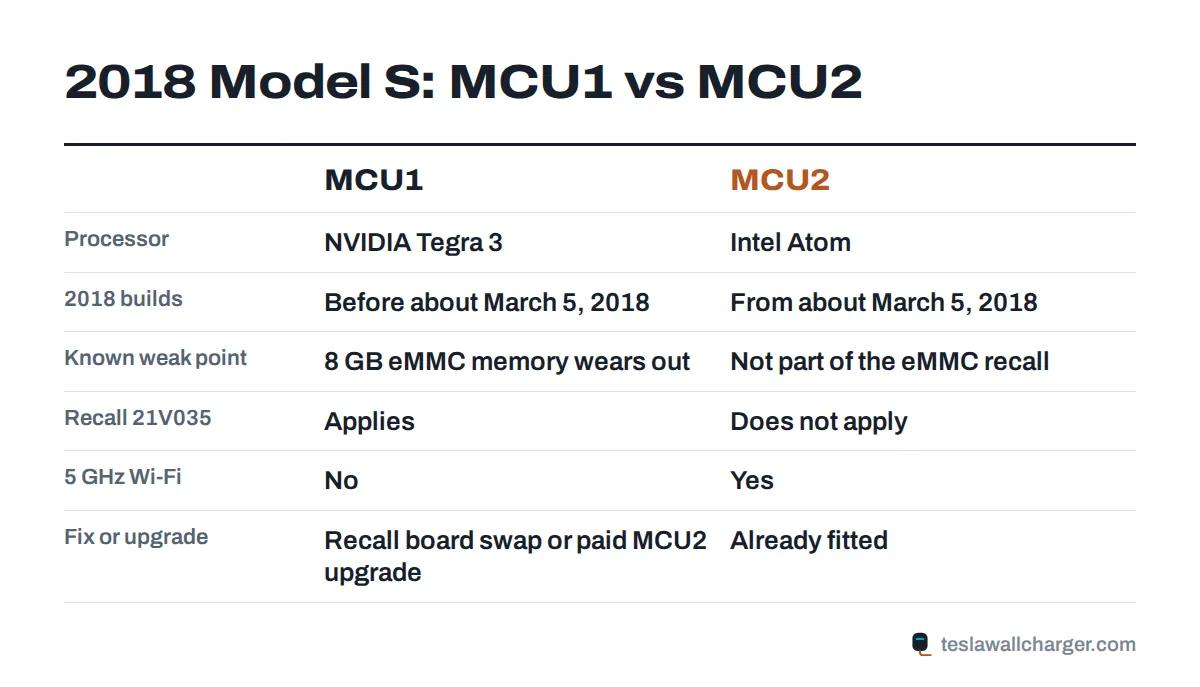
Cars built before about March 5, 2018 have MCU1, the same Tegra 3 computer used since 2012. NHTSA's investigation into its failing 8 GB eMMC memory (PE20-010, upgraded to EA20-003) covered Model S built through 2018. MCU2 builds sit outside that recall and add 5 GHz Wi-Fi and newer Bluetooth.
The door-pillar build date is the quickest check. On the touchscreen, the car's software information screen lists the infotainment computer. If you find an early-2018 MCU1 car at a good price, Tesla's paid Infotainment Upgrade turns it into an MCU2 car; get a current quote from a service center before you factor it in.
2018 line-up: all-wheel drive across the board
| Trim | EPA range | Efficiency | Home AC max | Price (USD) |
|---|---|---|---|---|
| 75 (EPA listing) | 249 mi | 34 kWh/100 mi | 11.5 kW | n/a |
| 75D | 259 mi | 33 kWh/100 mi | 11.5 kW | $75,700 |
| 100D | 335 mi | 33 kWh/100 mi | 11.5 kW | $95,200 |
| P100D | 315 mi | 34 kWh/100 mi | 11.5 kW | $136,200 |
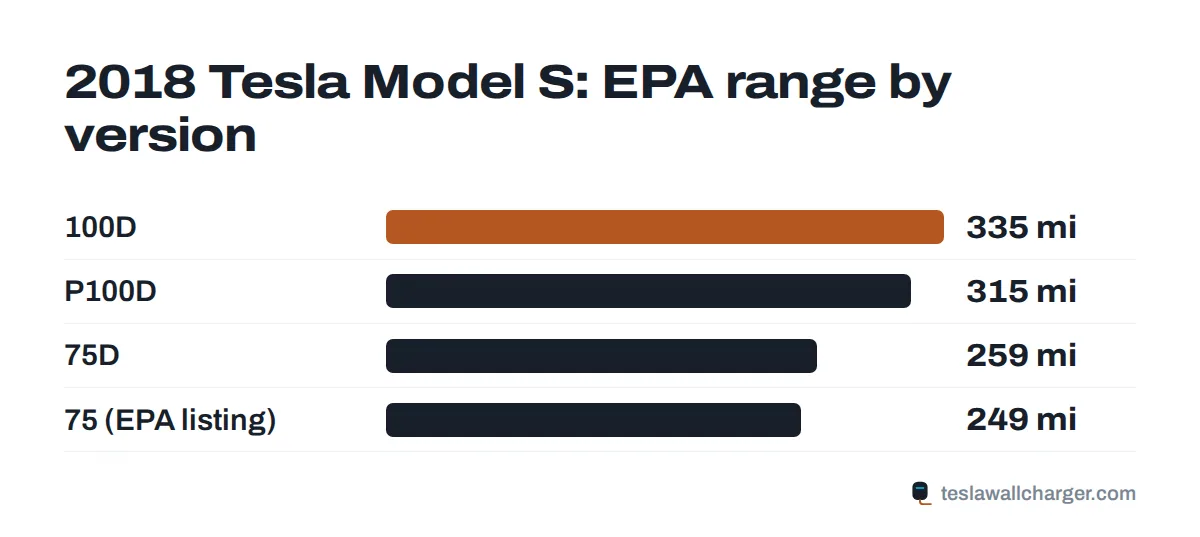
Consumer Guide lists the 2018 range as 75D, 100D and P100D, all dual-motor, with launch prices of $75,700, $95,200 and $136,200. EPA still has a 2018 "Model S 75 kWh" entry at 249 miles, so a few rear-drive cars may exist; confirm drivetrain by VIN. The 100D's 335-mile rating made it the long-distance choice, and it uses about 33 kWh per 100 miles, almost exactly what the smaller 75D uses.
Autopilot hardware 2.5 is standard on every 2018 car. HW3 came in 2019. With paid Full Self-Driving, a 2018 qualifies for a free HW3 computer, which is worth asking about when you compare it with the 2019 Tesla Model S.
Charging a 2018 at home, and what it costs
Plug a 2018 into a Gen 3 Wall Connector on a 60 A breaker and it takes the full 48 A (11.5 kW), which works out to roughly 35 miles of range for every hour plugged in (EPA-based). A 75D fills from empty in about 7 hours, a 100D in about 9.5. If you want the background on circuit sizing, read our Wall Connector installation guide and the take on whether a 14-50 outlet is enough; a licensed electrician and a permit are part of any new circuit.
TeslaTap reports that the optional 72 A charger was dropped in late 2018, and we could not confirm whether any 2018 cars were built with it. The charging screen will tell you: 72 as the maximum means it has the option and needs a Gen 2 Wall Connector to use it.
Worked running cost, using the EIA's July 2026 US average residential price of 18.31 cents per kWh:
- 100D at about 33 kWh per 100 miles: 1,000 miles needs about 330 kWh.
- 330 kWh x $0.1831 = about $60 per 1,000 miles at home.
- At the DCFC Tracker average Supercharger member rate of $0.434 per kWh, the same 1,000 miles would be about $143.
That gap is the strongest argument for a home circuit. Our guide to what a full charge costs on your rate shows how to plug in your own rate, and Wall Connector install pricing gives the other side of the sum.
Complaints and crash ratings
128 owner complaints filed with NHTSA for the 2018 Model S. Source: NHTSA complaints database.
At 128, the complaint count is far lower than the 2015 (646) or 2016 (604) car. Newer cars have had less time to collect complaints, so treat that as encouraging rather than proof. NHTSA only rated the 2018 75D for rollover (5 stars, 5.7% risk); overall, frontal and side scores were not published.
Checks before buying a 2018
- Build date before or after about March 5, 2018 (MCU1 or MCU2).
- Recall 21V00B completed, and 21V035 too on MCU1 cars.
- Software up to date, so the OTA recalls are in place.
- FSD purchased or not, which decides the free HW3 upgrade.
- Remaining battery warranty by VIN: an 8-year term from a 2018 delivery runs out during 2026.
For the Raven drivetrain and HW3, step up to 2019; for a lower price with MCU1, look at the 2017 Tesla Model S, or scan all Model S years to avoid and buy.
2018 Model S: common buyer questions
How many recalls does the 2018 Tesla Model S have?
NHTSA lists 11 recall campaigns for the 2018 Model S as of October 2026. Nine were remedied by over-the-air software updates. Two need a service visit: 21V035, which replaces the MCU1 memory board on early-2018 cars, and 21V00B, which realigns the front trunk latch. Run the VIN at nhtsa.gov to confirm none are open.
Does the 2018 Model S have MCU2?
Only cars built from about March 5, 2018. Earlier 2018 builds have MCU1, the NVIDIA Tegra 3 computer whose eMMC memory wears out. MCU2 uses an Intel Atom chip and adds 5 GHz Wi-Fi and newer Bluetooth. Check the build date on the door-pillar label or the computer listed under the car's software information screen.
Does the 2018 Model S have HW3?
No 2018 car left the factory with HW3; they were all built with Autopilot hardware 2.5. Tesla's HW3 computer entered Model S production in 2019. If Full Self-Driving was purchased for a 2018 car, it qualifies for a free swap to HW3. Cars with an FSD subscription, or without FSD, stay on HW2.5.
Is the 2018 Model S battery still under warranty?
Possibly, for a few more months. The battery warranty runs 8 years from the original delivery date, so a car delivered in late 2018 may still be covered into late 2026. The mileage limit for these packs is not something we could confirm, so check the remaining coverage in the Tesla app or with Tesla using the VIN.
How much does it cost to charge a 2018 Model S?
At the July 2026 US average of 18.31 cents per kWh, a 100D using about 33 kWh per 100 miles costs roughly $6 per 100 miles, or about $60 per 1,000 miles, charged at home. Your own rate may be much higher or lower. At the average Supercharger rates tracked in October 2026, the same energy costs roughly 2.4 to 3.4 times as much.
Sources
- NHTSA recalls API, 2018 Tesla Model S, api.nhtsa.gov
- NHTSA SafetyRatings API, 2018 Model S 75D (VehicleId 12780), api.nhtsa.gov
- Consumer Guide: 2018 Tesla Model S, consumerguide.com
- TeslaTap: Autopilot processors and hardware (MCU/HW) demystified, teslatap.com
- NHTSA PE20-010 opening resume: MCU eMMC failures, static.nhtsa.gov
- EIA Electric Power Monthly: average residential price, eia.gov
- DCFC Tracker: Supercharger pricing report, dcfctracker.com
- TeslaTap: onboard chargers (72 A option history), teslatap.com
Independent site. Not affiliated with or endorsed by Tesla, Inc. Tesla, Wall Connector and Supercharger are trademarks of Tesla, Inc.