The 2014 Tesla Model S is really two cars. Builds from about mid-September 2014 gained Autopilot hardware 1 and those after March 6, 2014 gained a titanium underbody shield, while the battery choices (60 or 85 kWh, 208 or 265 miles EPA) and the 40 A onboard charger stayed the same all year. If you shop for a 2014 Model S, the build month on the door-pillar sticker is worth more attention than the odometer.
Three build dates that split the 2014 Model S
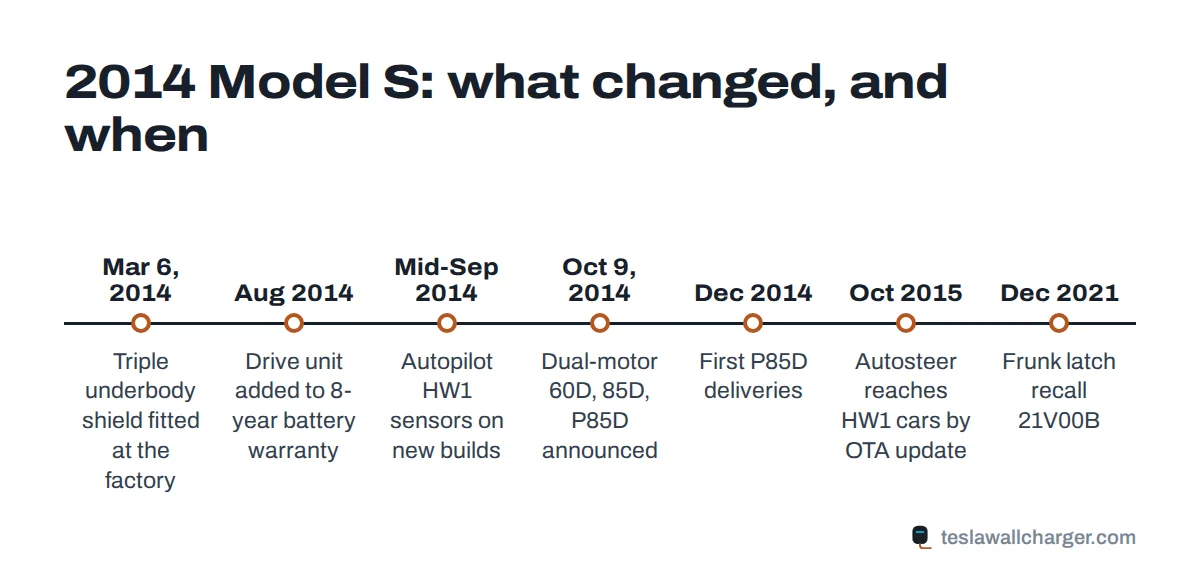
March 6, 2014. After two 2013 fires caused by road debris piercing the battery, Tesla raised ride height by software and began fitting a three-part shield under the pack: an aluminum bar, a titanium plate and an aluminum extrusion. Earlier cars could have it retrofitted free. NHTSA closed its investigation that same month. On an early-2014 car, ask for the retrofit record or look under the front of the pack on a lift.
August 2014. Drive units were failing often enough that Tesla extended their coverage to match the 8-year battery warranty, retroactively. That helped first owners. For you, it means any 2014 car has probably had at least one drive unit visit, and the extended cover has now run out.
Mid-September 2014. Autopilot hardware 1 went into production, and this is the change that matters most to a buyer today. More on it below.
The dual-motor announcement on October 9, 2014 came at the very end of the model year, and dual-motor deliveries only began in December.
Spotting an Autopilot car, and what HW1 does in 2026
HW1 is a single forward camera at the top of the windshield behind the mirror, a radar unit in the nose, 12 ultrasonic sensors in the bumpers and a Mobileye EyeQ3 processor. A pre-September car has no camera or radar at all. The camera housing behind the mirror is the quickest giveaway from outside the car.
On cars with the hardware, Autopilot features were an option and arrived by software after the sale: Autosteer and automatic lane change reached HW1 cars by over-the-air update in October 2015. Check the Autopilot settings screen during a test drive to see what is enabled. The December 2023 Autosteer recall, 23V838, added driver-engagement checks; a car that has been offline for years may need updating.
Do not expect more than those basics. HW1 is a Mobileye-based system, and Tesla has not offered these cars a move to its later Autopilot computers (HW2, HW2.5 or HW3), so later navigation and self-driving features are off the table. If those matter, start your search at the Tesla Model S 2016, where HW2 arrived in October.
2014 trims and EPA range
| Trim | EPA range | Efficiency | Home AC max | Price (USD) |
|---|---|---|---|---|
| 60 kWh | 208 mi | 35 kWh/100 mi | 9.6 kW | n/a |
| 85 kWh | 265 mi | 38 kWh/100 mi | 9.6 kW | n/a |
| Performance (P85 / P85+) | n/a | n/a | 9.6 kW | n/a |
| AWD 85 kWh (EPA listing) | 242 mi | 38 kWh/100 mi | 9.6 kW | n/a |
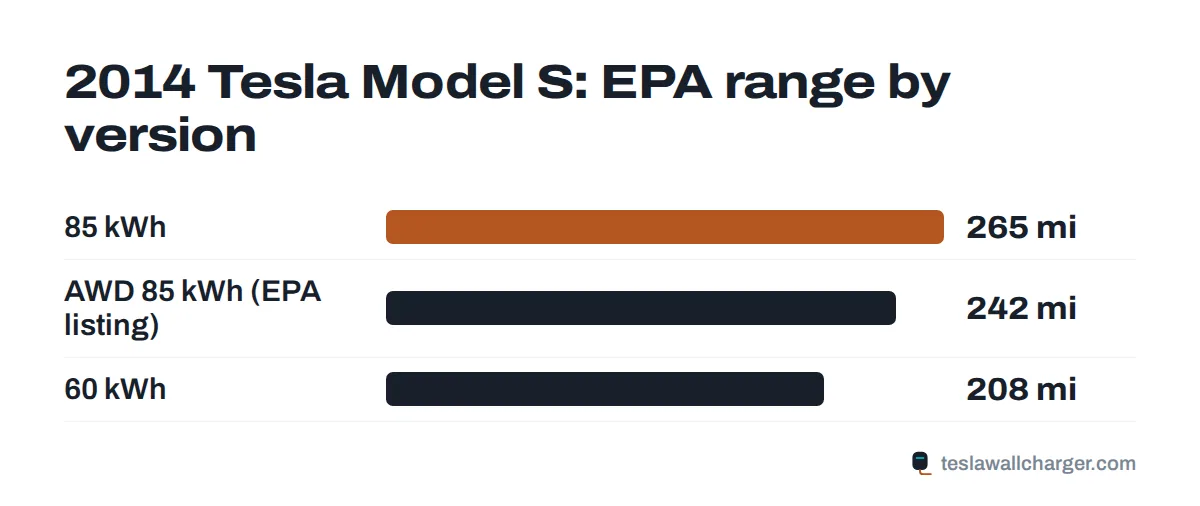
The 60 kWh car was rated at 208 miles and the 85 kWh car at 265, with consumption of about 35 and 38 kWh per 100 miles. The single-motor P85 (later P85+) used the 85 kWh pack; coverage from October 2014 quoted 0 to 60 mph in 4.2 seconds. EPA also lists a 2014 "Model S AWD (85 kWh)" at 242 miles; which dual-motor build that entry describes is not documented, so treat any "2014 85D" with care and confirm it by VIN.
Recalls, crash rating and owner complaints
NHTSA gave the 2014 rear-drive car 5 stars overall, with 5 stars in frontal, side and rollover tests and a 5.7% rollover risk.
| NHTSA test | Rating |
|---|---|
| Overall | 5 stars |
| Frontal crash | 5 stars |
| Side crash | 5 stars |
| Rollover | 5 stars |
| Rollover risk | 5.7% |
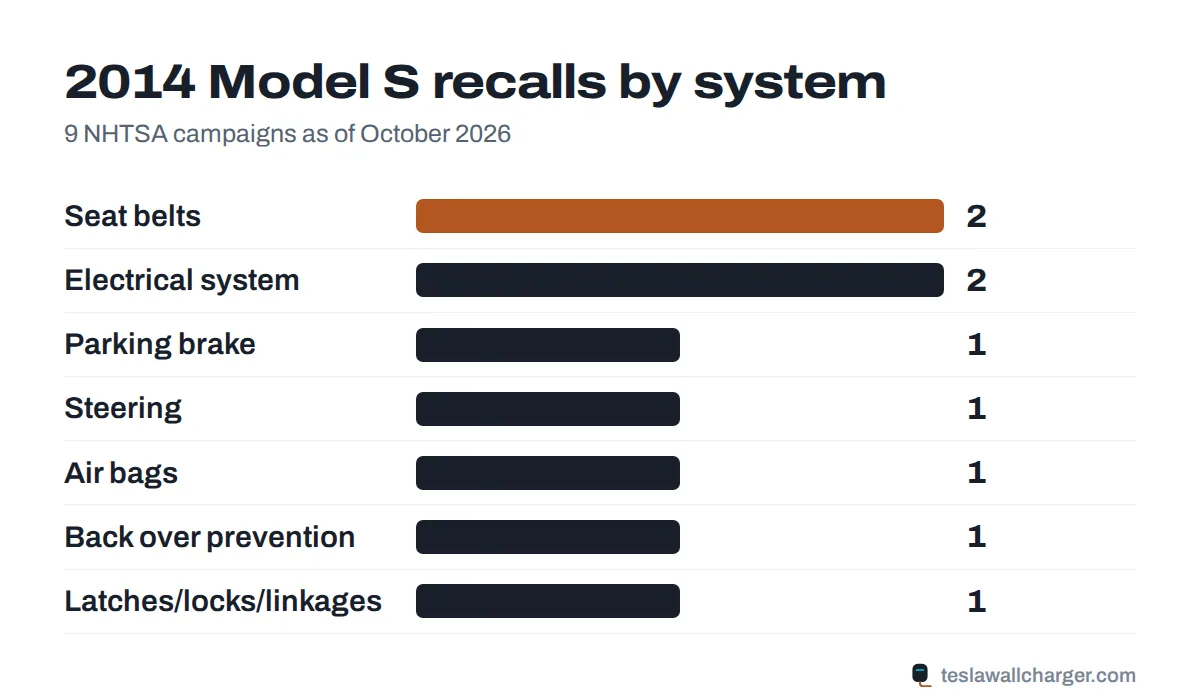
There are 9 recall campaigns. Two are specific to this era and worth singling out. Campaign 19V002 is the Takata passenger airbag inflator, whose propellant degrades over time; on a 12-year-old car that is the first one to confirm. Campaign 21V00B, from December 2021, found the front trunk latch could be misaligned so the secondary latch does not catch, which means the frunk lid could open while driving. Both need a service visit.
- 15V780000November 23, 2015Seat belts, frontService visit
Front seat belts may not be correctly attached to the outboard lap pretensioner - 17V260000April 19, 2017Parking brakeService visit
Electric parking brake caliper internal gear may break, leaving the car immobile or unable to hold position - 18V204000March 29, 2018Steering, electric power assist systemService visit
Aluminum bolts holding the power steering assist motor (Bosch rack) can corrode and break, reducing or removing power assist - 19V002000January 7, 2019Air bags, frontal, passenger side, inflator moduleService visit
Passenger frontal air bag inflator may rupture on deployment due to propellant degradation (Takata) - 21V035000January 29, 2021Back over prevention, softwareService visit
MCU1 touchscreen eMMC memory wear can cause loss of rearview camera, defrost/defog controls and exterior turn signal lighting; VCM daughterboard replaced (firmware 2020.48.48.12+ also advised) - 21V00B000December 21, 2021Latches/locks/linkages, hood, latchService visit
Front trunk (frunk) latch may be misaligned so the secondary latch does not engage; hood could open unexpectedly
Show all 9 recalls
- 23V838000December 12, 2023Electrical system, adas, autonomous/self driving, softwareSoftware update
Autosteer driver-engagement controls may be insufficient to prevent misuse (followed NHTSA EA22-002) - 24V051000January 30, 2024Electrical system, instrument cluster/panelSoftware update
Brake, park and ABS warning lights shown in a font too small to meet FMVSS 105/135 - 24V376000May 28, 2024Seat belts, front, warning light/devicesSoftware update
Driver seat belt warning light and chime may not activate when unbelted (FMVSS 208)
Source: NHTSA recalls API. A recall only applies if your VIN is listed.
Owners have filed 365 complaints with NHTSA for this year. Electrical faults lead, followed by suspension, steering, body structure and powertrain, which lines up with the screen, drive unit and steering-bolt issues already covered.
Setting up home charging for a 2014
Every 2014 car has a 40 A onboard charger; some were ordered with a second charger for 80 A. Plug in and read the maximum on the charging screen.
What to install, by situation:
- You have a 240 V dryer-style or 14-50 outlet already. Tesla's current Mobile Connector draws 32 A from a 14-50, which adds roughly 20 to 22 miles per hour. That refills a typical 40-mile day in about two hours. See charging a Tesla without a Wall Connector for other outlet types.
- You are adding a new circuit. A Gen 3 Wall Connector on a 50 A breaker gives a single-charger car its full 40 A (about 25 to 27 miles per hour). Run the circuit at 60 A if you might own a newer Tesla later; the unit's technical specs and our Mobile Connector vs Wall Connector comparison help you decide.
- The car has dual chargers and you want 80 A. That takes a Gen 2 Wall Connector, a 100 A breaker, 3 AWG copper and a disconnect within reach (NEC 625.43 applies above 60 A). Up to about 50 to 54 miles per hour, but it is a big install for a car whose pack holds 208 to 265 miles.
Any new circuit is a job for a licensed electrician with a permit. To see what a full charge costs on your utility rate, our Tesla charging cost guide uses the EIA's 18.31 cents per kWh national average for July 2026.
Quick checks before you buy a 2014
- Note the build month from the door-pillar label: before March 6 means checking for the shield retrofit, before mid-September means no Autopilot.
- Ask for recall 21V035 (or the MCU2 upgrade) paperwork. The MCU1 screen runs on an 8 GB memory chip that wears out, and when it goes, the backup camera and defrost controls go with it.
- Confirm 18V204, 19V002 and 21V00B are closed by running the VIN on NHTSA's recall lookup.
- Check for LTE. A 2014 car was built with a 3G modem, which went dark in 2022; Tesla's LTE retrofit cost $200.
- Get a battery health report, since the 8-year cover has ended.
For the dual-motor and Ludicrous-era cars that followed, see the 2015 Model S guide, or step back to the 2013 Tesla Model S if a lower price matters more than Autopilot.
Owners and shoppers ask about the 2014 Model S
Does the 2014 Tesla Model S have Autopilot?
Only cars built from about mid-September 2014. Those have Autopilot hardware 1: one forward camera, a front radar, 12 ultrasonic sensors and a Mobileye EyeQ3 chip. Traffic-aware cruise and Autosteer arrived later by software. Cars built before that date have no sensors, and Tesla never offered a retrofit, so check the build date and look for the camera behind the mirror.
What is the range of a 2014 Model S?
EPA rated the 60 kWh car at 208 miles and the 85 kWh car at 265 miles. EPA also lists a 2014 all-wheel-drive 85 kWh model at 242 miles, though it is unclear which dual-motor build that entry covers. A pack that is now over a decade old will show less, so ask to see the range at 100%.
Was there an all-wheel-drive 2014 Model S?
Tesla announced the dual-motor 60D, 85D and P85D on October 9, 2014, and the first P85D deliveries started in December 2014, with the 85D and 60D following in February 2015. EPA does list a 2014 AWD 85 kWh car. If a seller calls a car a 2014 85D, run the VIN to confirm the model year and drivetrain.
What recalls apply to the 2014 Model S?
NHTSA lists nine. The ones that need a service visit are the front seat belt pretensioner check, parking brake calipers, steering assist motor bolts (18V204), the Takata passenger airbag inflator (19V002), the MCU memory fix (21V035) and the frunk latch (21V00B). The rest were over-the-air software updates that any connected car should already have.
How do I charge a 2014 Model S at home?
A 240 V circuit is the answer. A standard car takes 40 A, so a Wall Connector set to 40 A on a 50 A breaker adds roughly 25 to 27 miles of range per hour. A NEMA 14-50 outlet with today's Mobile Connector gives about 20 to 22. Cars with dual chargers can take 80 A, but only from a Gen 2 Wall Connector.
Sources
- NHTSA recalls API, 2014 Tesla Model S, api.nhtsa.gov
- NHTSA SafetyRatings API, 2014 Model S (VehicleId 8787), api.nhtsa.gov
- Electric Cars Report: Model S P85D and Autopilot details (Oct 12, 2014), electriccarsreport.com
- TeslaTap: Autopilot processors and hardware (MCU/HW) demystified, teslatap.com
- Charged EVs: NHTSA closes Model S fire investigation; triple underbody shield (Mar 28, 2014), chargedevs.com
- Motor Authority: Model S drivetrain warranty extended to 8 years (Aug 18, 2014), motorauthority.com
- NHTSA PE20-010 opening resume: MCU eMMC failures, static.nhtsa.gov
- Tesla support: 3G cellular network retirement and LTE upgrade, tesla.com
Independent site. Not affiliated with or endorsed by Tesla, Inc. Tesla, Wall Connector and Supercharger are trademarks of Tesla, Inc.