The 2017 Tesla Model S is a facelifted car with a 48 A onboard charger, Autopilot hardware 2 or 2.5, and the original MCU1 screen computer. EPA range runs from 249 miles (75) to 335 miles (100D), and its 9 recalls are almost all over-the-air software fixes. For a used buyer it often hits the best balance of price and equipment among the 2012 to 2018 cars.
Where the 2017 sits between 2016 and 2018
Think of 2017 as a year of consolidation. The April 2016 facelift, the 48 A charger and the October 2016 switch to Autopilot HW2 all carry through unchanged, so you do not have to decode three different builds as you do with the mixed-build 2016 Model S. Every 2017 car has the camera suite.
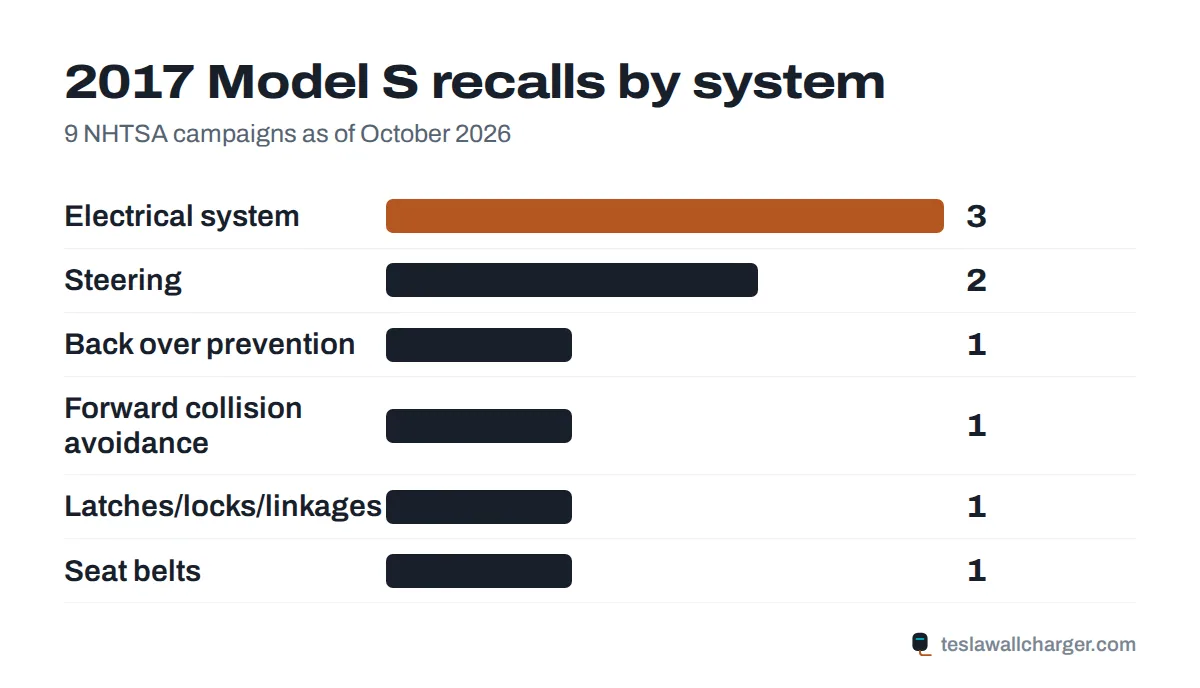
It also escapes several service recalls that hang over older cars. The NHTSA list for 2017 has no Takata airbag campaign, no corroded steering-bolt campaign and no parking-brake caliper campaign. Of its 9 recalls, only two need a service visit.
What it does not get is the newer media computer. MCU2, with its Intel Atom processor, 5 GHz Wi-Fi and newer Bluetooth, started on builds from about March 2018, so the 2018 Model S is the earliest year where you can find one from the factory. On a 2017, the touchscreen is slower and its 8 GB memory chip is the known weak point.
HW2 or HW2.5?
Tesla revised the Autopilot computer around August 2017. HW2.5 added redundancy and is what makes the dashcam and Sentry Mode video recording possible. Early 2017 cars have HW2.
Either version can be lifted to the HW3 computer for free, but only if Full Self-Driving was bought outright for that car. A subscription does not count. So a 2017 car with purchased FSD is worth more than the same car without it, by more than the paint and mileage suggest. To check what you have, look under Controls, Software, Additional Vehicle Information, or ask Tesla with the VIN.
2017 versions and EPA range
| Trim | EPA range | Efficiency | Home AC max | Price (USD) |
|---|---|---|---|---|
| 60 | 210 mi | 34 kWh/100 mi | 11.5 kW | n/a |
| 60D | 218 mi | 32 kWh/100 mi | 11.5 kW | n/a |
| 75 | 249 mi | 34 kWh/100 mi | 11.5 kW | $69,500 |
| 75D | 259 mi | 33 kWh/100 mi | 11.5 kW | $74,500 |
| 90D | 294 mi | 32 kWh/100 mi | 11.5 kW | $87,500 |
| 100D | 335 mi | 33 kWh/100 mi | 11.5 kW | $95,000 |
| P90D | 270 mi | 35 kWh/100 mi | 11.5 kW | n/a |
| P100D | 315 mi | 34 kWh/100 mi | 11.5 kW | $134,500 |
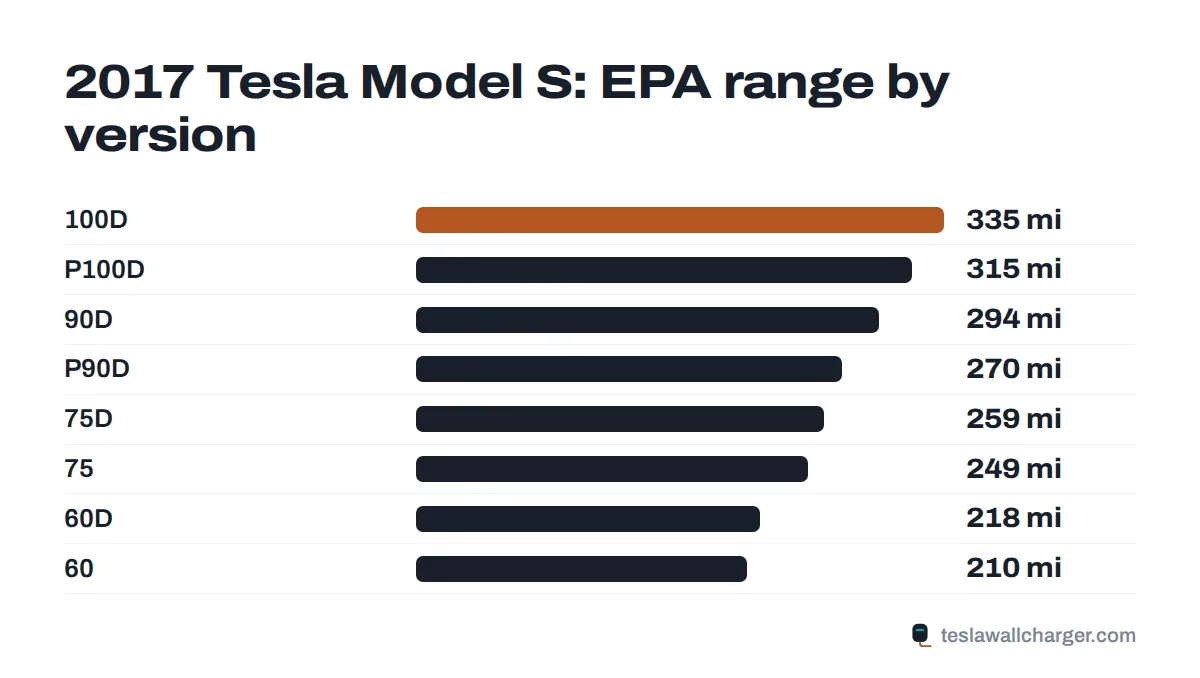
The line-up thinned out during the year. The 60 and 60D, which used software-limited 75 kWh packs, ended in March 2017, and the 75 became the entry car at $69,500 in April. The 90D was dropped during 2017. The 100D arrived early in the year and became the long-range pick at 335 miles; Tesla raised its price by $2,500 to $97,500 in April 2017, when the P100D went to $140,000.
For most buyers the choice comes down to a 75D (259 miles, about 33 kWh per 100 miles) or a 100D (335 miles, about the same efficiency). The 100D costs more but makes long trips far less dependent on Supercharger spacing.
How long a 2017 takes to charge at home
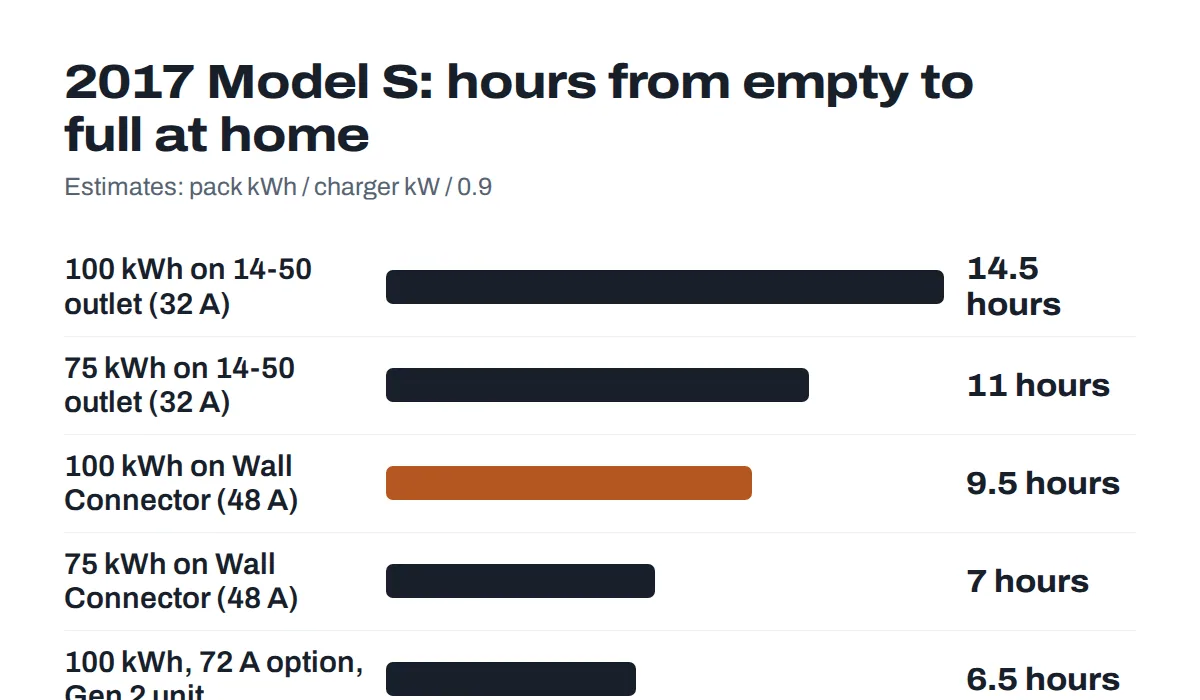
Every 2017 car accepts at least 48 A (11.5 kW), which is exactly what a Gen 3 Wall Connector delivers on a 60 A breaker. That pairing adds about 35 miles of range per hour by EPA-based estimates, so a 50-mile day is back in the battery in under 90 minutes. Tesla's current table for Model S at 48 A says up to 41 miles per hour, but that is for newer, more efficient cars.
Some 2017 cars were ordered with the optional 72 A charger. You will see 72 as the maximum on the charging screen. Using it means a Gen 2 Wall Connector on a 90 A breaker, which is a heavier, costlier circuit with its own disconnect rules. It adds about 52 miles per hour, but few owners need it. Our Tesla charger amps explainer lays out the breaker and wire pairings, and what an install costs covers the price drivers. Use a licensed electrician and get the permit.
If you already have a dryer-style or 14-50 outlet, the current Mobile Connector draws 32 A, about 23 miles per hour. That is enough for many commutes; see Wall Connector vs Mobile Connector for the trade-offs. To work out the monthly bill, use our home charging cost guide.
Away from home, older Model S may need a Tesla retrofit before the $300 CCS1 adapter will work at third-party fast chargers; Tesla prices the S/X retrofit with adapter at $380 (as of October 2026). Check eligibility for your VIN in the Tesla app first.
Recalls and crash data for 2017
The two service-visit recalls are 21V035, which replaces the MCU1 memory board, and 21V00B, which realigns the frunk latch so the secondary catch engages. The rest are software. Two of those matter on the road: 21V846 fixed a communication error that could trigger false forward-collision warnings or unexpected emergency braking, and 22V818 recalibrated the power steering so assist would not drop out after a pothole.
- 21V035000January 29, 2021Back over prevention, softwareService visit
MCU1 touchscreen eMMC memory wear can cause loss of rearview camera, defrost/defog controls and exterior turn signal lighting; VCM daughterboard replaced (firmware 2020.48.48.12+ also advised) - 21V846000October 29, 2021Forward collision avoidance, sensing system, cameraSoftware update
Software communication error may cause false forward-collision warnings or unexpected automatic emergency braking - 21V00B000December 21, 2021Latches/locks/linkages, hood, latchService visit
Front trunk (frunk) latch may be misaligned so the secondary latch does not engage; hood could open unexpectedly - 22V037000January 27, 2022Electrical system, adas, autonomous/self driving, softwareSoftware update
FSD (Beta) 'rolling stop' could let the car roll through all-way stop intersections; feature disabled - 22V818000November 1, 2022Steering, electric power assist systemSoftware update
Power steering assist may be lost on rough roads or after a pothole; EPAS recalibrated - 23V085000February 15, 2023Steering, automated/adaptive steeringSoftware update
FSD Beta may act unsafely around intersections and respond poorly to speed limit changes
Show all 9 recalls
- 23V838000December 12, 2023Electrical system, adas, autonomous/self driving, softwareSoftware update
Autosteer driver-engagement controls may be insufficient to prevent misuse (followed NHTSA EA22-002) - 24V051000January 30, 2024Electrical system, instrument cluster/panelSoftware update
Brake, park and ABS warning lights shown in a font too small to meet FMVSS 105/135 - 24V376000May 28, 2024Seat belts, front, warning light/devicesSoftware update
Driver seat belt warning light and chime may not activate when unbelted (FMVSS 208)
Source: NHTSA recalls API. A recall only applies if your VIN is listed.
NHTSA only rated the 2017 Model S for rollover (5 stars, 5.7% risk). The 75 and 75D are listed as not rated for overall, frontal and side crashes, so there is no full government score to compare.
379 owner complaints filed with NHTSA for the 2017 Model S. Source: NHTSA complaints database.
Who should buy a 2017
A 2017 suits someone who wants a capable long-range Model S with modern-looking styling and Autopilot, can live with or pay to replace the older screen computer, and charges at home. The battery warranty ended during 2025 for these cars, so pay for a health check before you agree a price. If a newer touchscreen is a must, stretch to a post-March 2018 build; otherwise compare the full set of Model S model years.
Things people ask about the 2017 Model S
What is the range of a 2017 Tesla Model S?
EPA ratings for 2017 run from 210 miles for the software-limited 60 up to 335 miles for the 100D. The 75 was rated at 249 miles, the 75D at 259, the 90D at 294 and the P100D at 315. Those were the numbers when new; ask to see the range estimate at a 100% charge to judge the pack today.
Does my 2017 Model S have HW2 or HW2.5?
Cars built from about August 2017 have HW2.5, a revised Autopilot computer with added redundancy; earlier 2017 builds have HW2. The practical difference today is that HW2.5 supports the dashcam and Sentry Mode video recording. Look under Controls, Software, Additional Vehicle Information on the touchscreen, or confirm with Tesla using the VIN.
Can a 2017 Model S get HW3?
Yes, if Full Self-Driving was purchased for that car. Tesla offered HW2 and HW2.5 cars with paid FSD a free swap to the HW3 computer. A Full Self-Driving subscription does not qualify. If FSD shows as purchased on the car but the computer is still HW2.5, ask Tesla service whether the upgrade is still open for that VIN.
Does the 2017 Model S have MCU1 or MCU2?
Every 2017 Model S left the factory with MCU1, the Tegra 3 media computer whose eMMC memory chip wears out. MCU2 only arrived on builds from about March 2018. A 2017 car may have been upgraded since through Tesla's paid Infotainment Upgrade, which also brings a faster screen. Otherwise, check that recall 21V035 was done.
How long does a 2017 Model S take to charge at home?
On a 48 A Wall Connector, a 75 kWh car goes from empty to full in about 7 hours and a 100 kWh car in about 9.5 hours, by our estimate. From a NEMA 14-50 outlet at 32 A, allow roughly 11 and 14.5 hours. Most nights you are only topping up, so a few hours is typical.
Sources
- NHTSA recalls API, 2017 Tesla Model S, api.nhtsa.gov
- NHTSA SafetyRatings API, 2017 Model S 75 RWD (VehicleId 11809), api.nhtsa.gov
- Motor Authority: Model S/X 100D price hikes (Apr 20, 2017), motorauthority.com
- Consumer Guide: 2017 Tesla Model S, consumerguide.com
- TeslaTap: Autopilot processors and hardware (MCU/HW) demystified, teslatap.com
- Drive Tesla Canada: MCU upgrade price change for AP2.0/2.5 cars, driveteslacanada.ca
- NHTSA EA20-003 opening resume: MCU eMMC failures, static.nhtsa.gov
- Tesla support: Wall Connector charging speeds, tesla.com
Independent site. Not affiliated with or endorsed by Tesla, Inc. Tesla, Wall Connector and Supercharger are trademarks of Tesla, Inc.