The 2013 Tesla Model S came with a 60 or 85 kWh battery, plus a short-lived "40" that was really a capped 60. EPA range was 208 or 265 miles (139 for the 40), every car is rear-wheel drive with no Autopilot hardware, and it carries a 5-star NHTSA crash rating. The pack decides almost everything about how useful one is today, so identify it before you look at anything else.
Which battery is it? 40, 60, 85 or Performance
Tesla raised prices by $2,500 for orders from January 1, 2013, and made 12-way heated front seats standard. The price ladder ran $59,900 for the 40, $69,900 for the 60, $79,900 for the 85 and $94,900 for the Performance car, a P85 with the same 85 kWh pack.
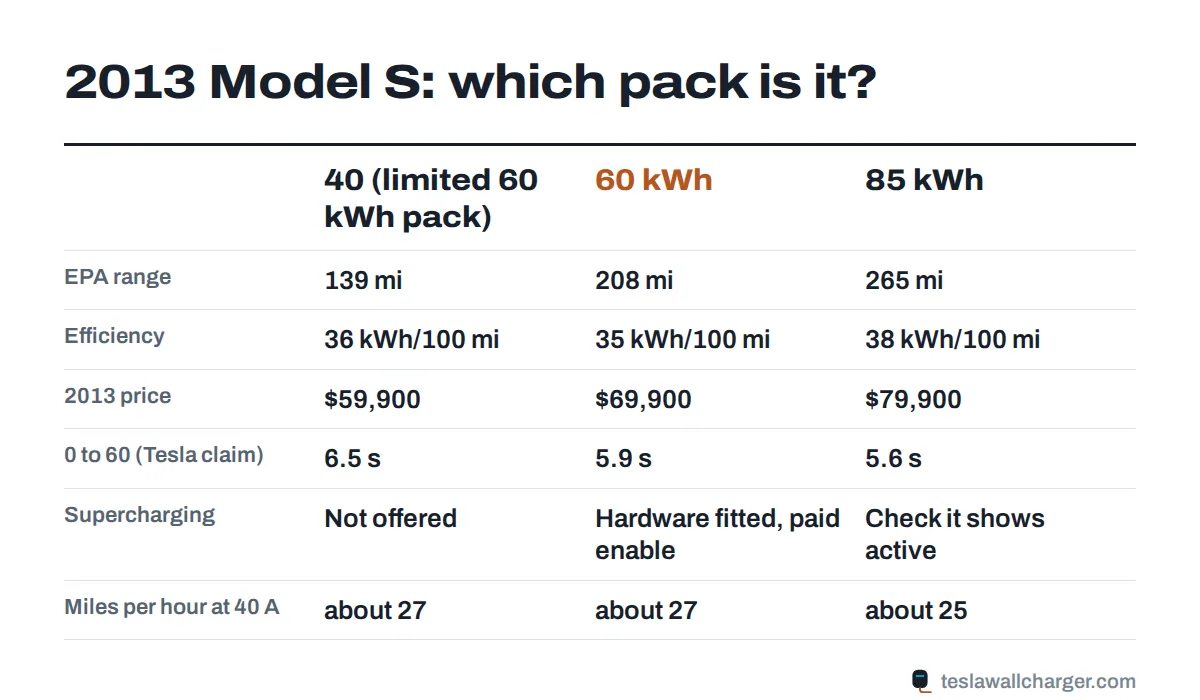
The 40 did not last. On April 1, 2013 Tesla said only 4% of buyers wanted it and stopped offering it. Customers who had already ordered one got a 60 kWh pack with software holding usable capacity to 40 kWh, which Tesla could raise later. So a car advertised as a 2013 "40" is either still capped or has been upgraded, and the badge on the trunk proves nothing. The range shown at 100% charge is the honest test.
The 60 has its own trap. All 60 kWh cars were built with Supercharger hardware, but Supercharging was a paid option. A 60 that never had it switched on is limited to Level 2 charging on road trips. Confirm the status with Tesla using the VIN.
| Trim | EPA range | Efficiency | Home AC max | Price (USD) |
|---|---|---|---|---|
| 40 kWh | 139 mi | 36 kWh/100 mi | 9.6 kW | $59,900 |
| 60 kWh | 208 mi | 35 kWh/100 mi | 9.6 kW | $69,900 |
| 85 kWh | 265 mi | 38 kWh/100 mi | 9.6 kW | $79,900 |
| Performance (P85) | n/a | n/a | 9.6 kW | $94,900 |
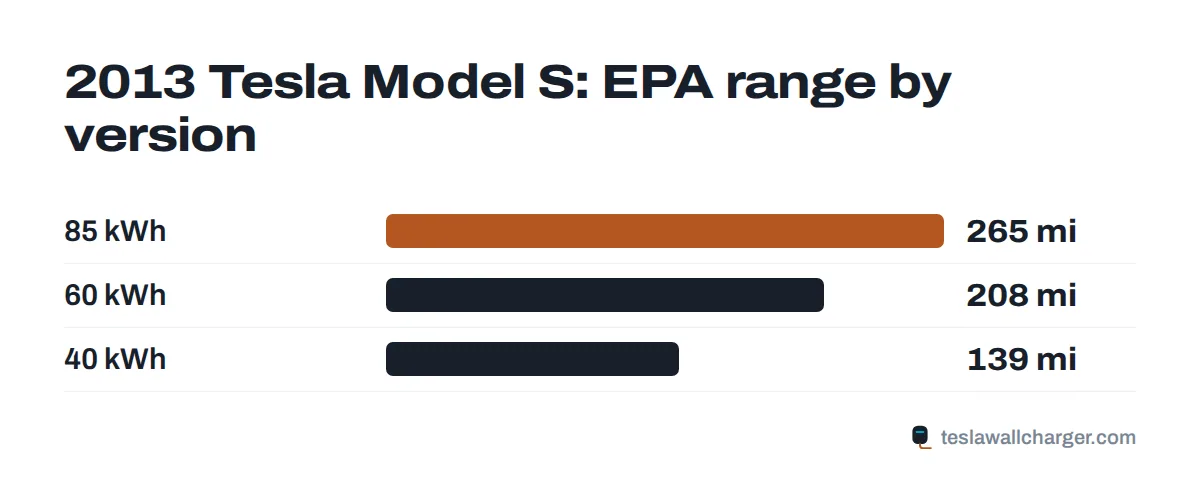
EPA did not publish a separate figure for the P85, which uses the 85 kWh pack and so sits near the 85's 265 miles. Efficiency differences between packs are small: about 35 to 38 kWh per 100 miles across the range, which is noticeably thirstier than any 2019 Model S or later car.
Crash rating and the 11 recalls
NHTSA tested the 2013 rear-drive Model S and gave it 5 stars overall, 5 for frontal and side crashes, and 5 for rollover with a calculated 5.7% rollover risk. For a car this old, that is a strong result.
| NHTSA test | Rating |
|---|---|
| Overall | 5 stars |
| Frontal crash | 5 stars |
| Side crash | 5 stars |
| Rollover | 5 stars |
| Rollover risk | 5.7% |
The recall list is longer than the 2012 car's because more 2013s were built and a few early issues surfaced on them first. Campaign 13V249 covered a misaligned left second-row seat-back striker that could weaken a bracket weld. Campaign 14V006 is the one with a direct link to home charging (more below). The Takata passenger airbag campaign for this year is 18V031, and the steering-bolt campaign 18V204 applies too.
- 13V249000June 14, 2013SeatsService visit
Left second-row seat back striker may be misaligned, weakening its bracket weld so the seat back could detach in a crash - 14V006000January 13, 2014Equipment, electricalSoftware update
NEMA 14-50 charging adapter, cord or outlet may overheat while charging, risking burns or fire; OTA update plus a replacement adapter sent to owners - 15V780000November 23, 2015Seat belts, frontService visit
Front seat belts may not be correctly attached to the outboard lap pretensioner - 17V260000April 19, 2017Parking brakeService visit
Electric parking brake caliper internal gear may break, leaving the car immobile or unable to hold position - 18V031000January 9, 2018Air bags, frontal, passenger side, inflator moduleService visit
Passenger frontal air bag inflator may rupture on deployment (Takata) - 18V204000March 29, 2018Steering, electric power assist systemService visit
Aluminum bolts holding the power steering assist motor (Bosch rack) can corrode and break, reducing or removing power assist
Show all 11 recalls
- 21V035000January 29, 2021Back over prevention, softwareService visit
MCU1 touchscreen eMMC memory wear can cause loss of rearview camera, defrost/defog controls and exterior turn signal lighting; VCM daughterboard replaced (firmware 2020.48.48.12+ also advised) - 23V838000December 12, 2023Electrical system, adas, autonomous/self driving, softwareSoftware update
Autosteer driver-engagement controls may be insufficient to prevent misuse (followed NHTSA EA22-002) - 24V051000January 30, 2024Electrical system, instrument cluster/panelSoftware update
Brake, park and ABS warning lights shown in a font too small to meet FMVSS 105/135 - 24V153000February 27, 2024Forward collision avoidance, warnings, external/pedestrian alertSoftware update
A factory reset could mute the Pedestrian Warning System sounds (fixed in 2023.44.30.14) - 24V376000May 28, 2024Seat belts, front, warning light/devicesSoftware update
Driver seat belt warning light and chime may not activate when unbelted (FMVSS 208)
Source: NHTSA recalls API. A recall only applies if your VIN is listed.
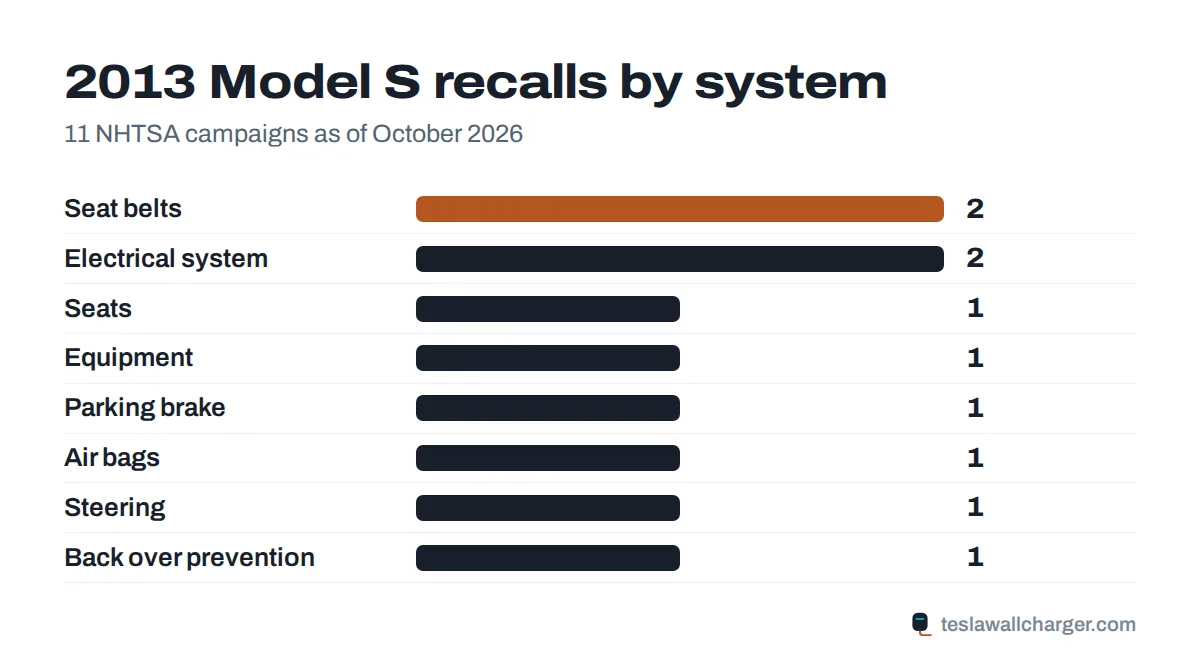
NHTSA holds 459 owner complaints for the 2013 Model S, led by electrical faults, then powertrain, suspension and steering. You can read them on the NHTSA 2013 Model S page to see the patterns in owners' own words.
The 14-50 adapter recall and charging a 2013 at home
In January 2014 Tesla recalled the NEMA 14-50 charging adapter after reports that the adapter, the cord or the wall outlet itself could overheat. The remedy came in two parts: an over-the-air update that changed how the car manages charging current, and a replacement adapter sent to owners. The software side is on every car that has taken updates since. The hardware side is the reason not to trust an original adapter that turns up in the trunk of a used car.
That recall is also a reminder of why hardwired charging is the better long-term setup. A Wall Connector compared with a NEMA 14-50 outlet avoids the receptacle, the plug contact and the GFCI questions the 2020 NEC raised for garage outlets.
Every 2013 car has a 40 A onboard charger (9.6 kW). Some have the optional second charger, for 80 A (19.2 kW). Look at the max amps on the charging screen to see which you have.
| Charging setup | 85 kWh car | 60 kWh car |
|---|---|---|
| Current Mobile Connector on a 14-50, 32 A | about 20 mi per hour | about 22 mi per hour |
| Wall Connector, 40 A single charger | about 25 mi per hour, 12 h full (EPA) | about 27 mi per hour, about 7 h full |
| Gen 2 Wall Connector, 80 A dual chargers | about 50 mi per hour, 5 h full (EPA) | about 54 mi per hour |
Figures are approximate and based on EPA consumption. For a single-charger car, a Gen 3 Wall Connector on a 50 A breaker (40 A output) matches the car exactly. If you want to keep the circuit useful for a newer Tesla later, a 60 A breaker with 6 AWG THWN-2 copper (75 C-rated breaker) lets the same unit deliver 48 A; our guide to amps and breaker sizing shows how the pairings work. Hire a licensed electrician and pull the permit either way; typical Tesla charger installation prices run $750 to $1,500 on Tesla's own estimate.
Dual-charger cars only see 80 A from a Gen 2 Wall Connector on a 100 A breaker, which is rarely worth the heavier wiring for a car with a 208 to 265 mile pack. Charging time by charger type explains why most owners never miss the extra speed overnight.
The expensive failures to price in
The drive unit story most often quoted about the classic Model S involves a 2013 car: Edmunds' long-term Model S had its drive unit replaced three times in about 18 months. In August 2014 Tesla extended drive unit coverage to the 8-year battery terms, retroactively. For a 2013 car, those 8 years ended in 2021. The battery warranty, 8 years and unlimited miles on the 85 or 125,000 miles on the 60, has also expired.
The touchscreen is the other big-ticket item. MCU1's 8 GB eMMC memory chip wears out from years of writes, and when it fails you can lose the backup camera and defrost controls along with the map. Recall 21V035 swaps the daughterboard holding that memory; the paid Infotainment Upgrade replaces the whole computer with MCU2. Either one should be documented.
Smaller items: a 3G-only modem that needs the $200 LTE retrofit for connectivity, the titanium underbody shield retrofit offered free from 2014, and the 2019 battery-software throttling that NHTSA reviewed under petition DP19-005.
Who a 2013 Model S suits
It suits a confident owner who wants a large, quick electric hatchback for local driving, has a garage for a 240 V circuit and keeps a repair fund. It does not suit someone who needs driver assistance, or a buyer who expects new-car reliability. Compare it with the 2014 Tesla Model S, where late builds add Autopilot hardware, and with the full list of Model S years.
2013 Model S questions from buyers
What is the range of a 2013 Tesla Model S?
EPA rated the 2013 car at 265 miles with the 85 kWh pack, 208 miles with the 60 kWh pack and 139 miles for the 40 kWh version. Those were new-car figures. After more than a decade, expect less; ask the seller to show the estimated range at a 100% charge and compare it with the rating for that pack.
Was there really a 40 kWh 2013 Model S?
Yes, but not as a separate battery. Tesla dropped the 40 kWh option in April 2013 after only about 4% of buyers chose it. People who had ordered one received a 60 kWh pack limited by software to 40 kWh, which Tesla could later raise. A car sold as a '40' may still carry that cap.
Can a 2013 Model S 60 use Superchargers?
Every 60 kWh car left the factory with the Supercharger hardware, but Tesla charged extra to turn it on. Some owners paid, some did not. Check the car's charging settings or ask Tesla with the VIN before you buy, because a 60 without Supercharging is a much less useful road-trip car.
What was the 2013 Model S 14-50 adapter recall?
Campaign 14V006, filed in January 2014, said the NEMA 14-50 adapter, cord or wall outlet could overheat while charging. Tesla fixed it with an over-the-air change to the car's charging-current logic plus a replacement adapter for owners. Treat any original adapter that comes with a used car as suspect.
How long does a 2013 Model S take to charge at home?
On a Wall Connector with the standard 40 A charger, EPA put a full charge of the 85 kWh car at about 12 hours; a 60 kWh car takes roughly 7 hours by our estimate. With the optional dual chargers and an 80 A Gen 2 Wall Connector, the 85 kWh car fills in about 5 hours.
Is the 2013 Model S reliable?
Not by modern standards. Edmunds' own long-term 2013 Model S needed three drive units in about 18 months, and Consumer Reports dropped its recommendation in 2015. Many survivors have had those parts replaced already. Service records showing a newer drive unit, a fixed screen and closed recalls are worth more than low miles.
Sources
- NHTSA recalls API, 2013 Tesla Model S, api.nhtsa.gov
- NHTSA SafetyRatings API, 2013 Model S (VehicleId 7769), api.nhtsa.gov
- Tesla press release: Model S sales exceed target; 40 kWh option dropped (Apr 1, 2013), ir.tesla.com
- Motor Authority: Tesla reprices the 2013 Model S, motorauthority.com
- Engadget: Tesla adds drive unit to infinite-mile warranty after Edmunds report (Aug 15, 2014), engadget.com
- NHTSA EA20-003 opening resume: MCU eMMC failures, static.nhtsa.gov
- Teslarati: Model S battery warranty (60 kWh 125k mi, 85 kWh unlimited), teslarati.com
- TeslaTap: onboard chargers (classic Model S 40 A, optional dual 80 A), teslatap.com
Independent site. Not affiliated with or endorsed by Tesla, Inc. Tesla, Wall Connector and Supercharger are trademarks of Tesla, Inc.