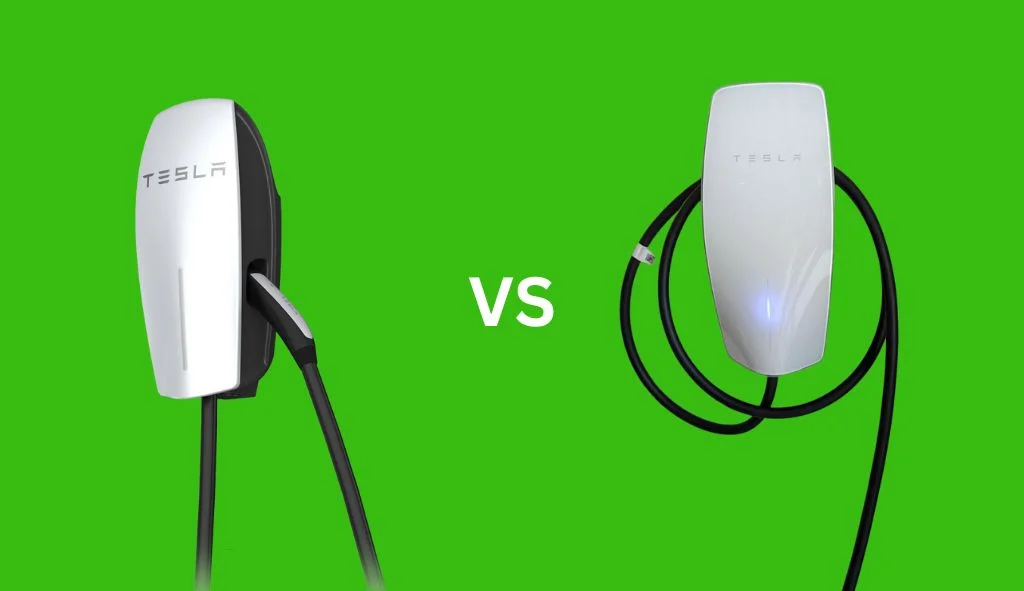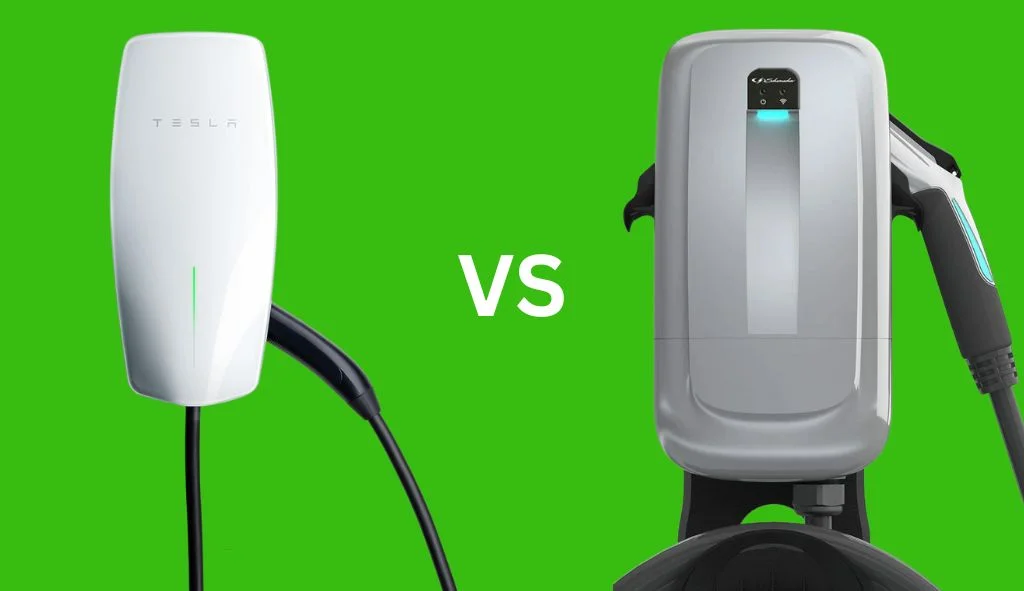
A hardwired Tesla Wall Connector on a 60 A breaker charges at 48 A, up to 44 miles of range per hour. A NEMA 14-50 outlet with the Mobile Connector stops at 32 A, about 30 mi/hr. In the NEMA 14-50 vs Tesla Wall Charger debate, speed used to be the only real difference, since the outlet was cheaper. That is no longer true for most garages.
Two changes moved the needle. The 2020 National Electrical Code (NEC) pulled 240 V garage receptacles into the GFCI rule, and Tesla now quotes the same installation range for a new 240 V outlet as for a Wall Connector. Once you add a 50 A GFCI breaker to the outlet side, the "cheap option" often costs about the same as the hardwired one and charges slower.
How the two setups differ in practice
A NEMA 14-50 is a 240 V, 50 A receptacle, the same type used for electric ranges and RV hookups. You plug Tesla's Mobile Connector into it with the 14-50 adapter, and the car draws up to 32 A. The NEC treats EV charging as a continuous load, so the charger may only pull 80% of the breaker rating: 50 A x 0.8 = 40 A in theory, and the Mobile Connector is capped lower still at 32 A.
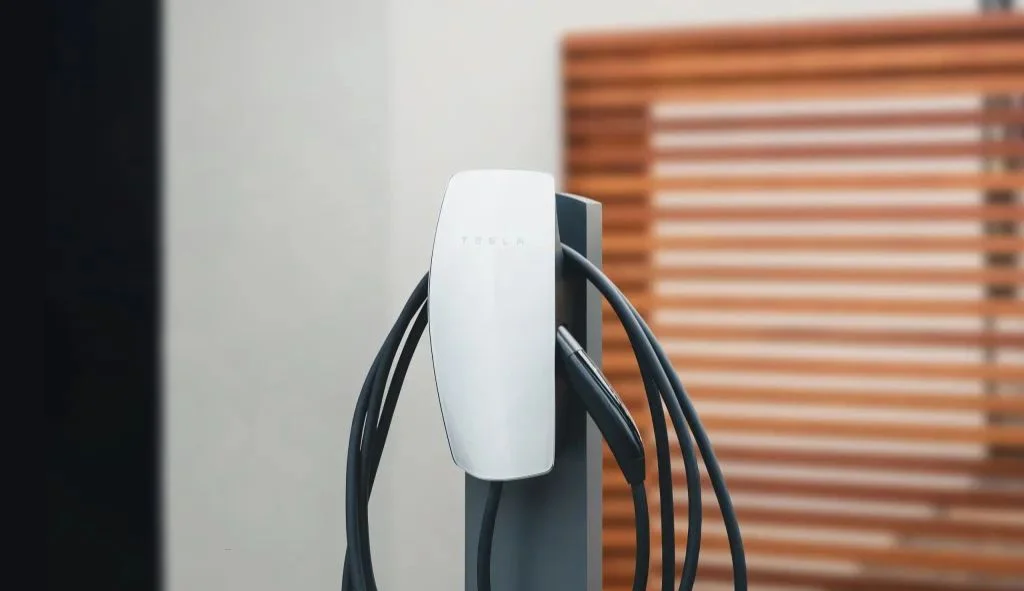
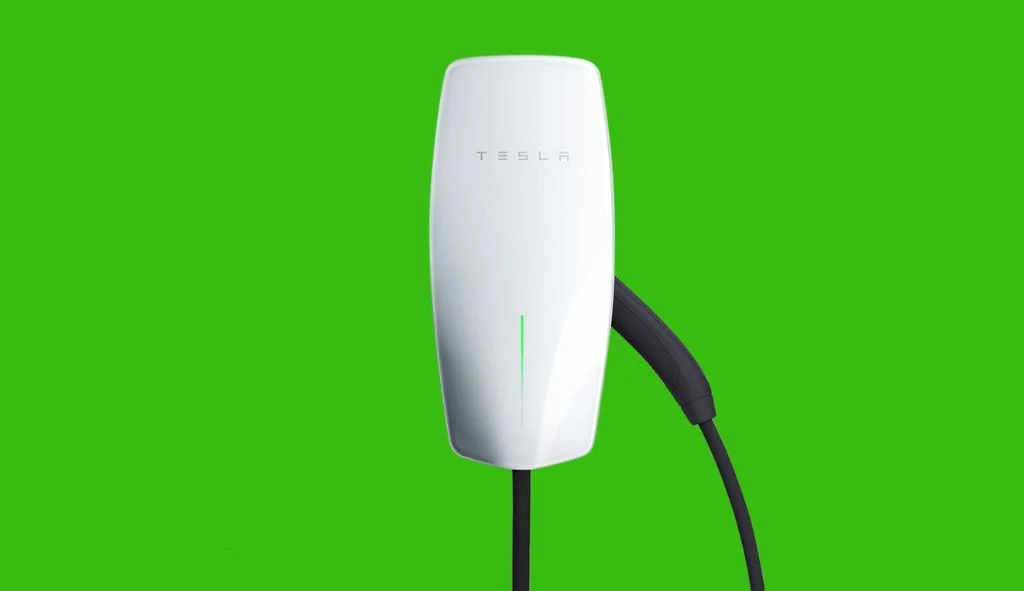
A Tesla Wall Connector (Gen 3) is wired straight to its own branch circuit. On a 60 A two-pole breaker it delivers 48 A, or 11.5 kW. It is commissioned in software to match whatever breaker the electrician installs, from 15 A up to 60 A, and it has a 24 ft cable compared with the Mobile Connector's 20 ft.
What "NEMA 14-50" means
NEMA is the National Electrical Manufacturers Association, which standardizes plug and receptacle shapes. The "14" is the configuration family: 125/250 V with four wires (two hots, a neutral and a ground). The "50" is the current rating in amps. A 14-50R is the receptacle on the wall; a 14-50P is the plug on the adapter or cord.
Charging speed by Tesla model
The gap between the two depends entirely on your car's onboard charger. Long Range, Premium and Performance trims accept 48 A. The base Model 3 (RWD or Standard) and base Model Y Standard trims stop at 32 A, so for those cars a Wall Connector at 60 A charges no faster than a 14-50.
| Vehicle | 14-50 + Mobile Connector (32 A) | Wall Connector, 60 A breaker (48 A) |
|---|---|---|
| Model 3 Long Range, Premium, Performance | 30 mi/hr | 44 mi/hr |
| Model 3 RWD or Standard (32 A car) | 30 mi/hr | 30 mi/hr |
| Model Y Premium, Performance | 27 to 30 mi/hr | 44 mi/hr |
| Model Y Standard RWD or AWD (32 A car) | 27 to 30 mi/hr | 30 mi/hr |
| Model S | 27 mi/hr | 41 mi/hr |
| Model X | 23 mi/hr | 35 mi/hr |
| Cybertruck (Premium AWD) | about 20 mi/hr | 30 mi/hr |
Figures come from Tesla's own support tables. Tesla's Mobile Connector table and its Wall Connector table list Model Y at 27 and 30 mi/hr respectively for the same 32 A, which is why that row shows a range. To check what your car accepts, tap the lightning bolt on the touchscreen while plugged in and look at the maximum amps. Our guide to Tesla charging time by charger turns these rates into hours for common battery sizes.

Does the extra speed matter?
For a typical commute, rarely. A worked example for a Model Y Premium driven 60 miles a day:
- On a 14-50: 60 mi / 27 mi/hr = about 2.2 hours of charging per night
- On a Wall Connector at 48 A: 60 mi / 44 mi/hr = about 1.4 hours
Both finish long before morning. The difference shows up after a road trip or a 250-mile day: 250 / 27 = about 9.3 hours on the outlet versus 250 / 44 = about 5.7 hours on the Wall Connector. If you regularly arrive home late and leave early, or two drivers share one charger, those three to four hours count.
GFCI rules for 240 V garage receptacles
This is the part most comparison articles skip, and it is the main reason the advice has changed.
NEC 2020, section 210.8(A). For homes, the GFCI requirement used to cover only 125 V, 15 A and 20 A receptacles in garages. The 2020 edition widened it to all 125 V through 250 V receptacles on single-phase circuits of 150 V or less to ground, in garages, accessory buildings and the other listed locations. A 14-50 in an attached garage falls squarely under that. The 50 A cap you may have seen applies to non-dwelling buildings under 210.8(B), not to houses.
NEC 2023, section 625.54. The 2023 edition adds a rule specific to EV charging: receptacles installed for charging electric vehicles must be GFCI-protected, regardless of location.
What this means for a new 14-50 in a garage built to NEC 2020 or 2023:
- The circuit needs a 50 A two-pole GFCI breaker (or another listed GFCI device), which is a far more expensive part than a standard two-pole breaker.
- The Mobile Connector, like every EV charger, already has its own ground-fault protection (a charge circuit interrupting device, or CCID). Stacking a GFCI breaker on top of it is a common source of nuisance tripping. Owners of several EV brands report the breaker opening mid-charge with no fault in the car or wiring. Tesla has not published guidance on this, so treat it as a widely reported complaint rather than a documented defect, but plan for it.
- States adopt NEC editions on their own schedule and sometimes amend them. Your local authority having jurisdiction (AHJ), meaning the building department that issues the permit, decides what applies.
Why a hardwired Wall Connector avoids this. A hardwired charger is not a receptacle, so the 210.8 receptacle rule does not apply to it. The Gen 3 Wall Connector carries its own CCID20 ground-fault protection inside the unit, which is what the listing requires.

Why many electricians now prefer hardwiring
Put the GFCI rules together with how receptacles behave under hours of continuous current and the reasoning is straightforward:
- No GFCI breaker cost and no nuisance trips. The protection lives inside the Wall Connector.
- No receptacle to wear out or overheat. A 14-50 carrying 32 A for hours every night is working harder than one feeding a range. Cheap residential-grade receptacles and loose terminal screws are a known source of heat damage, which is why electricians who do install outlets pick industrial-grade 14-50Rs and torque the terminals to spec. Tesla's Gen 2 Mobile Connector even has a dedicated warning code for a hot wall plug.
- More power from the same copper. On a 60 A breaker the Wall Connector delivers 48 A; the outlet route never gets above 32 A with the Mobile Connector.
- One fewer conductor. The Wall Connector needs two hots and a ground, no neutral. A 14-50 is a four-wire device, so the circuit has to carry a neutral even though the car charges between the two hot legs.
This lines up with Tesla's own position: its Mobile Connector support page calls the Wall Connector its "recommended charging solution" for home.
What it costs as of October 2026
Hardware prices come from the Tesla Shop; both items were listed out of stock in October 2026, so check availability before you book an electrician.
| Item | 14-50 route | Wall Connector route |
|---|---|---|
| Charging hardware | Mobile Connector $300 (includes 5-15 and 14-50 adapters) | Gen 3 Wall Connector $585 |
| Installation (Tesla's estimate, standard job) | New 240 V outlet $750 to $1,500 | Wall Connector $750 to $1,500 |
| Garage GFCI protection | 50 A GFCI breaker, extra cost | Not needed (built in) |
| Permit | Usually required | Usually required |
Worked example with Tesla's figures: at the low end, $300 + $750 = $1,050 for the outlet route before the GFCI breaker, against $585 + $750 = $1,335 for the Wall Connector. The visible gap is $285, and the GFCI breaker eats a good part of it. If you already own a Mobile Connector, for example one that came with a car ordered before April 2022, the outlet route saves more.
Anything beyond a short, simple run (a long trench, a subpanel, a service upgrade) adds the same cost to either option. Our breakdown of what electricians charge to install a Wall Connector covers those extras. The federal 30C charger credit no longer helps here: the IRS says it cannot be claimed for property placed in service after June 30, 2026.
Reusing an existing 14-50 circuit
Many owners already have a 14-50 from an earlier EV or an RV. That circuit is often the cheapest path to a Wall Connector, because the expensive part (the run from the panel) is done.
A typical 14-50 circuit is a 50 A two-pole breaker with 6 AWG copper. An electrician can:
- Turn off and verify the circuit is dead.
- Remove the receptacle and terminate the two hots and the ground in the Wall Connector's wirebox. The neutral is capped off; the Wall Connector does not use it.
- Commission the Wall Connector for a 50 A breaker, which gives 40 A output, 9.6 kW, about 37 mi/hr on a Model 3 Long Range.
Moving that circuit to 60 A and the full 48 A depends on the wire. Tesla's manual calls for at least 6 AWG 90 C THWN-2 copper with a 75 C-rated breaker, or 4 AWG with a 60 C-rated breaker. A 6 AWG NM-B cable (ordinary sheathed house wire) is rated at 55 A at 60 C, and whether it may sit on a 60 A breaker for a 48 A charger is argued about among electricians. That is not a call to make yourself. If the wire can't support 60 A, 40 A is still a solid result. See our page on breaker and wire sizing for the full table.
When a 14-50 outlet still makes sense
Hardwiring is not the right answer for everyone. An outlet is still reasonable when:
- The outlet already exists and works. An outlet installed legally under an older code edition generally does not have to be brought up to the newer GFCI rule, though your electrician or AHJ has the final word. Tesla's portable Mobile Connector on an existing 14-50 is a good setup.
- You rent. A Mobile Connector leaves with you. A landlord may also be more willing to approve an outlet.
- The circuit has other jobs, such as an RV or a welder that uses a 14-50P.
- Your car is a 32 A model, so the Wall Connector's extra current goes unused.
If you plan to own a non-Tesla EV later, note that a standard Wall Connector has a Tesla (NACS) plug; a J1772 car needs an adapter or Tesla's universal wall charger. The details are in our guide to whether Wall Connectors work with other EVs.
The 2019 plug-in Wall Connector
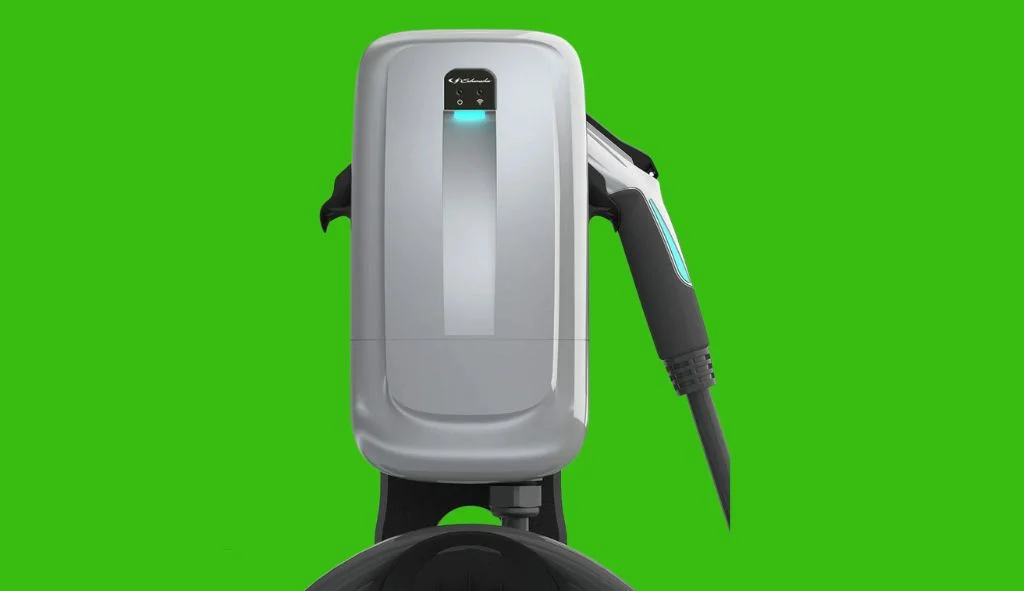
Searches for a "Tesla Wall Connector with a NEMA 14-50 plug" trace back to January 2019, when Tesla sold a Wall Connector with a 14-50 plug, limited to 40 A, for $500. It is not part of the current lineup. Today's Gen 3 manual states plainly: "Do NOT install cord-and-plug type connections." Fitting a Gen 3 with an aftermarket cord and plug goes against that instruction and should not pass inspection.
Multiple EVs on one panel
Two cars on two 14-50 outlets means two 50 A circuits, and each counts fully against your service capacity. Gen 3 Wall Connectors can share power: up to 6 units on separate branch circuits split an allocated amount of current between them over Wi-Fi. NEC 625.42 lets an energy management system like this limit the load counted for service sizing, which can avoid a panel upgrade. The older claim that 16 units can share power came from an early manual; Tesla's current documentation says 6.
Decision checklist
Pick the Wall Connector if most of these are true:
- Your Tesla accepts 48 A (Long Range, Premium, Performance, Model S or X, Cybertruck)
- The charger will be in a garage or outside, where a new receptacle needs GFCI protection
- You drive more than about 150 miles on some days, or two cars share the charger
- You own the home and want a permanent install
- You may add a second EV and want power sharing
Pick a 14-50 outlet if most of these are true:
- A working 14-50 is already installed
- Your car is a 32 A model
- You rent or expect to move soon
- The receptacle also serves an RV or other equipment
Either way, hire a licensed electrician, pull the permit and have the work inspected. Our walkthrough of a professional Wall Connector install covers what that visit should include, and if you go the outlet route, read up on Level 1 charging at home and other outlet options first.
Questions owners ask before choosing an outlet or a Wall Connector
How fast does a NEMA 14-50 charge a Tesla?
With Tesla's Mobile Connector the car draws 32 A at 240 V, about 7.7 kW. Tesla rates that at roughly 30 miles of range per hour for a Model 3, 27 for a Model S or Model Y and 23 for a Model X. An empty-to-full charge on a long-range car takes most of a night, which is fine for typical daily driving.
Does a NEMA 14-50 in a garage need GFCI protection?
Under the 2020 NEC, section 210.8(A) extended dwelling GFCI protection to 125 V through 250 V receptacles in garages and accessory buildings, which covers a 14-50. The 2023 NEC also requires GFCI protection for receptacles installed for EV charging (625.54). Your local inspector decides which edition applies where you live.
Can you plug a Tesla Wall Connector into a NEMA 14-50 outlet?
Not the current Gen 3 unit. Its installation manual says not to install cord-and-plug connections, so it must be hardwired. Tesla did sell a Wall Connector with a 14-50 plug in 2019, limited to 40 A, but it is no longer in the lineup. A plug-in setup today means the Mobile Connector or a third-party charger.
Can I swap my 14-50 outlet for a Wall Connector later?
Usually yes. If the existing circuit is a 50 A breaker with suitable copper wire, an electrician can remove the receptacle, mount a Wall Connector and set it to a 50 A breaker for 40 A output. Going to 60 A and 48 A only works if the wire size and type support it, which the electrician must confirm.
What is the difference between a 14-50R and a 14-50P?
The R stands for receptacle, the part mounted in the wall. The P stands for plug, the male end on the cord or adapter. The 14 identifies the four-wire configuration with two hots, a neutral and a ground, and the 50 is the 50 amp rating. Tesla's Mobile Connector adapter is a 14-50P.
Can you hardwire the Tesla Mobile Connector?
It is built to plug into a receptacle through one of Tesla's adapters, not to be wired directly to a circuit, and Tesla does not offer a hardwire kit for it. If you want a permanent connection, the Wall Connector is the product designed for that job.
Sources
- Tesla Wall Connector support page (charging rates by breaker), tesla.com
- Tesla Mobile Connector support page, tesla.com
- Tesla home charging installation estimates, tesla.com
- Gen 3 Wall Connector installation manual: wiring requirements, energylibrary.tesla.com
- IAEI: NEC requirements for GFCI protection, section 210.8, iaeimagazine.org
- Mike Holt: NEC Article 625 (2023), mikeholt.com
- TechCrunch: Tesla's 2019 plug-in Wall Connector, techcrunch.com
Independent site. Not affiliated with or endorsed by Tesla, Inc. Tesla, Wall Connector and Supercharger are trademarks of Tesla, Inc.