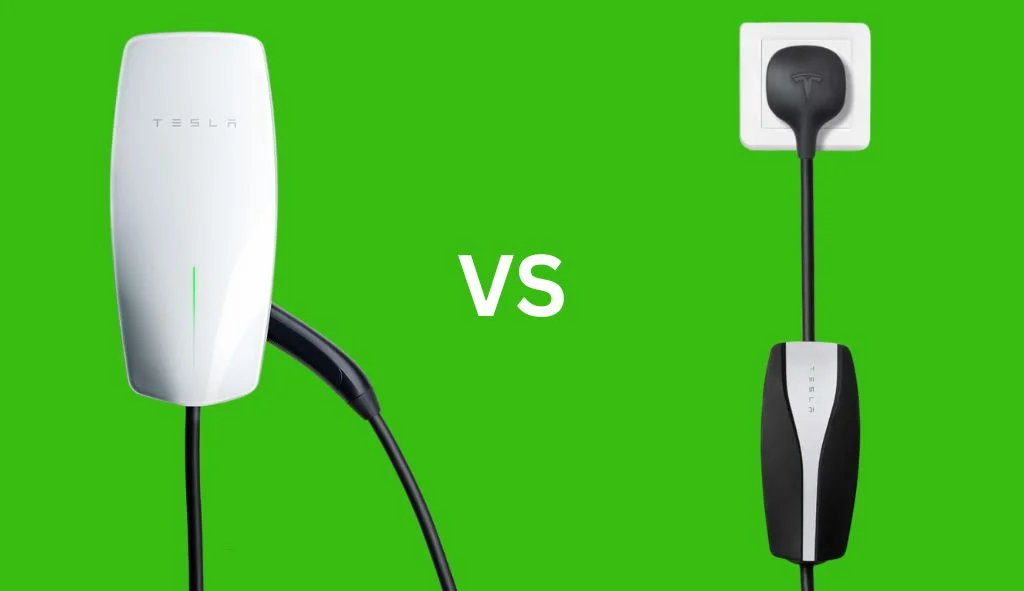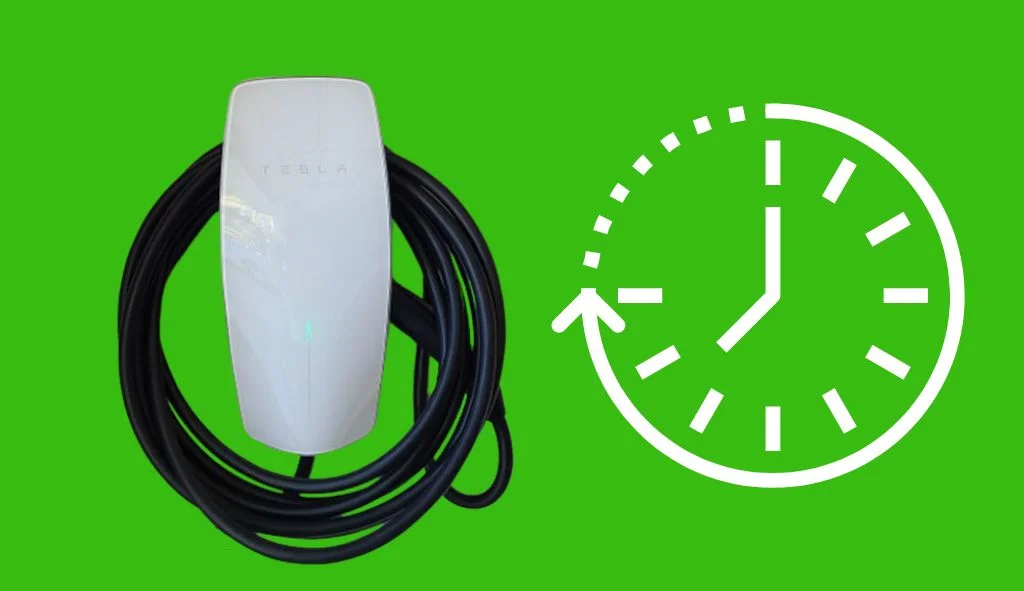
You can charge a Tesla at home without a Wall Connector by plugging Tesla's Mobile Connector into a regular 120 V outlet or a 240 V outlet, using the adapter that matches the receptacle. That is how to charge a Tesla at home for the cost of a cable and, at most, one new outlet. A standard outlet adds about 2 to 3 miles of range per hour; a 240 V outlet adds up to about 30.
One catch for new owners: Tesla stopped putting the Mobile Connector in the box for cars ordered from late April 2022 onward. It sells for $300 on the Tesla Shop (listed out of stock in October 2026), so read what comes with a new Tesla before you assume you have one.
What you need
- A charging cable. Tesla's Mobile Connector (20 ft cable, ships with NEMA 5-15 and NEMA 14-50 adapters, max 32 A) is the default. If it's out of stock, a third-party portable charger with a Tesla (NACS) plug, or a J1772 charger used with the J1772 adapter Tesla includes with every car, does the same job.
- The right adapter for your outlet. Tesla sells 5-15, 5-20, 6-15, 6-20, 10-30, 14-30, 14-50 and 6-50 adapters for $35 to $45 each. It does not sell a TT-30 (RV park) adapter; those are third-party only.
- An outlet in reach. The Mobile Connector's 20 ft cable has to reach your charge port, which sits at the left rear on the Model 3, Model Y, Model S and Model X.
That's the whole kit. No app setup, no Wi-Fi, no installer visit unless you add a new outlet.
Every household outlet, ranked by speed
Tesla publishes these rates for the Mobile Connector. The amp figure is what the car actually draws; it is always 80% of the breaker or less, because the NEC treats EV charging as a continuous load.
| Outlet (adapter) | Where you find it | Volts / breaker | Car draws |
|---|---|---|---|
| NEMA 5-15 | Any ordinary wall outlet | 120 V / 15 A | about 12 A |
| NEMA 5-20 | Garage and kitchen outlets with a T-slot | 120 V / 20 A | 16 A |
| NEMA 6-20 | Some shop tools, window AC units | 240 V / 20 A | 16 A |
| NEMA 14-30 | Dryer outlet, newer homes | 240 V / 30 A | 24 A |
| NEMA 10-30 | Dryer outlet, older homes | 240 V / 30 A | 24 A |
| NEMA 14-50 | Range or RV outlet | 240 V / 50 A | 32 A |
| NEMA 6-50 | Welder outlet | 240 V / 50 A | 32 A |
Range added per hour on each outlet, by model:
| Outlet (adapter) | Model 3 | Model Y | Model S | Model X |
|---|---|---|---|---|
| NEMA 5-15 | 2 to 3 mi/hr | 2 to 3 | 2 to 3 | 2 to 3 |
| NEMA 5-20 | 7 | 7 | 7 | 6 |
| NEMA 6-20 | 15 | 14 | 14 | 12 |
| NEMA 14-30 | 22 | 21 | 21 | 17 |
| NEMA 10-30 | 22 | 21 | 21 | 17 |
| NEMA 14-50 | 30 | 27 | 27 | 23 |
| NEMA 6-50 | 30 | 27 | 27 | 23 |
On 120 V, Tesla's own pages disagree: its Mobile Connector table lists 4 to 6 mi/hr, while the same page's text, its main charging page and the shop say up to 3. We go with 2 to 3, which matches what owners see in practice. For hours to a full battery on each outlet, see our charging hours by outlet table.

Option 1: the regular outlet you already have
Level 1 charging means 120 V from a standard outlet. It costs nothing to set up and it is slower than most people expect.
Worked example: plugged in from 7 pm to 7 am is 12 hours. At 2 to 3 mi/hr that adds 24 to 36 miles. Tesla's own guidance is that the Mobile Connector suits drivers covering under 30 to 40 miles a day who charge overnight, which lines up.
Level 1 works well if you:
- Drive under about 30 miles most days
- Work from home, or the car sits for long stretches
- Have a Supercharger or workplace charger nearby for heavier weeks
It falls short in winter. Cabin and battery heating draw power while the car charges, so in cold weather a noticeable share of a 1.4 kW trickle never reaches the battery. Plan on fewer miles per night from December to February.
Tip: a 5-20 outlet (the one with a sideways T on one slot) on a 20 A circuit gives 16 A instead of 12 A, about 7 mi/hr on a Model 3. If your garage already has one, Tesla's $35 to $45 NEMA 5-20 adapter more than doubles your Level 1 speed.
Option 2: the dryer outlet
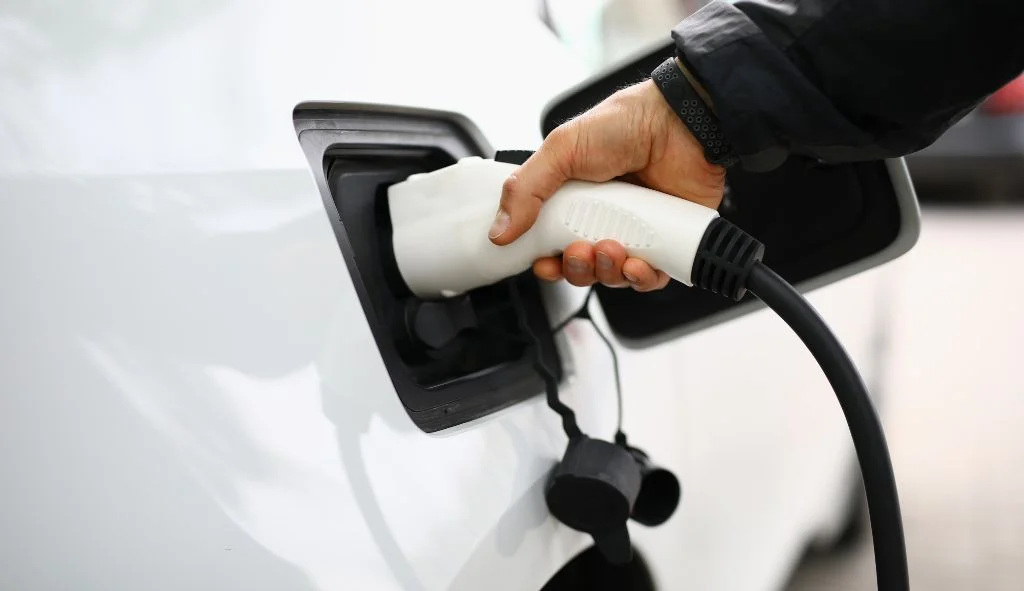
If your laundry area is near where you park, the dryer outlet is the cheapest route to Level 2 (240 V) charging. With a NEMA 14-30 or 10-30 adapter, the car draws 24 A, which is about 5.8 kW and roughly 22 mi/hr on a Model 3 or 21 on a Model Y. Ten hours overnight adds about 210 to 220 miles.
Things to know before you rely on it:
- One load at a time. The dryer and the car can't share the outlet. Unplugging and replugging a dryer cord daily wears out the receptacle, so some owners have an electrician add a second 30 A outlet beside it instead.
- 10-30 outlets have no ground wire. They are an older three-wire design. Tesla sells an adapter for it, but have an electrician look at the outlet's condition, since many are decades old.
- Check the breaker is really 30 A. The adapter tells the car to draw 24 A. If someone put the receptacle on a smaller breaker, it will trip.
Option 3: add a 240 V outlet
A new NEMA 14-50 on a 50 A circuit gives the Mobile Connector its maximum 32 A, about 30 mi/hr on a Model 3. That covers almost any daily driving overnight. Tesla estimates $750 to $1,500 for a new 240 V outlet on a standard job, the same range it quotes for a Wall Connector.
A new 14-50 in a garage generally needs GFCI protection under the 2020 and 2023 NEC, which adds an expensive 50 A GFCI breaker and a risk of nuisance trips. That is why many electricians now steer owners to hardwiring instead. Our NEMA 14-50 or hardwire comparison runs the numbers, and the cost guide on how much to install a Tesla charger covers longer runs and panel work.
Option 4: a J1772 home charger with the included adapter
Every new Tesla comes with Tesla's J1772 adapter (rated up to 19.2 kW). It lets the car charge from any J1772 Level 2 station, including a plug-in or hardwired home charger made by another brand. If you share a garage with a non-Tesla EV, one J1772 charger can serve both cars. The car's onboard charger still sets the ceiling: 48 A on Long Range, Premium and Performance trims, 32 A on base Model 3 and Model Y Standard trims. If you'd rather have a Tesla unit that does both, look at the Tesla universal wall charger.
Plugging in the first time
- Look at the outlet. It should grip the plug firmly and show no cracks, melting or brown marks. Ideally nothing else heavy runs on the same circuit.
- Attach the adapter to the Mobile Connector until it clicks.
- Plug the adapter into the wall first and wait for the status light to show it's ready.
- Open the charge port by pressing the button on the handle, then plug into the car.
- Check the charging screen. Tap the lightning bolt to see the amps the car is drawing. If a shared circuit keeps tripping, you can lower the current there.
- Set your charge limit and schedule. Use Scheduled Charging to match your utility's off-peak hours.

For battery health, Tesla recommends a daily limit around 80% on most cars and 100% on LFP-battery cars, which the car flags by showing 100% as its daily recommendation. Tesla also suggests leaving the car plugged in when parked, which suits slow outlet charging well.
What it costs to charge from an outlet
The kWh you pay for are the same whether a Wall Connector or an outlet supplies them, with one exception: Level 1 wastes more. Studies summarized by Recurrent put Level 1 charging at about 75 to 84% efficient and Level 2 at about 89 to 95%.
Estimate for 900 miles a month in a Model Y Premium RWD (EPA rating 134 MPGe, about 251 Wh per mile) at the US average residential price of 18.31 cents per kWh (EIA, July 2026):
- Level 2: 900 x 0.251 = about 226 kWh, x $0.1831 = about $41
- Level 1: the same miles need roughly 12% more energy from the wall if L1 loses about 20% and L2 about 10% (0.9 / 0.8 = 1.125), so about 254 kWh = about $47
Our guide to Tesla charging cost at home has state-by-state rates and a calculator. On a time-of-use plan, the off-peak rate matters far more than the outlet type.
When outlet charging isn't enough
Signs you have outgrown Level 1: the battery trends lower through the week, you are Supercharging to make up the gap, or cold mornings leave you short. The usual fixes, in rising order of cost:
- Add a NEMA 5-20 adapter if a 20 A outlet exists.
- Use the dryer outlet with a 14-30 or 10-30 adapter.
- Top up at work or at shops with Level 2 stations using the J1772 adapter. Our page on how to charge a Tesla at a non-Tesla station lists which networks work.
- Have a 240 V outlet or a Wall Connector installed.
Safety rules for outlet charging
- Use a dedicated circuit where you can. A freezer or space heater on the same 15 A circuit is the most common reason a Level 1 setup trips.
- Plug straight into the wall. Skip extension cords, power strips and cheap outlet splitters.
- Feel the plug after the first hour or two of charging. Warm is normal; hot, discolored or smelling of plastic is not. Stop and call an electrician.
- Leave adapters plugged into a 240 V outlet rather than pulling them out every day, to reduce wear on the receptacle contacts.
- Any new circuit or outlet is a job for a licensed electrician with a permit where your town requires one.
Which home setup fits your driving
| Typical daily miles | Setup that covers it overnight | What it involves |
|---|---|---|
| Under 30 | 120 V outlet, NEMA 5-15 | Mobile Connector only |
| 30 to 50 | 120 V, 20 A outlet (NEMA 5-20), or a dryer outlet | $35 to $45 adapter |
| 50 to 150 | Dryer outlet or NEMA 14-50 | Adapter, or a new 240 V outlet |
| Over 150, or two EVs | Wall Connector at 48 A | Hardwired install |
The Tesla Mobile Connector vs Wall Connector comparison goes further into the last row. If you drive a base 2026 Model Y or a 2026 Model 3 Standard, remember the car tops out at 32 A, so a 14-50 outlet already gives it full home charging speed.
Owner questions about charging from a household outlet
Can you plug a Tesla into a regular outlet?
Yes. With the Mobile Connector and its NEMA 5-15 adapter, any standard 120 V household outlet works. Expect about 2 to 3 miles of range per hour, so a 12-hour overnight session adds roughly 24 to 36 miles. Use an outlet on a circuit that isn't shared with a freezer, heater or other big load, and plug straight into the wall.
Can I use my dryer outlet to charge a Tesla?
Usually, if you buy the matching adapter. Most dryer outlets are NEMA 14-30 (newer homes) or 10-30 (older homes) on a 30 A circuit. With Tesla's adapter the car draws 24 A and gains about 22 miles of range an hour on a Model 3. You can't run the dryer and charge at the same time, so plan around laundry.
Do I need a Wall Connector for a Tesla?
No. Tesla says the Mobile Connector suits owners who drive under 30 to 40 miles a day and charge overnight, and a 240 V outlet covers far more than that. A Wall Connector is worth it when you need 48 A, have two EVs sharing one circuit, or want a permanent hardwired install.
What is the best time to charge a Tesla at home?
Overnight, during your utility's off-peak window if you're on a time-of-use plan. Set Scheduled Charging in the car so it starts or finishes at the right time. Slow Level 1 charging needs the longest window, so start as early as your rate plan allows and leave the car plugged in whenever it's parked.
Why does my Tesla stop charging at home?
The usual causes are a tripped breaker (often a shared circuit), a scheduled charge that hasn't started yet, the charge limit already reached, or the Mobile Connector reducing or stopping the charge because it sensed heat at the wall plug. A warm or discolored outlet is a warning sign: stop using it and have an electrician replace it.
Can I use an extension cord?
Avoid it. A household extension cord isn't built for hours of continuous current, and the plug joints are where heat builds up. If the car can't reach the outlet, have an electrician add a properly placed receptacle instead. Never use an extension cord on a 240 V circuit.
Sources
- Tesla Mobile Connector support page, tesla.com
- Tesla support: charging overview, tesla.com
- Tesla Shop: Gen 2 NEMA adapters, shop.tesla.com
- Tesla Shop: SAE J1772 charging adapter, shop.tesla.com
- EIA Electric Power Monthly: average residential price, eia.gov
- Recurrent: charging losses by level, recurrentauto.com
Independent site. Not affiliated with or endorsed by Tesla, Inc. Tesla, Wall Connector and Supercharger are trademarks of Tesla, Inc.