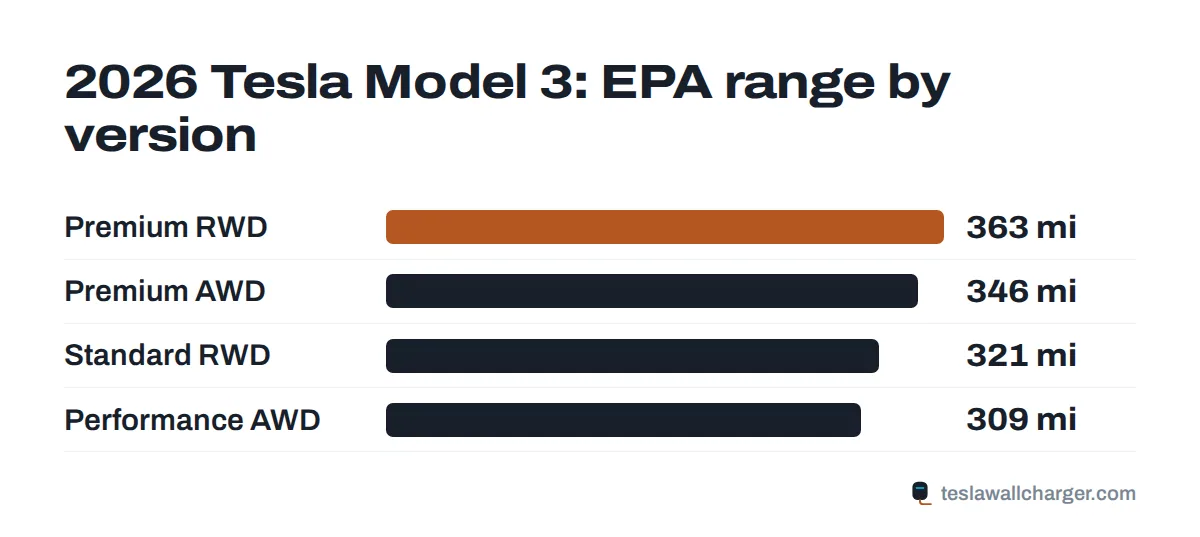
The 2026 Tesla Model 3 starts at $38,380 including destination for the new Standard trim (321 miles of EPA range) and runs to $56,380 for the Performance, with Premium RWD ($43,880, 363 miles) and Premium AWD ($48,880, 346 miles) in between, per Edmunds' July 2026 pricing. It is the car Tesla builds and sells new in October 2026, and early examples from late 2025 are already reaching the used market.
2026 Tesla Model 3 prices and range by trim
| Trim | Price with destination | EPA range | Efficiency |
|---|---|---|---|
| Standard RWD | $38,380 | 321 mi | 139 MPGe |
| Premium RWD | $43,880 | 363 mi | 137 MPGe |
| Premium AWD | $48,880 | 346 mi | 128 MPGe |
| Performance AWD | $56,380 | 309 mi | 114 MPGe |
| Trim | 0 to 60 mph | Home AC max |
|---|---|---|
| Standard RWD | 5.8 s | 32 A / 7.7 kW |
| Premium RWD | 4.9 s | 48 A / 11.5 kW |
| Premium AWD | 4.2 s | 48 A / 11.5 kW |
| Performance AWD | 2.9 s | 48 A / 11.5 kW |
Prices come from Edmunds' July 10, 2026 guide; Tesla changes them without notice, so confirm on the order page. The Performance launched at $54,490 before destination in October 2025 and was $54,990 by July. The EPA also lists a second Performance entry at 314 miles and 111 MPGe.
The Standard is the most efficient Tesla on fueleconomy.gov's 2026 Top Ten list at 139 MPGe, about 24 kWh per 100 miles.
What the Standard leaves out
Tesla launched the Model 3 Standard on October 7, 2025 at $36,990 before destination. To reach that price it removed:
- the 8-inch rear-seat screen and the ambient light strip
- the subwoofer and AM/FM radio
- power adjustment for the steering wheel and mirrors
- Autosteer, Tesla's lane-centering feature
- the active dampers
It also has a smaller battery, about 60 kWh against about 79 kWh in the other trims (both estimates), and a 32 A onboard charger.
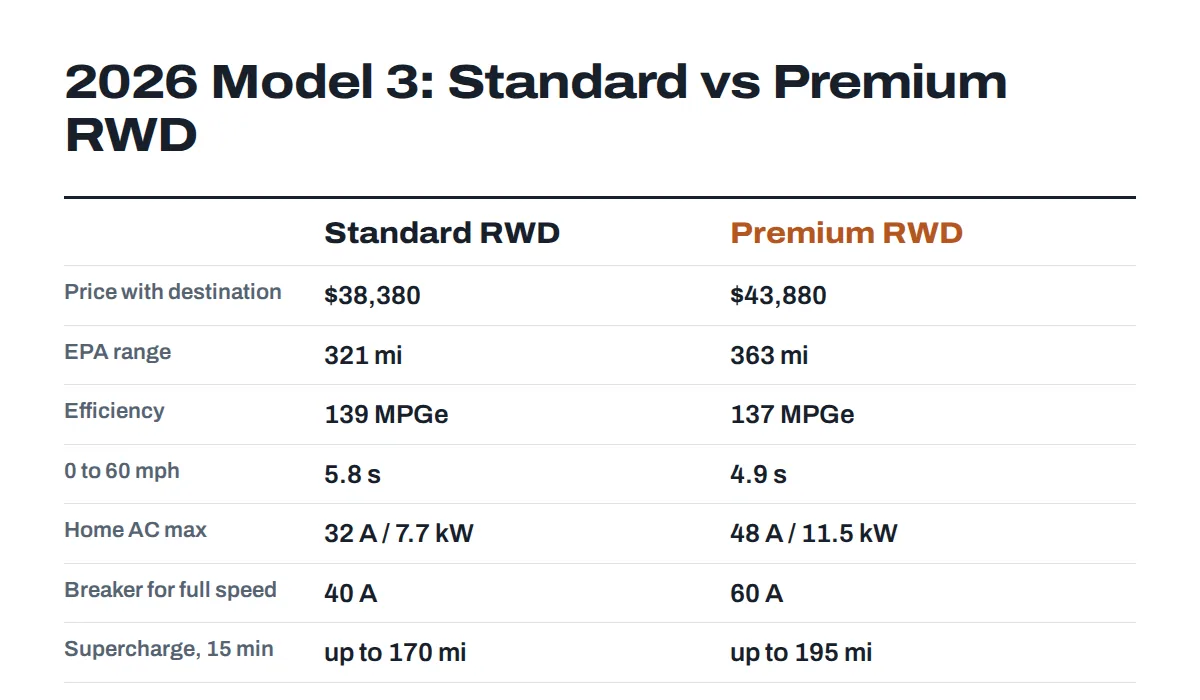
The gap is $5,500. For that, the Premium RWD gives 42 more miles of range, faster home charging, 25 more miles per 15-minute Supercharger stop by Edmunds' figures, and 20,000 more miles of battery warranty. Most buyers who keep a car five years or more will get that money's worth. The Standard suits a short, predictable commute and a buyer who does not want driver-assist lane-keeping anyway.
What changed from the 2025
- New Standard trim, the first sub-Long Range Model 3 since the base RWD was dropped after 2024.
- Long Range renamed Premium. Premium RWD and Premium AWD are rated the same as the 2025 Long Range RWD and AWD, 363 and 346 miles.
- Turn-signal stalk returns to the steering column, replacing the steering-wheel buttons of the 2025 Model 3 and Tesla Model 3 2024.
- Performance range up to 309 miles from 298.
- Five-star NHTSA rating, which the 2024 and 2025 never received.
Charging at home, and what a year of driving costs
The trim decides the circuit. The Standard tops out at 32 A, which a 40 A breaker or a NEMA 14-50 outlet with the Mobile Connector fully supplies, giving about 30 miles per hour and a full charge in roughly 8.7 hours. The Premium and Performance take 48 A, reaching up to 44 miles per hour, but only on a Wall Connector with a 60 A breaker; empty to full is about 7.6 hours. Tesla's estimate for a Wall Connector install is $750 to $1,500, and the unit itself is $585 (out of stock on Tesla's shop as of October 2026). The federal 30C credit ended for chargers placed in service after June 30, 2026, so budget the full amount.
| How you charge | Speed |
|---|---|
| Wall Connector at 48 A (11.5 kW, 60 A breaker) | up to 44 mi of range per hour |
| Wall Connector at 32 A (7.7 kW, 40 A breaker) | up to 29 mi of range per hour |
| NEMA 14-50 outlet, Mobile Connector at 32 A | about 30 mi per hour |
| Regular 120 V outlet | 2 to 3 mi per hour |
| Empty to full, largest pack (about 79 kWh) | about 7.5 hours at 11.5 kW |
Rates scale Tesla's published Wall Connector table for this model; older cars and cold batteries charge slower. Times are estimates.
Here is the annual electricity bill for 12,000 miles, priced at EIA's July 2026 residential average of 18.31 cents per kWh, using each trim's EPA consumption (measured at the wall, so charging losses are included):
| Trim | kWh per 100 mi | kWh per year | Cost per year |
|---|---|---|---|
| Standard RWD | 24 | 2,880 | about $527 |
| Premium RWD | 25 | 3,000 | about $549 |
| Premium AWD | 26 | 3,120 | about $571 |
| Performance AWD | 30 | 3,600 | about $659 |
The spread between trims is small next to the difference your utility's rate makes. Our page on Tesla charging costs by utility plan shows how time-of-use plans change the math, and our Tesla charge time guide covers public charging times.
Safety rating and the one recall so far
NHTSA tested the 2026 RWD and AWD and gave both five stars in every category, with a 6.8% rollover risk. Cars NHTSA classes as "early release" RWD are listed separately as not rated, so check which NHTSA entry matches the car you are buying.
| NHTSA test | Rating |
|---|---|
| Overall | 5 stars |
| Frontal crash | 5 stars |
| Side crash | 5 stars |
| Rollover | 5 stars |
| Rollover risk | 6.8% |
The only recall in our data is 25V410000 (June 2025): seat-back fasteners on some 2026 Model 3 and Model Y cars may not be tightened correctly, so the seat may not hold an occupant properly in a crash. Tesla Service inspects and fixes them free. NHTSA files this year as "Model 3 BEV," and our query used the plain model name, so later campaigns could be missing. Check any VIN on NHTSA's recall site.
- 25V410000June 18, 2025Seats, critical fastenersService visit
Seat-back fasteners may be improperly tightened so the seat may not restrain an occupant in a crash
Source: NHTSA recalls API. A recall only applies if your VIN is listed.
Only 20 complaints had been filed as of October 2026, too few to show a pattern.
20 owner complaints filed with NHTSA for the 2026 Model 3. Most frequent areas (approximate order): unknown or other; forward collision avoidance; steering; back over prevention; lane departure; structure. Source: NHTSA complaints database.
Buying a used or demo 2026
Early 2026 cars are now trading as lightly used and demo units. Three checks matter more than usual:
- Confirm the trim. Standard and Premium look alike from outside. The rear screen is the quickest giveaway; the Premium has it, the Standard does not.
- Confirm 25V410000 is done.
- Get the in-service date. The 4-year, 50,000-mile basic warranty and the 8-year battery warranty both start on it.
For how 2026 compares with every earlier year, see the Tesla Model 3 years hub.
Full 2026 specs
| Trim | EPA range | Efficiency | Home AC max | Price (USD) |
|---|---|---|---|---|
| Standard RWD | 321 mi | 24 kWh/100 mi | 7.7 kW | $36,990 |
| Premium RWD | 363 mi | 25 kWh/100 mi | 11.5 kW | $42,490 |
| Premium AWD | 346 mi | 26 kWh/100 mi | 11.5 kW | $47,490 |
| Performance AWD | 309 mi | 30 kWh/100 mi | 11.5 kW | $54,490 |
What 2026 Model 3 buyers ask
How much is the 2026 Tesla Model 3?
Edmunds' July 2026 pricing, including the $1,390 destination fee, is $38,380 for the Standard, $43,880 for the Premium RWD, $48,880 for the Premium AWD and $56,380 for the Performance. Tesla changes prices without notice, so check the order page before you sign, and compare against demo or lightly used 2026 cars.
What is the difference between the Model 3 Standard and Premium?
The Standard has a smaller battery (about 60 kWh versus about 79), 321 miles of range against 363 for the Premium RWD, and a 32 A onboard charger instead of 48 A. It also drops the rear screen, ambient lighting, subwoofer, AM/FM radio, power steering-wheel and mirror adjustment, Autosteer and the active dampers, and its battery warranty stops at 100,000 miles.
Does the 2026 Model 3 have a turn-signal stalk?
Yes. Tesla brought back a traditional turn-signal stalk on the steering column for the 2026 model year, after the 2024 and 2025 cars used buttons on the steering wheel. Drive, reverse and park are still chosen on the touchscreen. If a used listing shows a stalk-free wheel, it is a 2024 or 2025 car.
What home charger does the 2026 Model 3 Standard need?
The Standard accepts 32 A, about 7.7 kW, which is roughly 30 miles of range per hour. A Wall Connector on a 40 A breaker or a NEMA 14-50 outlet with the Mobile Connector both deliver that full rate. A 60 A circuit adds nothing for this trim, though it keeps your options open for a future car.
Is the 2026 Model 3 safe?
NHTSA rates the 2026 Model 3 RWD and AWD at five stars overall, frontal, side and rollover, with a 6.8% rollover risk. Early-release RWD cars are listed separately as not rated. As of October 2026 the only recall in our data is 25V410000, for seat-back fasteners that may not be tightened correctly, fixed free at Tesla Service.
Sources
- Edmunds: 2026 Tesla Model 3 pricing guide (2026-07-10), edmunds.com
- InsideEVs: 2026 Tesla Model 3 Standard, insideevs.com
- NHTSA safety ratings API, 2026 Model 3 BEV, api.nhtsa.gov
- NHTSA recalls API, 2026 Model 3 (queried 2026-10-13), api.nhtsa.gov
- fueleconomy.gov: Top ten EVs by efficiency (2026), fueleconomy.gov
- Tesla support: Wall Connector charging speeds by breaker, tesla.com
- Tesla support: vehicle warranty, tesla.com
- IRS: Alternative Fuel Vehicle Refueling Property Credit (30C), irs.gov
- EIA Electric Power Monthly: average residential price (July 2026), eia.gov
Independent site. Not affiliated with or endorsed by Tesla, Inc. Tesla, Wall Connector and Supercharger are trademarks of Tesla, Inc.