The 2022 Tesla Model 3 came in three versions: a Rear-Wheel Drive car with an LFP battery and 272 miles of EPA range, a 358-mile Long Range AWD, and the 315-mile Performance. It is a sensible used buy in October 2026, but two cars with the same model year can differ in screen computer, parking sensors and what came in the trunk, so the build date tells you more than the badge.
What changed for the 2022 model year
The body and interior carried over from the October 2020 refresh, so every 2022 has the heat pump, power trunk, double-pane windows and black trim of the refreshed 2021 Model 3. The changes sit underneath.
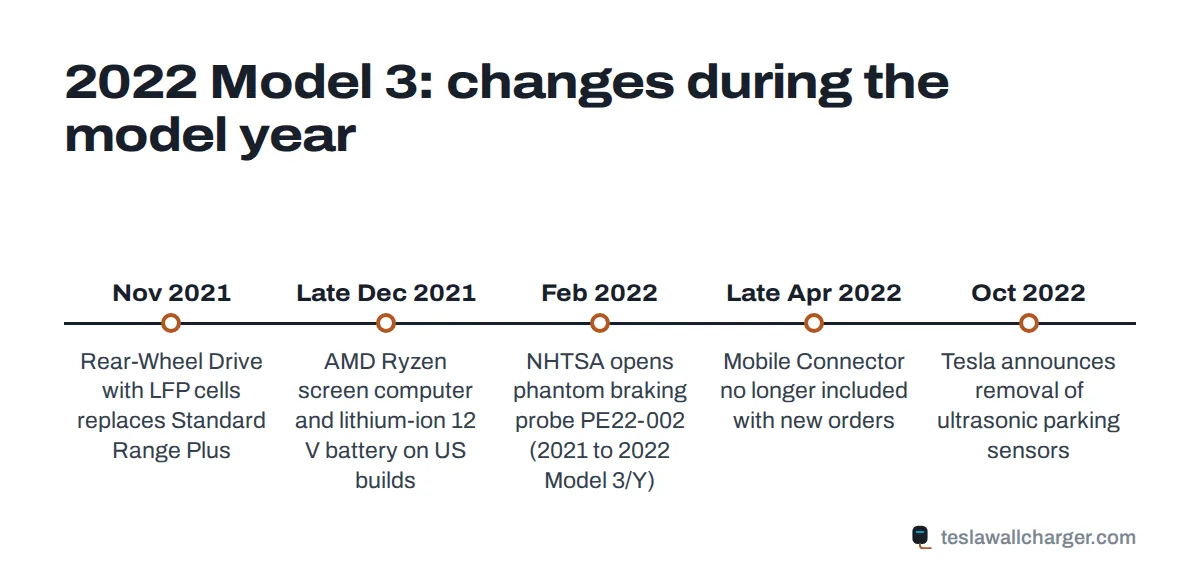
- Standard Range Plus became "Rear-Wheel Drive." Tesla made the switch in early November 2021 and moved the base car to lithium iron phosphate (LFP) cells. EPA range rose to 272 miles on 18-inch wheels (267 on 19s), but 0 to 60 mph slowed to 5.8 seconds from the old car's 5.3. The price at the time was $43,990 before a $1,200 destination fee.
- Long Range AWD gained a little range. EPA rated it at 358 miles, up from 353, with Long Range priced at $49,990 and Performance at $57,990 in November 2021 (before destination).
- New electronics. The AMD Ryzen screen computer and a lithium-ion 12 V battery replaced the Intel Atom unit and lead-acid battery on US builds from about late December 2021.
- No radar on any 2022. Model 3s built after late April 2021 already used cameras only (Tesla Vision).
Every 2022 Model 3 also uses Tesla's HW3 driver-assistance computer, the same as late 2021 and all 2023 cars.
Three checks that depend on the build month
Tesla changes cars in the middle of a model year, and 2022 had more of these switches than most. Read the build month from the label on the driver's door jamb, then run these checks.
- Screen computer. Open Controls, then Software, then Additional Vehicle Information. "AMD Ryzen" means the faster unit with quicker maps and app loading; a few early cars sold as 2022 models may still show Intel Atom.
- Parking sensors. Tesla announced on October 4, 2022 that the ultrasonic sensors were going. Cars built after that rely on cameras for Park Assist, and features like Autopark and Summon were limited for a while until camera-based versions arrived by software update. If you park in a tight garage, an earlier build with sensors is worth a small premium.
- The charging cable. Orders placed from late April 2022 no longer came with a Mobile Connector. Ask the seller to show it. Every Tesla still ships with the J1772 adapter for public Level 2 stations, which you can read about in our guide to charging a Tesla at non-Tesla stations.
2022 Tesla Model 3 range, specs and prices by trim
| Trim | EPA range | Efficiency | Home AC max | Price (USD) |
|---|---|---|---|---|
| Rear-Wheel Drive | 272 mi | 26 kWh/100 mi | 7.7 kW | $43,990 |
| Long Range AWD | 358 mi | 26 kWh/100 mi | 11.5 kW | $49,990 |
| Performance AWD | 315 mi | 30 kWh/100 mi | 11.5 kW | $57,990 |
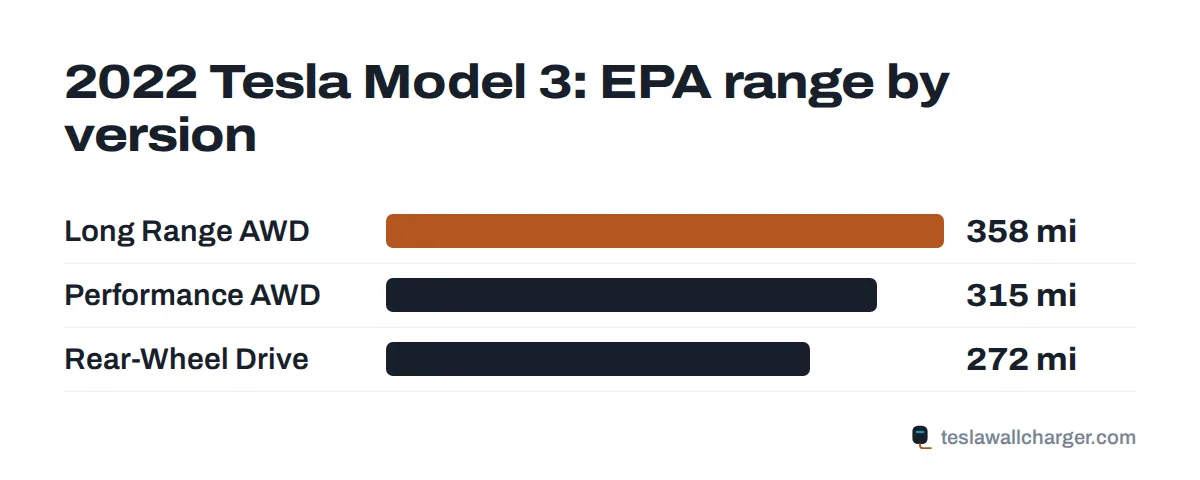
The Rear-Wheel Drive car is the efficiency pick at 132 MPGe, roughly 26 kWh per 100 miles measured at the wall. The Long Range is almost as frugal at 131 MPGe and adds 86 miles of rated range. The Performance gives up range and efficiency (113 MPGe) to its 20-inch wheels and 3.1-second 0 to 60 time.
Battery sizes are approximate because Tesla does not publish usable capacity: about 57.5 kWh for the LFP car and about 82 kWh for Long Range and Performance. Tesla's 2023 Impact Report put average Model 3/Y capacity loss at about 15% after 200,000 miles, so a 2022 with average mileage should still be close to its original range. The battery warranty runs 8 years from the in-service date (100,000 miles for Rear-Wheel Drive, 120,000 for Long Range and Performance under Tesla's current terms, with at least 70% capacity retained), so most 2022 cars have coverage into 2030.
Recalls, complaints and crash scores
NHTSA lists 18 recall campaigns for the 2022 Model 3. That number looks alarming until you sort them: almost all were fixed by over-the-air software updates, so a car running current software already has those fixes.
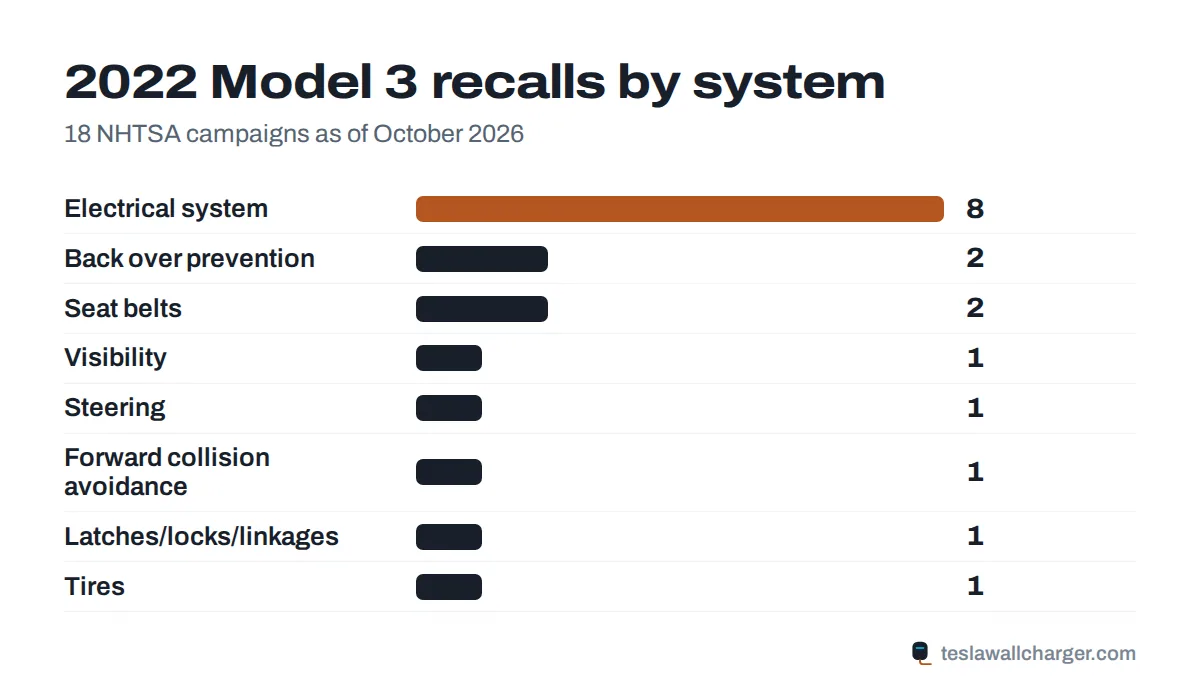
The ones that involve the car itself, and deserve a VIN check on NHTSA's recall lookup:
- 26V507000 (August 2026): low-beam headlights may be brighter than the federal limit. The remedy is a service visit, and it is recent enough that many used cars will still be open.
- 22V798000: a rear seat belt buckle and anchor may have been put back wrong after earlier service. Only cars that had that work are affected.
- 22V296000: the screen computer could overheat during fast charging and blank the rearview camera. Fixed by software.
Beyond recalls, the 2022 sits inside NHTSA's phantom braking probe (PE22-002), opened in February 2022 after 354 complaints across about 416,000 2021 and 2022 Model 3 and Model Y cars. Forward collision avoidance is still the top complaint area among the 765 filed for this year. The December 2023 Autopilot recall (23V838000) added driver-attention alerts by software, and the FSD reduced-visibility investigation (now EA26-002) only matters if the car runs FSD.
- 22V037000January 27, 2022Electrical system, adas, autonomous/self driving, softwareSoftware update
FSD Beta 'rolling stop' could let the car pass through all-way stops without stopping - 22V045000February 1, 2022Electrical system, softwareSoftware update
Seat belt chime may not sound at startup for an unbelted driver - 22V050000February 2, 2022Electrical system, softwareSoftware update
Software error may open a heat pump valve, reducing windshield defrost performance - 22V063000February 4, 2022Electrical system, softwareSoftware update
Boombox sounds may mask Pedestrian Warning System sounds (superseded by 22V235000) - 22V235000April 12, 2022Electrical system, softwareSoftware update
Boombox sounds may mask Pedestrian Warning System sounds; replaces 22V063000 - 22V263000April 18, 2022Electrical system, instrument cluster/panelSoftware update
Speed unit (mph or km/h) may not display on the speedometer in Track Mode
Show all 18 recalls
- 22V296000May 3, 2022Back over prevention, display functionSoftware update
Infotainment CPU may overheat during fast charging, blanking the rearview camera image and warning displays - 22V702000September 19, 2022Visibility, power window devices and controlsSoftware update
Window automatic reversal may not react correctly after detecting an obstruction (pinch risk) - 22V798000October 21, 2022Seat belts, rear/other, anchorageService visit
Second-row left buckle and center belt anchor may have been reassembled incorrectly during service - 23V085000February 15, 2023Steering, automated/adaptive steeringSoftware update
FSD Beta may act unsafely at intersections and respond poorly to speed limit changes - 23V838000December 12, 2023Electrical system, adas, autonomous/self driving, softwareSoftware update
Autosteer controls may not be sufficient to prevent driver misuse - 24V051000January 30, 2024Electrical system, instrument cluster/panelSoftware update
Brake, park and ABS warning lights shown in a font smaller than required - 24V153000February 27, 2024Forward collision avoidance, warnings, external/pedestrian alertSoftware update
A factory reset could mute Pedestrian Warning System sounds - 24V376000May 28, 2024Seat belts, front, warning light/devicesSoftware update
Unbelted-driver warning light and chime may not activate - 24V554000July 24, 2024Latches/locks/linkages, hood, latchSoftware update
Hood latch may fail to detect an unlatched hood after it was opened - 24V935000December 17, 2024Tires, pressure monitoring and regulating systemsSoftware update
TPMS warning light may not stay on between drive cycles - 26V283000May 5, 2026Back over prevention, softwareSoftware update
Rearview camera image may be delayed when shifting to reverse on software 2026.8.6; remedy text says OTA (API OTA flag: false) - 26V507000August 5, 2026Exterior lighting, headlightsService visit
Low-beam headlights may be too bright, exceeding the maximum allowed light output
Source: NHTSA recalls API. A recall only applies if your VIN is listed.
765 owner complaints filed with NHTSA for the 2022 Model 3. Most frequent areas (approximate order): forward collision avoidance; unknown or other; electrical system; steering; visibility/wiper; vehicle speed control. Source: NHTSA complaints database.
Crash scores are strong. NHTSA gave both the RWD and AWD cars five stars overall and in every category, with a 6.6% rollover risk.
| NHTSA test | Rating |
|---|---|
| Overall | 5 stars |
| Frontal crash | 5 stars |
| Side crash | 5 stars |
| Rollover | 5 stars |
| Rollover risk | 6.6% |
Charging a 2022 Model 3 at home
The trim decides how much home charging hardware is worth paying for.
| Trim | Onboard charger | Breaker it can use | Miles of range per hour | Approx. empty to full |
|---|---|---|---|---|
| Rear-Wheel Drive (LFP) | 32 A, 7.7 kW | 40 A | about 30 | 8.3 hours |
| Long Range AWD | 48 A, 11.5 kW | 60 A | up to 44 | 7.9 hours |
| Performance AWD | 48 A, 11.5 kW | 60 A | a little under 44 | 7.9 hours |
For the Rear-Wheel Drive car, a NEMA 14-50 outlet with the Mobile Connector delivers the same 32 A as a Wall Connector, so the outlet is the cheaper route if you already have one. Under the 2020 and 2023 NEC, a new 14-50 in a garage generally needs GFCI protection, which some electricians avoid by hardwiring a Wall Connector instead. For Long Range and Performance owners, the 48 A rate on a 60 A circuit is where a Wall Connector earns its $585 price (listed out of stock on Tesla's shop as of October 2026). Our breaker size and amperage guide covers the wire sizes an electrician will use, and Tesla puts a typical Wall Connector install at $750 to $1,500. The federal 30C charger credit does not apply to anything installed after June 30, 2026.
LFP cars need a different habit: Tesla recommends a 100% charge limit, even for daily driving, and a full charge at least once a week. Nickel-based Long Range and Performance packs are happier around 80% day to day.
A full charge of the LFP pack costs about $11.70 at the July 2026 US average of 18.31 cents per kWh (57.5 kWh usable, about 64 kWh drawn from the wall at 90% efficiency). See what a Tesla costs to charge at home for rates by state.
| How you charge | Speed |
|---|---|
| Wall Connector at 48 A (11.5 kW, 60 A breaker) | up to 44 mi of range per hour |
| Wall Connector at 32 A (7.7 kW, 40 A breaker) | up to 29 mi of range per hour |
| NEMA 14-50 outlet, Mobile Connector at 32 A | about 30 mi per hour |
| Regular 120 V outlet | 2 to 3 mi per hour |
| Empty to full, largest pack (about 82 kWh) | about 8 hours at 11.5 kW |
Rates scale Tesla's published Wall Connector table for this model; older cars and cold batteries charge slower. Times are estimates.
Who the 2022 suits, and when to look at 2021 or 2023
- Short daily drives and a garage outlet: the Rear-Wheel Drive. LFP cells tolerate full charges, and a 40 A circuit gives it all the speed it can take.
- Long commutes or cold winters: the Long Range. 358 rated miles leaves a real buffer once heat and highway speed cut into it.
- Tight parking: an early-2022 build with ultrasonic sensors.
- Lowest price: a 2021 can be cheaper but mixes radar and non-radar cars and Intel screens.
- Newest original-design car: the 2023 Model 3 is nearly the same car, but it lacks parking sensors on most builds and has its own steering-assist recall.
Our Model 3 years overview ranks every year side by side.
Questions 2022 Model 3 shoppers ask
Does the 2022 Tesla Model 3 have an LFP battery?
The Rear-Wheel Drive version does. Tesla renamed the Standard Range Plus in November 2021 and moved it to lithium iron phosphate cells, rated 272 miles on 18-inch wheels. Long Range and Performance cars use nickel-based NCA cells. The easiest check is the charge screen: an LFP car recommends a 100% daily limit, while an NCA car suggests around 80%.
Does the 2022 Model 3 have ultrasonic parking sensors?
Most do. Tesla announced on October 4, 2022 that new Model 3 and Model Y cars would drop the ultrasonic sensors, so late-2022 builds may lack them and rely on cameras for Park Assist. Look for the small round sensor caps in the front and rear bumpers, and confirm the build date on the door-jamb label before you pay.
What breaker does a 2022 Model 3 need for home charging?
It depends on the trim. The Rear-Wheel Drive car accepts 32 A, so a 40 A circuit gives it full speed, about 30 miles of range per hour. Long Range and Performance accept 48 A, which needs a 60 A breaker and a Wall Connector for up to 44 miles per hour. A licensed electrician should size the wire and pull the permit.
Is the 2022 Model 3 part of the phantom braking investigation?
Yes. NHTSA opened Preliminary Evaluation PE22-002 in February 2022 covering an estimated 416,000 2021 and 2022 Model 3 and Model Y cars after 354 complaints of unexpected braking at highway speed. On a test drive, use Traffic-Aware Cruise Control on an open highway for several miles and watch for sudden slowdowns with no obstacle ahead.
Did the 2022 Model 3 come with a home charger?
Only some did. Tesla stopped including the Mobile Connector for orders placed from late April 2022, so a car ordered earlier in the year should have one in the trunk. Later cars shipped with the J1772 adapter only. A replacement Mobile Connector costs $300 from Tesla, though it was listed out of stock as of October 2026.
Sources
- NHTSA recalls API, 2022 Model 3 (queried 2026-10-13), api.nhtsa.gov
- NHTSA ODI resume PE22-002 (phantom braking), static.nhtsa.gov
- InsideEVs: Model 3 Standard Range Plus gone, say hi to Model 3 RWD (2021-11-02), insideevs.com
- Tom's Hardware: AMD Ryzen upgrade arrives stateside for Model 3, Model Y (2021-12-29), tomshardware.com
- Not a Tesla App: Tesla is removing ultrasonic sensors (2022-10-04), notateslaapp.com
- InsideEVs: Tesla recommends charging Model 3 RWD LFP battery to 100%, insideevs.com
- InsideEVs: Tesla Mobile Connector no longer standard (2022), insideevs.com
- fueleconomy.gov: 2022 Tesla Model 3, fueleconomy.gov
- Tesla support: onboard charger, tesla.com
- Tesla support: Wall Connector charging speeds by breaker, tesla.com
- EIA Electric Power Monthly: average residential price (July 2026), eia.gov
Independent site. Not affiliated with or endorsed by Tesla, Inc. Tesla, Wall Connector and Supercharger are trademarks of Tesla, Inc.