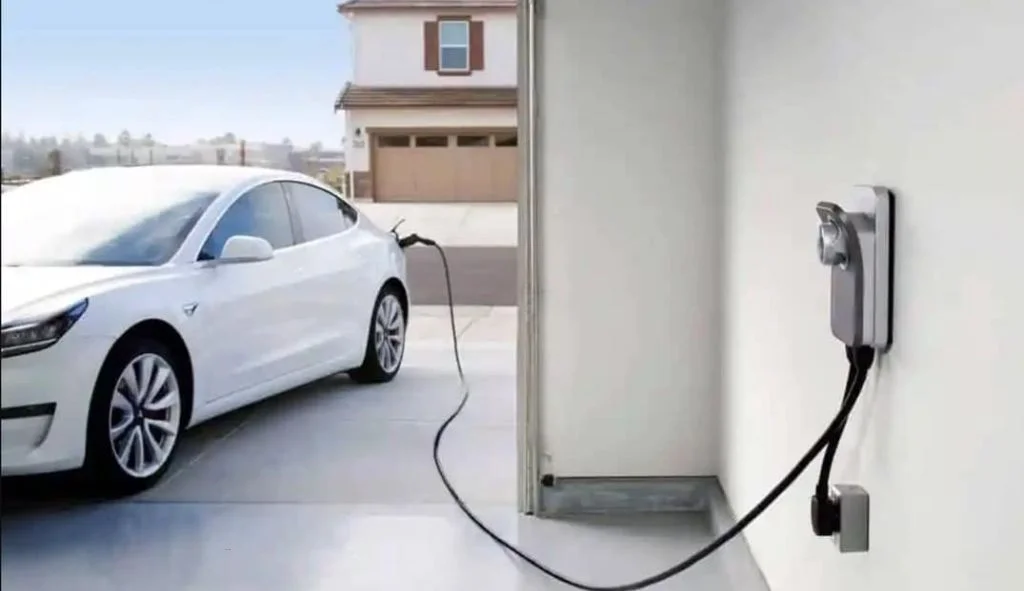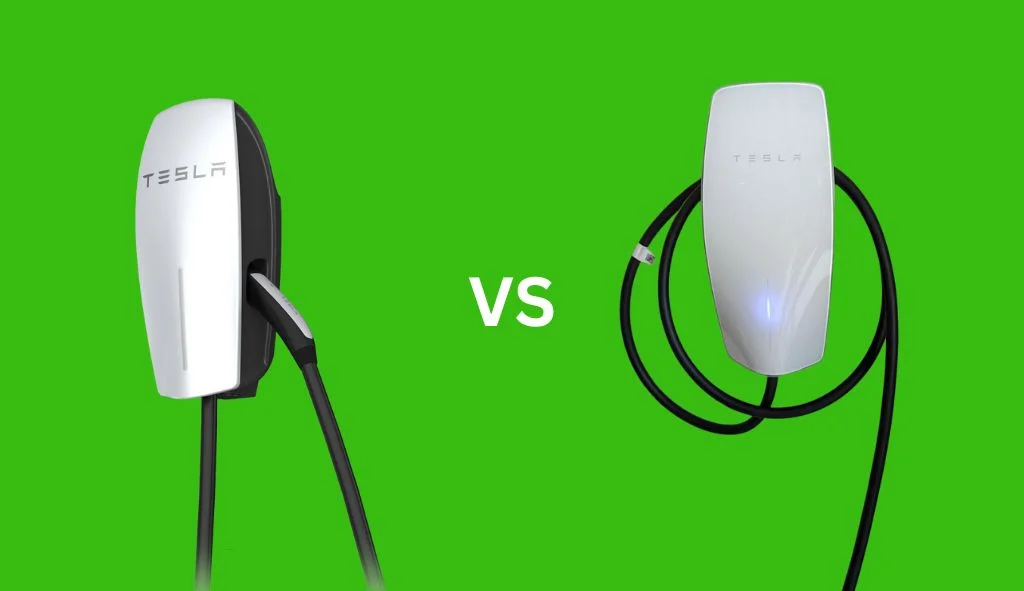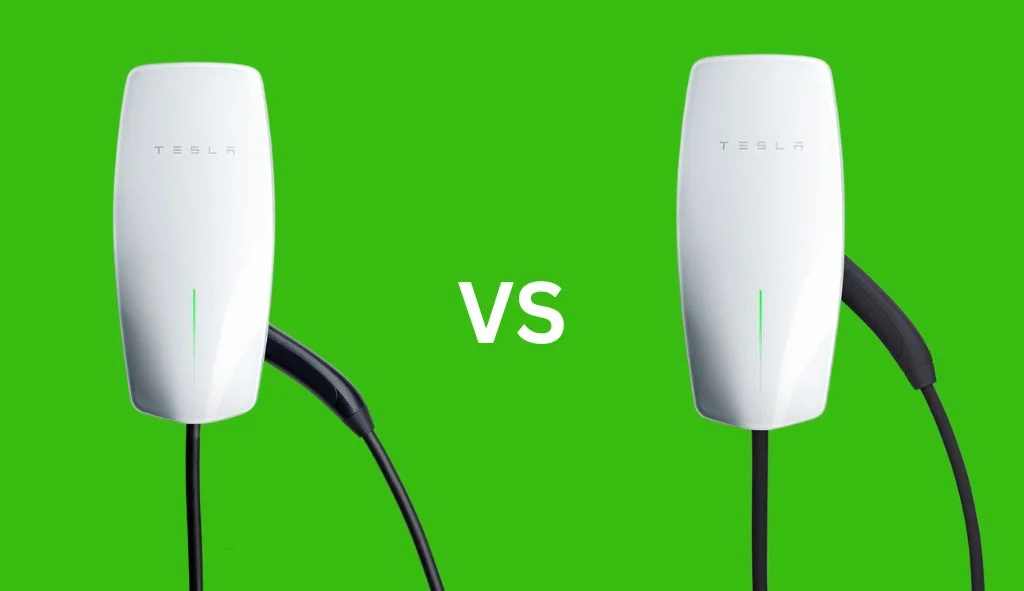
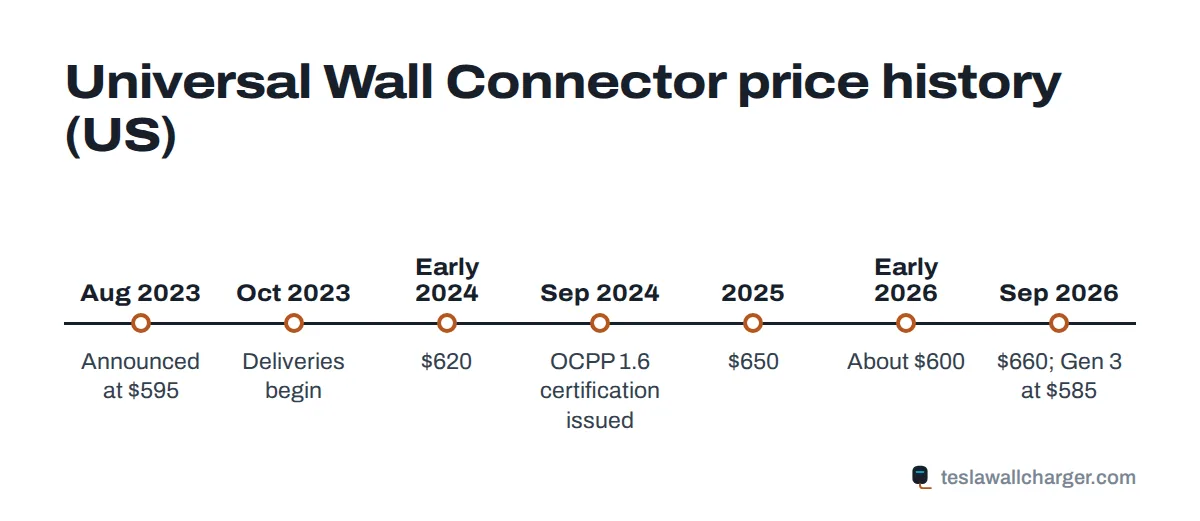
The Tesla Universal Wall Connector is the same 48 A home charger as the standard Gen 3 Wall Connector, with one addition: a J1772 adapter that docks in the side of the unit, so cars with a J1772 port can charge without bringing their own adapter. As of October 13, 2026, it costs $660 against $585 for the standard unit, and both are listed out of stock on the Tesla Shop.
The gap between the two has never been large. It has ranged from $75 now to roughly $120 in mid-2023, when the Universal launched at $595 and the standard unit sold for $475. So the decision is less about money and more about which plugs will actually be used on your wall over the next ten years.
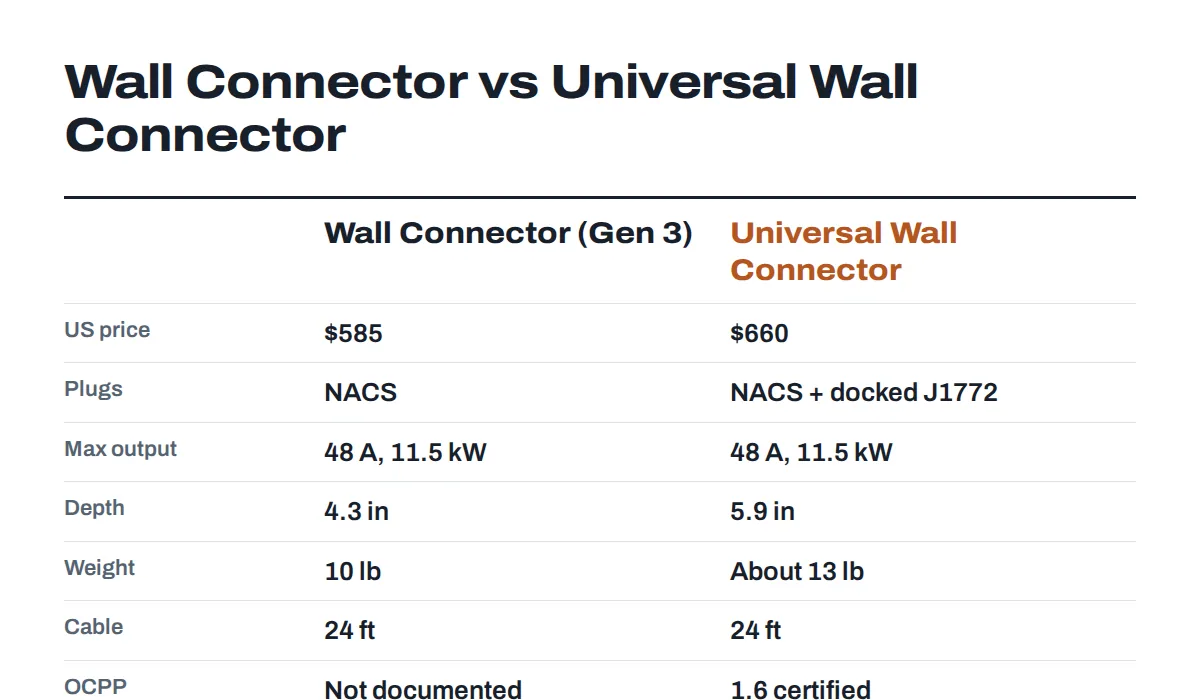
What is identical
Most of the hardware is shared. Both units:
- Deliver 12 to 48 A on a single-phase 200 to 240 V supply, up to 11.5 kW on a 60 A breaker, with the same breaker table.
- Need the same circuit: 6 AWG 90 C THWN-2 copper with a 75 C-rated breaker for full power, or 4 AWG with a 60 C-rated breaker, and no neutral.
- Carry a 24 ft cable, run from -22 F to 122 F, and are rated Type 3R and IP54 for indoor or outdoor mounting.
- Join 2.4 GHz Wi-Fi (see how to connect it to Wi-Fi for the router side), take automatic firmware updates, appear in the Tesla app, and share power with up to six units.
- Get a 4-year residential warranty and support Powershare home backup from a 2024-model-year Cybertruck or later truck.
A Tesla plugged into either one charges at the same speed: up to 44 miles of range per hour for a Model 3 or Model Y Long Range, less for a base trim that tops out at 32 A (see how many amps your Tesla can take). Installation is the same job at the same price, which Tesla estimates at $750 to $1,500 for a typical run. Our guide to Tesla charger install costs breaks that range down.
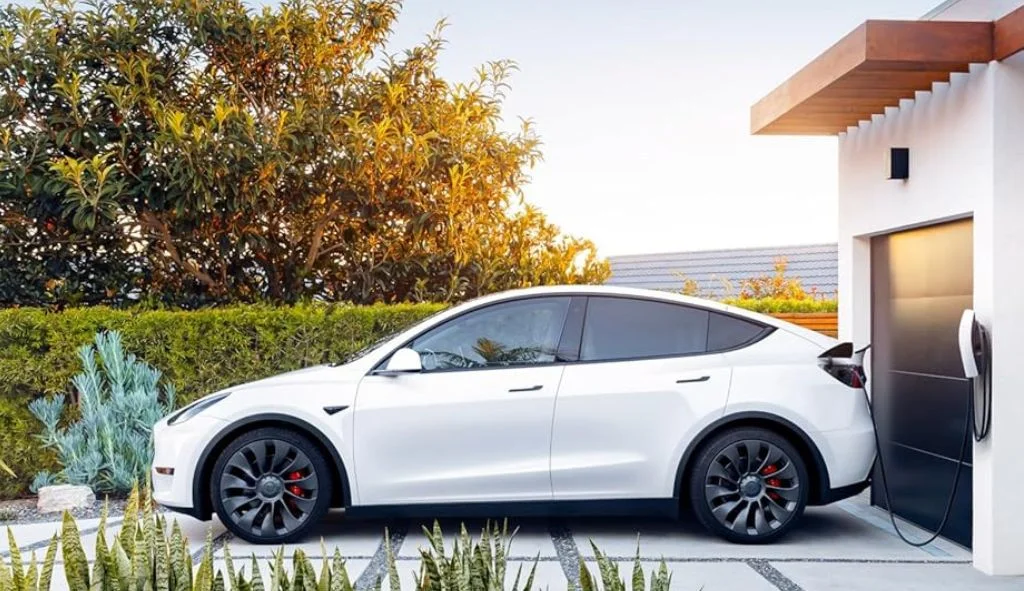
What the Universal adds
A J1772 adapter that cannot go missing
The adapter is the whole point. It lives in a dock on the side of the unit. A Tesla driver lifts the NACS handle and plugs in as normal. A J1772 driver presses the black button on the docked adapter and lifts the handle out with the adapter attached, so it goes straight into a J1772 port. When the handle goes back, the adapter goes back with it. Tesla built the same idea into Supercharger "Magic Dock" stalls for CCS cars.
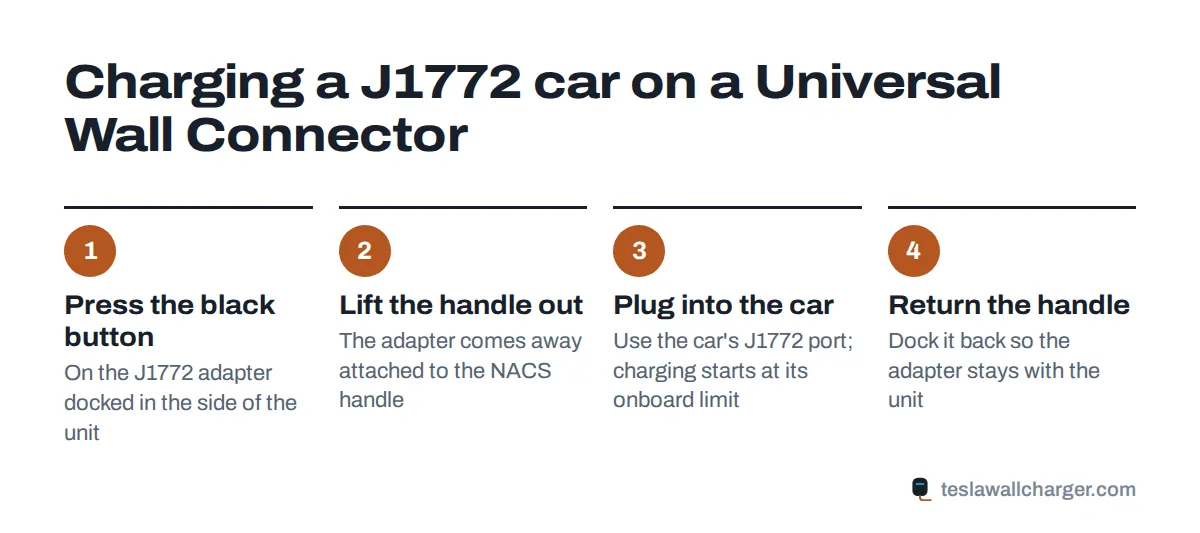
That design solves a real annoyance with the standard unit. A loose NACS-to-J1772 adapter gets left in a friend's car, dropped in a puddle or simply lost, and a cheap one may not be rated for 48 A.
One point that confuses Tesla owners: the J1772 adapter that comes with every new Tesla works in the opposite direction. It lets your Tesla use public J1772 chargers. It will not let a J1772 car use your Wall Connector.
OCPP for shared and commercial sites
The Universal Wall Connector is certified by the Open Charge Alliance for OCPP 1.6 (certificate dated September 30, 2024). OCPP is the protocol third-party charging networks and property management platforms use to bill users, track sessions and control access. Tesla has not documented OCPP support on the standard Wall Connector. For a condo garage, a workplace or a small business that wants to charge drivers, that alone can decide it.
Commercial installs also change the warranty: 12 months instead of 48 for any location where people other than the owner can reasonably use the charger.
Compatibility Mode for older EVs
Some older non-Tesla vehicles fault when they first talk to the unit. The Universal has an optional Compatibility Mode access setting for them. It trades away some software features to get a stable session, so leave it off unless a specific car needs it.
Where the Universal is worse
- Depth. It projects 5.9 in from the wall against 4.3 in for the standard unit. In a tight garage where a mirror or a door swings past the charger, that 1.6 in matters.
- Weight. About 13 lb with the wirebox per the installation manual (Tesla's datasheet says 15 lb with bracket) against 10 lb.
- Price. $75 more today, and the gap has moved around since launch.
- More to break. The adapter latch and its release button are moving parts the standard unit does not have. We have not seen published failure data either way, but it is one more thing that can wear.
Is the Universal worth it? Three common households
Tesla only, now and next
Buy the standard Wall Connector. A Tesla never uses the J1772 adapter, and since most automakers committed to building NACS (SAE J3400) charge ports from 2025, your next car, Tesla or not, is likely to plug straight into a NACS handle anyway. The DOE and DOT's connector explainer tracks that switch.
One Tesla and one J1772 car
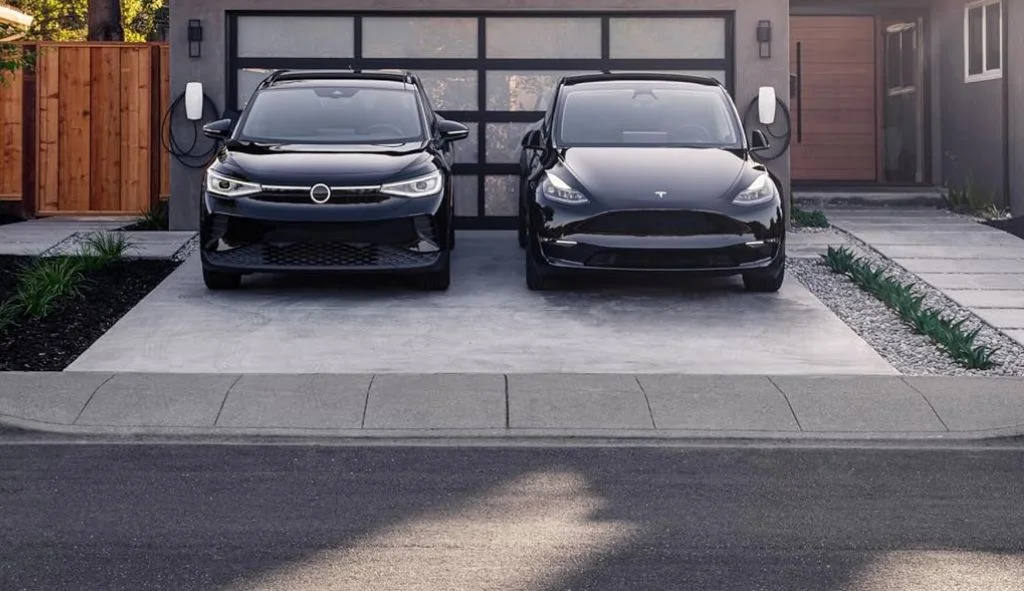
This is the Universal's best case. Run the numbers on two options for a typical install:
| Universal Wall Connector | Gen 3 plus a loose adapter | |
|---|---|---|
| Hardware | $660 | $585 plus a NACS-to-J1772 adapter |
| Installation (Tesla's estimate) | $750 to $1,500 | $750 to $1,500 |
| Adapter rated for full output | Built in, 48 A | Depends on the adapter you buy |
| Adapter storage | Docked in the unit | Your job |
| Total before adapter | $1,410 to $2,160 | $1,335 to $2,085 |
A decent third-party adapter can eat most of the $75 gap, and it has to be stored, kept dry and not lent out. If the J1772 car charges at home most nights, the Universal is the better buy. If it visits twice a year, a separate adapter is fine. Our page on how to charge a non-Tesla EV on a Wall Connector explains what to look for in that adapter.
Rental, condo or small business
The Universal, for OCPP and because you cannot know what your tenants or customers will drive. Ask the property's software provider to confirm OCPP 1.6 compatibility before ordering.
Specifications side by side
| Spec | Wall Connector (Gen 3) | Universal Wall Connector |
|---|---|---|
| US price (October 13, 2026) | $585, out of stock | $660, out of stock |
| Connectors | NACS | NACS with docked J1772 adapter |
| Output | 12 to 48 A, up to 11.5 kW | 12 to 48 A, up to 11.5 kW (any EV; car may limit) |
| Supply | 200 to 240 V single-phase | 200 to 240 V single-phase |
| Dimensions (H x W x D) | 13.6 x 6.1 x 4.3 in | 13.6 x 6.1 x 5.9 in |
| Weight | 10 lb with wirebox | About 13 lb (manual); 15 lb (datasheet) |
| Cable | 24 ft (7.3 m) | 24 ft (7.3 m); datasheet also lists a 13.1 ft version |
| Enclosure | Type 3R, IP54 | Type 3R, IP54 |
| Wi-Fi | 2.4 GHz 802.11b/g/n | 2.4 GHz 802.11b/g/n |
| Power sharing | Up to 6 | Up to 6 (1 leader, 5 followers) |
| OCPP | Not documented | 1.6 certified |
| Safety listing | cULus E351001 | ETL/cETL in the manual; cULus E351001 on the datasheet |
| Part number | 1457768-xx-x | 1734412-02-X (24 ft), 1734412-03-X (13.1 ft) |
| Residential warranty | 48 months | 48 months |
Tesla's Universal documents disagree on weight and listing body, so both are shown. For the complete electrical table, including miles per hour at every breaker size, see our Wall Connector specs page.
Questions to settle before you order
Work through these with your electrician before you pick a model:
- What will plug in over the next five years? Count cars with J1772 ports, including visitors who charge overnight.
- How much wall depth do you have? Measure from the wall to the nearest door swing or mirror path; the Universal needs 5.9 in.
- Is the site shared or billed? If yes, the Universal's OCPP certification and the 12-month commercial warranty both apply.
- Will you add units later? Both share power across up to six Gen 3-family units, but not with a Gen 2 Wall Connector.
- Is stock available? Both were out of stock on October 13, 2026, and purchase requires a Tesla account with a vehicle. Plan the circuit first; the hardware swap later is four screws.
Whichever you choose, the circuit, permit and commissioning are the same, and our Tesla charger installation steps cover them.
Questions about the Universal Wall Connector
Is a Tesla charger universal?
The standard Tesla Wall Connector is not. Its only plug is NACS, so cars with a J1772 port need an adapter. The Universal Wall Connector is the exception: it carries a J1772 adapter docked in the side of the unit, so it can charge virtually any EV sold in North America without the owner bringing anything.
Does the Universal Wall Connector have an app?
It uses the same Tesla app as the standard Wall Connector for status, schedules and session history once it is on your 2.4 GHz Wi-Fi. Installers commission it in Tesla One version 10.8 or newer. It is also OCPP 1.6 certified, which lets property managers connect it to third-party charging management software.
Can I convert my Wall Connector into a Universal Wall Connector?
Tesla does not sell a conversion kit, and the Universal's body is deeper to house the adapter dock, so the two are separate products. If you already own a Gen 3 and only occasionally charge a J1772 car, a NACS-to-J1772 adapter rated for the current you will use is the cheaper route. Store it somewhere it cannot walk off.
What do I do if the J1772 adapter will not come off the car?
Check the car first. With a J1772 vehicle on a Universal Wall Connector, the handle releases only when the car itself is not locked, so open the car with its key or app and try again. If the adapter will not release from the dock, press the black button on the adapter firmly while lifting the handle.
Do non-Tesla EVs charge as fast on the Universal?
The Universal supplies up to 48 A, 11.5 kW, to any car, so the limit is the car's onboard charger. Many non-Tesla EVs accept 11 kW or less on AC, and some older models charge at 7 kW or below. Tesla also offers a Compatibility Mode for older vehicles that fault, at the cost of some software features.
Does the Universal Wall Connector work with Cybertruck Powershare?
Yes. Tesla lists Cybertruck Powershare home backup support for the Universal Wall Connector, and its owner's manual says Powershare uses either the Universal or Wall Connector 3 depending on the home's setup, with a Powershare Gateway in typical whole-home installs. A 2026 software update added sharing into a Powerwall 3 during outages.
Sources
- Tesla Shop: Universal Wall Connector, shop.tesla.com
- Tesla Shop: Wall Connector, shop.tesla.com
- Tesla Universal Wall Connector installation manual, energylibrary.tesla.com
- Tesla Universal Wall Connector datasheet, energylibrary.tesla.com
- Open Charge Alliance OCPP 1.6 certificate for Tesla, openchargealliance.org
- Electrek: Tesla launches Universal Wall Connector (August 2023), electrek.co
- Tesla North: 2026 Wall Connector price increases, teslanorth.com
- U.S. DOT and DOE: charging connector types and SAE J3400, driveelectric.gov
Independent site. Not affiliated with or endorsed by Tesla, Inc. Tesla, Wall Connector and Supercharger are trademarks of Tesla, Inc.