A 2017 Tesla Model 3 is worth buying only if the battery checks out and the price allows for the fact that its factory battery coverage has ended or soon will. Tesla built a single version that year, the Long Range rear-wheel drive with 310 miles of EPA range, so the decision comes down to the condition of one particular car rather than picking a trim.
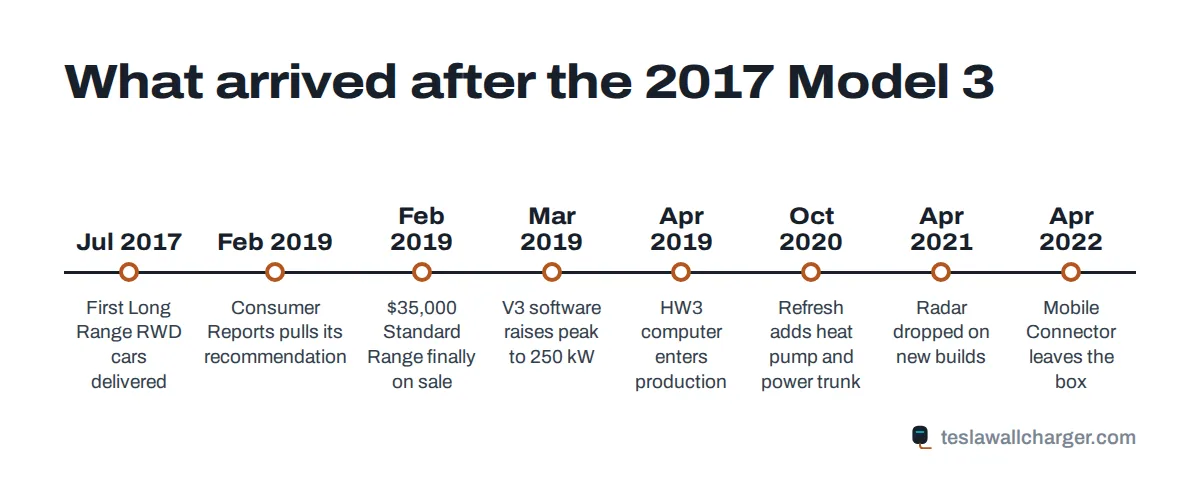
These were the first customer cars off the Fremont line, delivered from July 2017. They drive much like a 2019 Long Range, but they missed several hardware changes, and they were built while Tesla was still sorting out paint and trim quality.
One version: 310 miles and a 48 A charger
The $35,000 Standard Model 3 was announced for 2017 but did not reach customers until February 2019. Every 2017 car is therefore the Long Range RWD, priced at launch at $44,000 before destination: the $35,000 base plus $9,000 for the long-range battery.
| Trim | EPA range | Efficiency | Home AC max | Price (USD) |
|---|---|---|---|---|
| Long Range RWD | 310 mi | 27 kWh/100 mi | 11.5 kW | $44,000 |
What you get, by the numbers:
- EPA range: 310 miles, 126 MPGe combined (about 27 kWh per 100 miles).
- Battery: roughly 75 kWh, Panasonic NCA cells. Tesla never published usable capacity, so treat that as approximate.
- Performance: Tesla quoted 0 to 60 mph in 5.1 seconds and a 140 mph top speed.
- Onboard charger: 11.5 kW (48 A), the full rate a Gen 3 Wall Connector can supply.
- Supercharging: up to 250 kW peak, but only after Tesla's V3 software in March 2019. Delivered cars charged slower at first.
Under the skin, a 2017 has the earlier Autopilot computer (HW3 arrived around April 2019), forward radar, ultrasonic parking sensors, the Intel Atom media computer, a manual trunk and resistive cabin heating. That last point matters most in cold states: without the heat pump that came with the October 2020 refresh, heating the cabin takes a bigger bite out of winter range.
Early-build quality: what to inspect in person
Consumer Reports withdrew its Model 3 recommendation in February 2019 after its owner survey showed paint, trim and body hardware problems. Owners also reported stress cracks in the rear glass and sticky door latches. On a launch-year car, assume any of these could be present and check for yourself:
- Paint: look along the edges of the hood, trunk lid and door shuts for thin coverage, chips and mismatched panels.
- Panel gaps: compare left and right sides at the trunk and frunk. Uneven gaps on an early car can be factory, but large ones can also mean crash repair.
- Glass: inspect the rear window and roof glass for cracks that start at an edge.
- Doors and latches: open and close every door several times, from the inside and outside.
- Trunk camera cable: open and close the trunk a few times while watching the reversing camera feed. A flickering or blank image points to the harness covered by recall 21V00D000.
NHTSA has not published a crash rating for the 2017 model year, so there is no star rating to quote. The complaint file is small: 26 complaints in total, led by forward collision avoidance, airbags, seat belts and seats.
26 owner complaints filed with NHTSA for the 2017 Model 3. Most frequent areas (approximate order): forward collision avoidance; air bags; seat belts; seats; unknown or other; vehicle speed control. Source: NHTSA complaints database.
The recall record: 15 campaigns, two need a shop
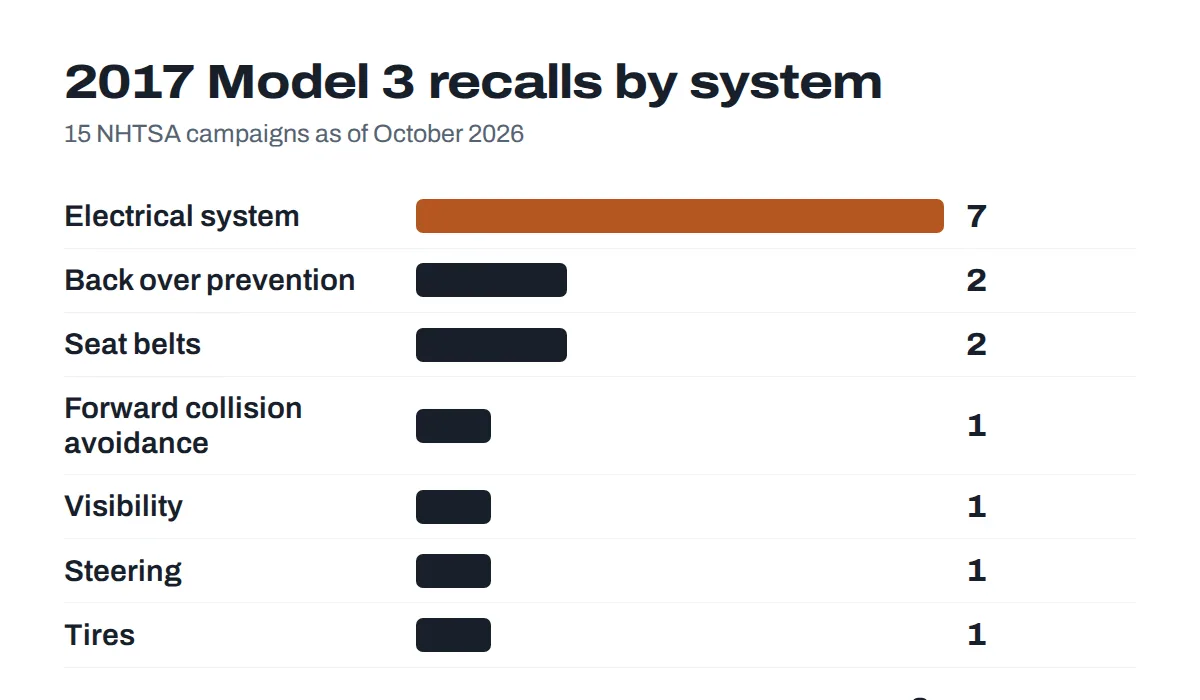
As of October 2026 NHTSA lists 15 recall campaigns for the 2017 Model 3. Thirteen were fixed by over-the-air software, which a car that connects to Wi-Fi or LTE will already have. Only two need a person with tools:
| Campaign | Problem | What to ask the seller |
|---|---|---|
| 21V00D000 | Trunk opening and closing can wear through the rearview camera harness | Service record showing the harness protection was fitted |
| 22V798000 | Second-row left buckle and center belt anchor may have been refitted wrongly after earlier service | Only matters if the rear seat was removed in service; confirm the inspection was done |
Two software recalls only apply if the car uses Full Self-Driving: 22V037000 (rolling stops) and 23V085000 (intersection behavior). The Autosteer driver-monitoring recall 23V838000 came out of NHTSA's EA22-002 investigation, and NHTSA's newer EA26-002 probe into FSD in fog and glare also covers 2017 cars that run FSD.
The 2017 list does not include the front suspension lateral link fastener recalls or the 2026 headlight brightness recall that appear on later model years. Run the VIN on NHTSA's recall lookup anyway, because coverage is decided per car, not per year.
- 21V846000October 29, 2021Forward collision avoidance, sensing system, cameraSoftware update
Communication error may cause false forward collision warnings or unexpected automatic emergency braking - 21V00D000December 21, 2021Electrical system, wiring, rear compartment/trunkService visit
Opening and closing the trunk can damage the rearview camera cable harness (campaign number as given by the API) - 22V037000January 27, 2022Electrical system, adas, autonomous/self driving, softwareSoftware update
FSD Beta 'rolling stop' could let the car pass through all-way stops without stopping - 22V045000February 1, 2022Electrical system, softwareSoftware update
Seat belt chime may not sound at startup for an unbelted driver - 22V063000February 4, 2022Electrical system, softwareSoftware update
Boombox sounds may mask Pedestrian Warning System sounds (superseded by 22V235000) - 22V169000March 18, 2022Back over prevention, display functionSoftware update
Rearview camera image may not display immediately when reversing
Show all 15 recalls
- 22V235000April 12, 2022Electrical system, softwareSoftware update
Boombox sounds may mask Pedestrian Warning System sounds; replaces 22V063000 - 22V702000September 19, 2022Visibility, power window devices and controlsSoftware update
Window automatic reversal may not react correctly after detecting an obstruction (pinch risk) - 22V798000October 21, 2022Seat belts, rear/other, anchorageService visit
Second-row left buckle and center belt anchor may have been reassembled incorrectly during service - 23V085000February 15, 2023Steering, automated/adaptive steeringSoftware update
FSD Beta may act unsafely at intersections and respond poorly to speed limit changes - 23V838000December 12, 2023Electrical system, adas, autonomous/self driving, softwareSoftware update
Autosteer controls may not be sufficient to prevent driver misuse - 24V051000January 30, 2024Electrical system, instrument cluster/panelSoftware update
Brake, park and ABS warning lights shown in a font smaller than required - 24V376000May 28, 2024Seat belts, front, warning light/devicesSoftware update
Unbelted-driver warning light and chime may not activate - 24V935000December 17, 2024Tires, pressure monitoring and regulating systemsSoftware update
TPMS warning light may not stay on between drive cycles - 26V283000May 5, 2026Back over prevention, softwareSoftware update
Rearview camera image may be delayed when shifting to reverse on software 2026.8.6; remedy text says OTA (API OTA flag: false)
Source: NHTSA recalls API. A recall only applies if your VIN is listed.
Warranty in 2026: assume you are on your own
The 4-year, 50,000-mile basic warranty ended years ago. The one that matters is the battery and drive unit warranty: 8 years from the in-service date, with a 120,000-mile cap for Long Range cars and a guarantee of at least 70% capacity, under Tesla's current warranty terms.
The math is simple. A car delivered in December 2017 lost that coverage in December 2025. Some late deliveries may have a few months left in 2026, but none will reach 2027. A replacement pack or drive unit is now the buyer's cost, which is why the battery check carries more weight here than on any later Model 3 year.
For a rough health check, charge to a known level and compare the range the car shows with what a new car showed at the same level. Tesla's 2023 Impact Report put average Model 3 and Model Y capacity loss at about 15% after 200,000 miles, so a much larger drop on a lower-mileage car is a warning sign.
Charging a 2017 Model 3 at home
The 48 A onboard charger is the useful part of buying a Long Range: a 2017 can use every amp a Wall Connector supplies. Tesla's current Model 3 figures by circuit:
| Setup | Breaker | Car draws | Range added per hour |
|---|---|---|---|
| Gen 3 Wall Connector | 60 A | 48 A (11.5 kW) | up to 44 mi |
| Gen 3 Wall Connector | 50 A | 40 A (9.6 kW) | up to 37 mi |
| Gen 3 Wall Connector | 40 A | 32 A (7.7 kW) | up to 30 mi |
| Mobile Connector, NEMA 14-50 | 50 A | 32 A | about 30 mi |
| Mobile Connector, 120 V outlet | 15 A | 12 A | 2 to 3 mi |
From empty, a 60 A Wall Connector refills the pack in about 7 hours by our estimate (75 kWh at 11.5 kW and roughly 90% charging efficiency). If your panel cannot spare 60 A, a dryer-style 14-50 outlet still covers about 30 miles per hour overnight. For the wire and breaker pairing, see our page on Wall Connector breaker sizes, and budget with our breakdown of what an electrician charges to fit a Wall Connector.
| How you charge | Speed |
|---|---|
| Wall Connector at 48 A (11.5 kW, 60 A breaker) | up to 44 mi of range per hour |
| NEMA 14-50 outlet, Mobile Connector at 32 A | about 30 mi per hour |
| Regular 120 V outlet | 2 to 3 mi per hour |
| Empty to full, largest pack (about 75 kWh) | about 7 hours at 11.5 kW |
Rates scale Tesla's published Wall Connector table for this model; older cars and cold batteries charge slower. Times are estimates.
Running cost is easy to estimate. At the EPA's 27 kWh per 100 miles and the US average residential rate of 18.31 cents per kWh (EIA, July 2026), 1,000 miles costs about $49 at home. Your own price per kWh to charge may be much higher or lower depending on your utility and time-of-use plan.
Two accessories to ask about. Every 2017 was sold with a Mobile Connector, since Tesla only stopped boxing it with orders from late April 2022, so it should come with the car. The J1772 adapter also shipped with every Tesla. For DC fast charging on CCS networks, some older Model 3s need a $330 retrofit plus adapter (as of October 2026); check eligibility in the Tesla app before you count on CCS fast charging.
Who a 2017 suits, and who should keep looking
A 2017 makes sense if you:
- drive mostly local miles and can charge at home every night;
- get a documented battery health check and a price well under a 2019 or 2020 Long Range;
- do not care about Full Self-Driving, or the seller can show the computer upgrade was done;
- live where winters are mild, since there is no heat pump.
Look at newer years instead if you want warranty cover on the battery, HW3 from the factory or better cold-weather efficiency. The 2018 Model 3 adds all-wheel drive, a 2019 Model 3 built after mid-April has HW3, and the refreshed Tesla Model 3 2021 brings the heat pump. Our guide to Model 3 years to avoid puts all of them side by side.
Questions 2017 Model 3 shoppers ask
What is the range of a 2017 Tesla Model 3?
The EPA rated the only 2017 version, the Long Range rear-wheel drive, at 310 miles with 126 MPGe combined. That is the new-car figure. After eight or nine years most packs show less, and Tesla's own data for Model 3 and Model Y points to roughly 15% capacity loss after 200,000 miles, so check the rated range the car displays at a known charge level.
Does a 2017 Model 3 still have battery warranty?
Probably not for long, if at all. Tesla's battery and drive unit warranty runs 8 years from the in-service date, with a 120,000-mile cap for Long Range cars under its current terms. Deliveries began in July 2017, so the earliest cars lost coverage in mid-2025. Ask the seller for the original delivery date and confirm it with Tesla.
Does a 2017 Model 3 have HW3?
Not from the factory. The Full Self-Driving computer, often called HW3, went into Model 3 production around April 2019. A 2017 car shipped with the earlier Autopilot computer. Tesla upgraded the computer on cars whose owners bought Full Self-Driving, so check Controls > Software > Additional Vehicle Information to see what is fitted.
How long does a 2017 Model 3 take to charge at home?
On a Wall Connector with a 60 A breaker it charges at 48 A, adding up to 44 miles of range per hour, or roughly 7 hours from empty to full by our estimate. A NEMA 14-50 outlet with the Mobile Connector gives about 30 miles per hour. A standard 120 V outlet adds only 2 to 3 miles per hour.
Is the 2017 one of the Model 3 years to avoid?
It is the riskiest Model 3 year rather than one to rule out. Consumer Reports flagged paint, trim and body hardware problems on early cars, and these are the oldest batteries on the road with the least warranty left. A well-kept example at a fair price can still make sense for short daily driving with home charging.
Sources
- NHTSA recalls API, 2017 Tesla Model 3 (queried October 13, 2026), api.nhtsa.gov
- NHTSA complaints API, 2017 Tesla Model 3, api.nhtsa.gov
- CleanTechnica: Tesla Model 3 will come in Standard and Long Range (July 29, 2017), cleantechnica.com
- TechCrunch: Consumer Reports pulls Model 3 recommendation (February 21, 2019), techcrunch.com
- TechCrunch: Tesla's computer is now in all new cars (April 22, 2019), techcrunch.com
- InsideEVs: Tesla reveals Supercharger V3, up to 250 kW (March 6, 2019), insideevs.com
- MPG Buddy: 2017 Model 3 Long Range (EPA data), mpgbuddy.com
- Tesla support: vehicle warranty, tesla.com
- Tesla support: Wall Connector charging speeds, tesla.com
- EIA Electric Power Monthly: average residential price, eia.gov
Independent site. Not affiliated with or endorsed by Tesla, Inc. Tesla, Wall Connector and Supercharger are trademarks of Tesla, Inc.