The 2019 Tesla Model S comes in two forms. Early-2019 cars are carry-over 75D, 100D and P100D models (259 to 335 miles EPA), while cars built from the April 23, 2019 "Raven" update have a permanent-magnet front motor, adaptive air suspension, HW3 and up to 370 miles of range. Every 2019 has the MCU2 screen and 48 A charging. If the budget stretches, a Raven Long Range is the 2019 to find.
What changed on April 23, 2019
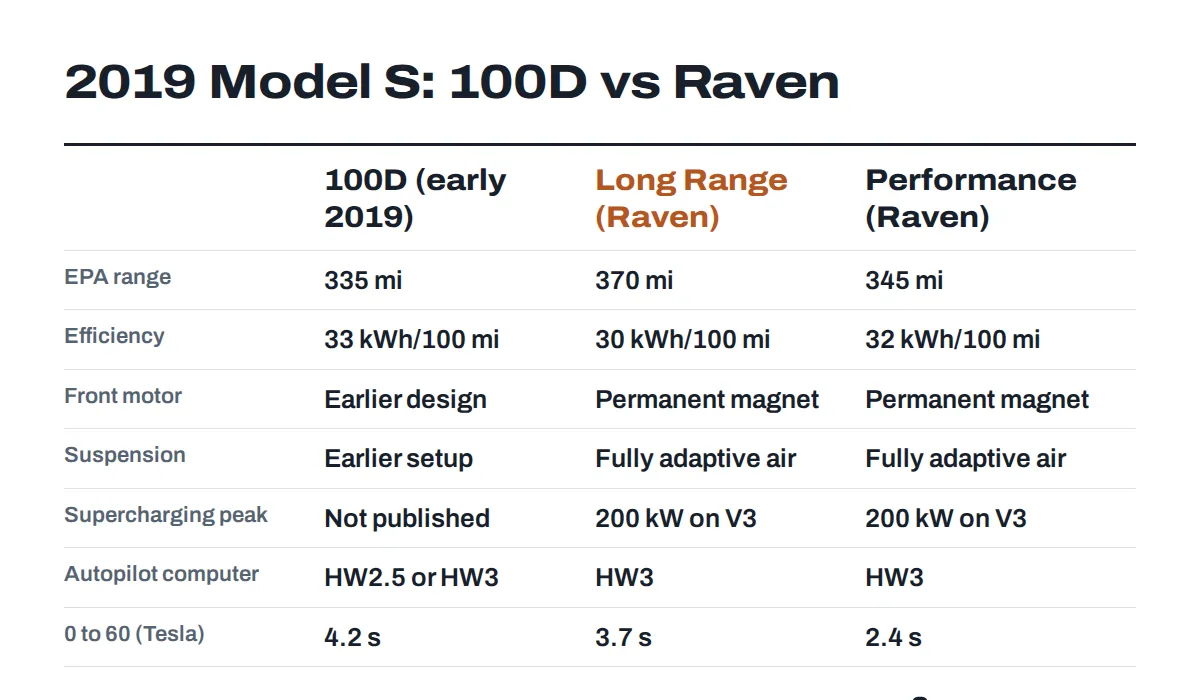
The update gave the car a permanent-magnet synchronous reluctance front motor, paired with the existing rear induction motor, and fully adaptive air suspension. The efficiency gain shows in EPA's numbers: the Long Range uses about 30 kWh per 100 miles against 33 for the 100D, and its rating jumped from 335 to 370 miles from what is broadly the same 100 kWh battery.
Fast charging improved too. Raven cars were rated for up to 200 kW on Tesla's new V3 Superchargers and 145 kW on V2 sites. In June 2020, Electrek reported that software 2020.24.6 raised the V3 peak to 225 kW on eligible Raven cars, so the figure a given 2019 car reaches depends on its software and build.
At the same time Tesla brought back a Standard Range car at $78,000 with 285 miles of EPA range (Tesla did not disclose its pack size), and dropped the rear-facing jump seat option, according to Consumer Guide.
HW3, the other spring 2019 change
Separate from Raven, Tesla's own Full Self-Driving computer, HW3, entered Model S production around March 22, 2019 (TeslaTap's date; Tesla's first-quarter letter confirms production started that quarter). So:
- January to mid-March 2019 builds: HW2.5.
- Late March and April 2019 builds: likely HW3, still pre-Raven.
- Late April 2019 onward: Raven with HW3.
A HW2.5 car with purchased Full Self-Driving qualifies for a free HW3 swap. Look under Controls, Software, Additional Vehicle Information to see which computer is fitted.
2019 versions and EPA range
| Trim | EPA range | Efficiency | Home AC max | Price (USD) |
|---|---|---|---|---|
| 75D | 259 mi | 33 kWh/100 mi | 11.5 kW | n/a |
| 100D | 335 mi | 33 kWh/100 mi | 11.5 kW | n/a |
| P100D | 315 mi | 34 kWh/100 mi | 11.5 kW | n/a |
| Standard Range | 285 mi | 31 kWh/100 mi | 11.5 kW | $78,000 |
| Long Range | 370 mi | 30 kWh/100 mi | 11.5 kW | $79,990 |
| Performance (19 in wheels) | 345 mi | 32 kWh/100 mi | 11.5 kW | $99,990 |
| Performance (21 in wheels) | 325 mi | 35 kWh/100 mi | 11.5 kW | $99,990 |
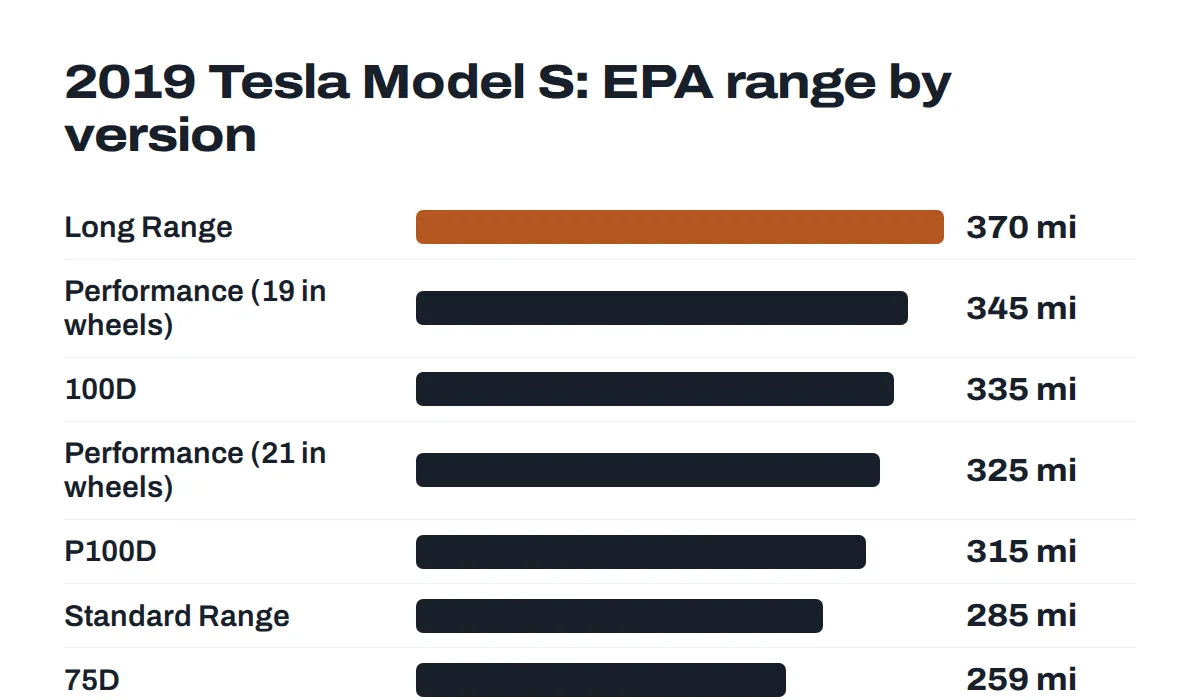
Wheel size matters on the Performance car: EPA rated it at 345 miles on 19-inch wheels and 325 on 21s. Launch prices per Consumer Guide were $79,990 for the Long Range and $99,990 for the Performance, though Tesla changed 2019 prices several times.
Battery chemistry is NCA throughout, and the Long Range and Performance use a pack of about 100 kWh. All 2019 cars carry radar and ultrasonic parking sensors, which Tesla only started removing from the Model S in 2022 and 2023.
Charging a 2019 at home
Every 2019 Model S accepts 48 A (11.5 kW). That is the maximum of Tesla's current Gen 3 and Universal Wall Connectors, so either one on a 60 A breaker gives the car all it can take. By EPA-based estimates, that adds about 38 miles of range per hour to a Raven Long Range and about 35 to a 100D. Tesla's own table says up to 41 miles per hour for a Model S at 48 A, a figure based on newer, more efficient cars.
From empty, a 100 kWh pack takes roughly 9.5 hours at 48 A and a 75 kWh pack about 7 hours, by our calculation. A NEMA 14-50 outlet with the current Mobile Connector (32 A) adds roughly 23 to 25 miles per hour, enough for most commutes overnight.
Whether any 2019 car was built with the optional 72 A charger is not something we could verify; TeslaTap says the option ended in late 2018. The charging screen will show the car's maximum. If it reads 48, a Gen 2 Wall Connector set higher adds nothing.
Useful next steps: how to size the breaker and wire for 48 A, our installing a Tesla wall charger guide, and Tesla charging times by charger. All of it is work for a licensed electrician with a permit.
On road trips beyond the Supercharger network, Tesla's CCS1 adapter ($300, out of stock as of October 2026) opens up third-party DC fast chargers. Tesla says some older Model S and X need a retrofit first ($380 including the adapter); the Tesla app shows whether your VIN does. See using CCS chargers with a Tesla for details.
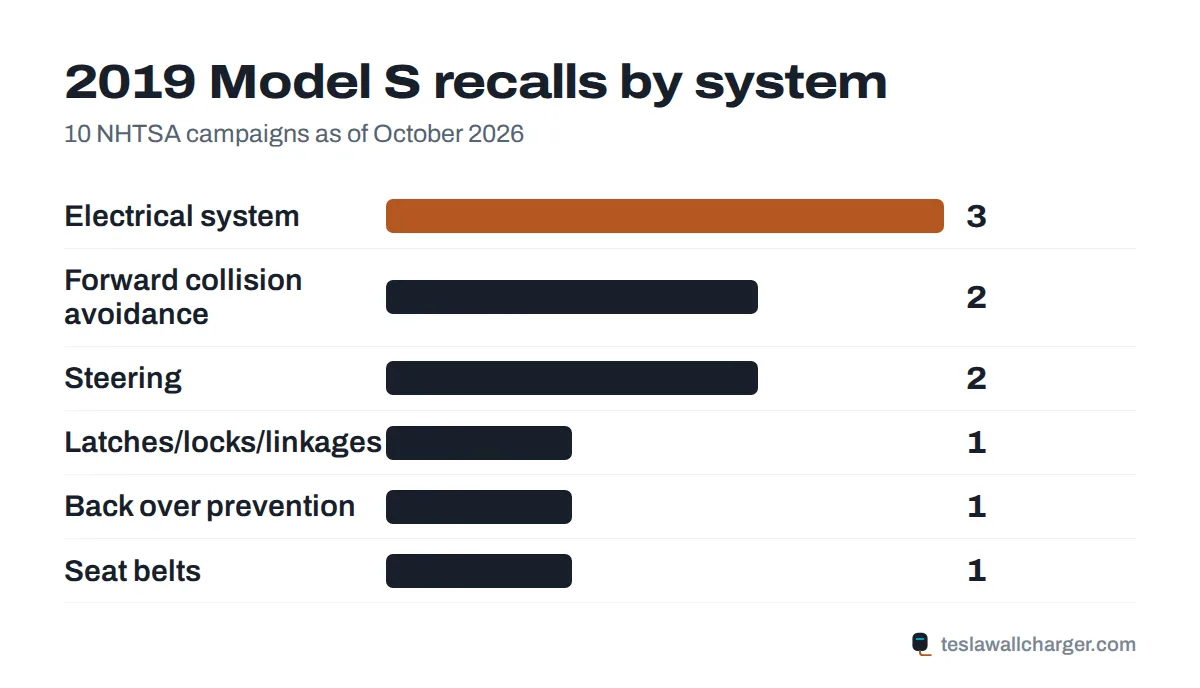
Recalls, complaints and safety data
NHTSA lists 10 recalls for the 2019 Model S, and only one needs a service visit: 21V00B, the frunk latch realignment. Because every 2019 car has MCU2, the MCU1 memory recall does not apply. The over-the-air fixes cover false forward-collision braking (21V846), a delayed rearview camera image (22V169), power steering assist loss on rough roads (22V818), FSD Beta behavior (22V037, 23V085), Autosteer driver monitoring (23V838) and three compliance items.
- 21V846000October 29, 2021Forward collision avoidance, sensing system, cameraSoftware update
Software communication error may cause false forward-collision warnings or unexpected automatic emergency braking - 21V00B000December 21, 2021Latches/locks/linkages, hood, latchService visit
Front trunk (frunk) latch may be misaligned so the secondary latch does not engage; hood could open unexpectedly - 22V037000January 27, 2022Electrical system, adas, autonomous/self driving, softwareSoftware update
FSD (Beta) 'rolling stop' could let the car roll through all-way stop intersections; feature disabled - 22V169000March 18, 2022Back over prevention, display functionSoftware update
Rearview camera image may be delayed when the car starts reversing - 22V818000November 1, 2022Steering, electric power assist systemSoftware update
Power steering assist may be lost on rough roads or after a pothole; EPAS recalibrated - 23V085000February 15, 2023Steering, automated/adaptive steeringSoftware update
FSD Beta may act unsafely around intersections and respond poorly to speed limit changes
Show all 10 recalls
- 23V838000December 12, 2023Electrical system, adas, autonomous/self driving, softwareSoftware update
Autosteer driver-engagement controls may be insufficient to prevent misuse (followed NHTSA EA22-002) - 24V051000January 30, 2024Electrical system, instrument cluster/panelSoftware update
Brake, park and ABS warning lights shown in a font too small to meet FMVSS 105/135 - 24V153000February 27, 2024Forward collision avoidance, warnings, external/pedestrian alertSoftware update
A factory reset could mute the Pedestrian Warning System sounds (fixed in 2023.44.30.14) - 24V376000May 28, 2024Seat belts, front, warning light/devicesSoftware update
Driver seat belt warning light and chime may not activate when unbelted (FMVSS 208)
Source: NHTSA recalls API. A recall only applies if your VIN is listed.
Owners have filed only 32 complaints with NHTSA for this year, the fewest of any Model S from 2012 to 2019. NHTSA rated the 2019 75D for rollover only (5 stars, 5.7% risk), with no published overall, frontal or side score.
| NHTSA test | Rating |
|---|---|
| Rollover | 5 stars |
| Rollover risk | 5.7% |
What a 2019 does not have
It has no heat pump; that came with the 2021 refresh, so cold-weather range losses are larger than on newer cars. It keeps the older interior with the portrait screen and conventional steering wheel. And the battery warranty, 8 years from first delivery, runs out around 2027; confirm the mileage limit and remaining cover by VIN.
Choosing between 2019 cars
- Best all-round: Raven Long Range, built late April 2019 or later.
- Fastest: Raven Performance, ideally on 19-inch wheels for range.
- Best value: an early-2019 100D with HW3 or purchased FSD, priced below a Raven.
- Skip unless cheap: early-2019 75D with HW2.5 and no FSD.
To see how the line-up evolved toward Long Range Plus, compare with the 2018 Tesla Model S and the 2020 Model S, or browse all Model S years.
Raven and 2019 Model S questions
What is a Raven Tesla Model S?
Raven is the owner nickname for Model S and X built after Tesla's April 23, 2019 drivetrain update. It added a permanent-magnet synchronous reluctance front motor alongside the rear induction motor, plus fully adaptive air suspension. The Long Range rose to 370 miles of EPA range and V3 Supercharging peaks reached 200 kW.
Does the 2019 Model S have HW3?
Cars built from roughly late March or April 2019 have HW3, Tesla's own Full Self-Driving computer, which entered production that spring. Earlier 2019 cars have HW2.5. Those HW2.5 cars qualify for a free HW3 computer swap only if Full Self-Driving was purchased, not subscribed. Check the computer listed under the software information screen.
Does the 2019 Model S have a heat pump?
No. The heat pump arrived on the Model S with the 2021 refresh. A 2019 car heats its cabin with resistive heating, so expect bigger range losses in cold weather than on a 2021 or later car. Preconditioning while plugged in at home helps, because the energy then comes from the wall, not the battery.
How fast does a 2019 Model S Supercharge?
Raven cars launched with up to 200 kW on V3 Superchargers and 145 kW on older V2 stations. In June 2020, software 2020.24.6 raised the V3 peak to 225 kW on eligible Raven cars, according to Electrek. Early-2019 75D, 100D and P100D cars had no published peak. Actual speed depends on battery temperature and charge level.
How do I charge a 2019 Model S at home?
Every 2019 Model S accepts 48 A, so a Gen 3 Wall Connector on a 60 A breaker delivers its full speed, about 35 to 38 miles of range per hour by EPA-based estimates. A NEMA 14-50 outlet with the current Mobile Connector gives about 23 to 25 miles per hour. Have a licensed electrician install either.
Sources
- NHTSA recalls API, 2019 Tesla Model S, api.nhtsa.gov
- NHTSA SafetyRatings API, 2019 Model S 75D (VehicleId 14096), api.nhtsa.gov
- Electrek: new Model S/X drivetrain, adaptive suspension, 370 mi, 200 kW (Apr 23, 2019), electrek.co
- Tesla Q1 2019 update letter (Form 8-K): FSD computer production, streetinsider.com
- Consumer Guide: 2019 Tesla Model S, consumerguide.com
- TeslaTap: Autopilot processors and hardware (MCU/HW) demystified, teslatap.com
- Tesla Shop: CCS Combo 1 Adapter, shop.tesla.com
- Tesla support: Wall Connector charging speeds, tesla.com
Independent site. Not affiliated with or endorsed by Tesla, Inc. Tesla, Wall Connector and Supercharger are trademarks of Tesla, Inc.