A 2012 Tesla Model S is a 14-year-old, first-production-year car: 85 kWh battery, 265 miles of EPA range when new, rear-wheel drive, no Autopilot hardware and the original MCU1 touchscreen. It can still be a fast, comfortable sedan for very little money, but only if the known early-build faults have been dealt with and you budget for repairs that are no longer under warranty.
What you are actually buying
Tesla started deliveries on June 22, 2012. The price list published in December 2011 promised 40, 60 and 85 kWh batteries plus an 85 kWh Performance car (P85), with ranges quoted at 55 mph before EPA testing. For the 2012 model year, EPA only published a rating for the 85 kWh car: 265 miles and 89 MPGe, or about 38 kWh per 100 miles. Most 2012 cars on the market are 85s or P85s.
Launch prices were $77,400 for the 85 and $87,400 for the P85, before the federal credit and destination. Tesla's pre-production 0 to 60 mph claims were 5.6 and 4.4 seconds.
Things a 2012 car does not have, and cannot be given:
- Autopilot of any kind. Hardware 1 arrived on builds from mid-September 2014, so if you want lane keeping, look at the 2015 Model S instead.
- All-wheel drive. Dual-motor "D" cars came in late 2014.
- An LTE modem from the factory. Cars built before June 2015 were 3G only and lost cellular service when AT&T shut 3G down in February 2022.
The Supercharger network itself only opened on September 24, 2012, with six sites in California. Confirm that Supercharging shows as active on the car you are looking at rather than assuming it.
Early-build problems that still decide the price
Consumer Reports pulled its Model S recommendation in October 2015 over drivetrain trouble, door handles that would not extend, screen faults, leaks, rattles and coolant pumps. It did not name model years, but a 2012 car has had the longest time to show every one of those faults.
The MCU1 screen
The 17-inch display runs on MCU1, an NVIDIA Tegra 3 board with 8 GB of eMMC flash memory. Constant logging wears that memory out. The failure starts with slow boots and random reboots, then lost navigation and cellular data, then a black screen. Because the screen also handles the backup camera and defrost, NHTSA treated it as a safety defect: preliminary evaluation PE20-010 in June 2020 became engineering analysis EA20-003, covering about 159,000 Model S and X.
Recall 21V035 replaces the board that carries the memory (the VCM daughterboard). The alternative is Tesla's paid Infotainment Upgrade to the newer Intel-based MCU2, which also fixes the 3G problem. Ask which one was done, and get the paperwork. A 2012 car with neither is a repair waiting to happen.
Drive unit and battery
Early drive units failed often enough that Edmunds' long-term 2013 Model S needed three in about 18 months. Tesla responded in August 2014 by extending drive unit coverage to 8 years and unlimited miles for 85 kWh cars, retroactively. That coverage ran out for 2012 cars around 2020. Ask how many drive units the car has had and when the last one went in.
Battery health matters more than mileage here. In 2019, Tesla pushed battery-management updates that cut usable charge on some older packs. NHTSA opened defect petition DP19-005 covering about 2,000 2012 to 2019 Model S and X, and a $1.5 million class settlement followed in 2021. If a seller says the car "lost range overnight" after an update, that history is real and worth asking about.
The underbody and the steering
After two road-debris fires in 2013, Tesla raised ride height in software and fitted a triple underbody shield (aluminum bar, titanium plate and aluminum extrusion) to bodies built from March 6, 2014, offering free retrofits to earlier cars. Put the car on a lift and look for it.
On the steering side, recall 18V204 covers 2012 to 2016 cars with the Bosch rack: aluminum bolts holding the assist motor can corrode and snap, and you lose power assist. The fix is new bolts and sealer.
2012 Model S recalls, complaints and crash data
NHTSA lists 8 recall campaigns for this year. Five were service visits (seat belt pretensioner attachment, the Takata passenger airbag inflator under 17V023, electric parking brake calipers, steering bolts and the MCU memory) and three were software updates pushed over the air. The Takata and steering campaigns are the ones a used buyer must see closed.
- 15V780000November 23, 2015Seat belts, frontService visit
Front seat belts may not be correctly attached to the outboard lap pretensioner - 17V023000January 10, 2017Air bags, frontal, passenger side, inflator moduleService visit
Passenger frontal air bag inflator may rupture on deployment after long-term heat/humidity exposure (Takata) - 17V260000April 19, 2017Parking brakeService visit
Electric parking brake caliper internal gear may break, leaving the car immobile or unable to hold position - 18V204000March 29, 2018Steering, electric power assist systemService visit
Aluminum bolts holding the power steering assist motor (Bosch rack) can corrode and break, reducing or removing power assist - 21V035000January 29, 2021Back over prevention, softwareService visit
MCU1 touchscreen eMMC memory wear can cause loss of rearview camera, defrost/defog controls and exterior turn signal lighting; VCM daughterboard replaced (firmware 2020.48.48.12+ also advised) - 23V838000December 12, 2023Electrical system, adas, autonomous/self driving, softwareSoftware update
Autosteer driver-engagement controls may be insufficient to prevent misuse (followed NHTSA EA22-002)
Show all 8 recalls
- 24V051000January 30, 2024Electrical system, instrument cluster/panelSoftware update
Brake, park and ABS warning lights shown in a font too small to meet FMVSS 105/135 - 24V376000May 28, 2024Seat belts, front, warning light/devicesSoftware update
Driver seat belt warning light and chime may not activate when unbelted (FMVSS 208)
Source: NHTSA recalls API. A recall only applies if your VIN is listed.
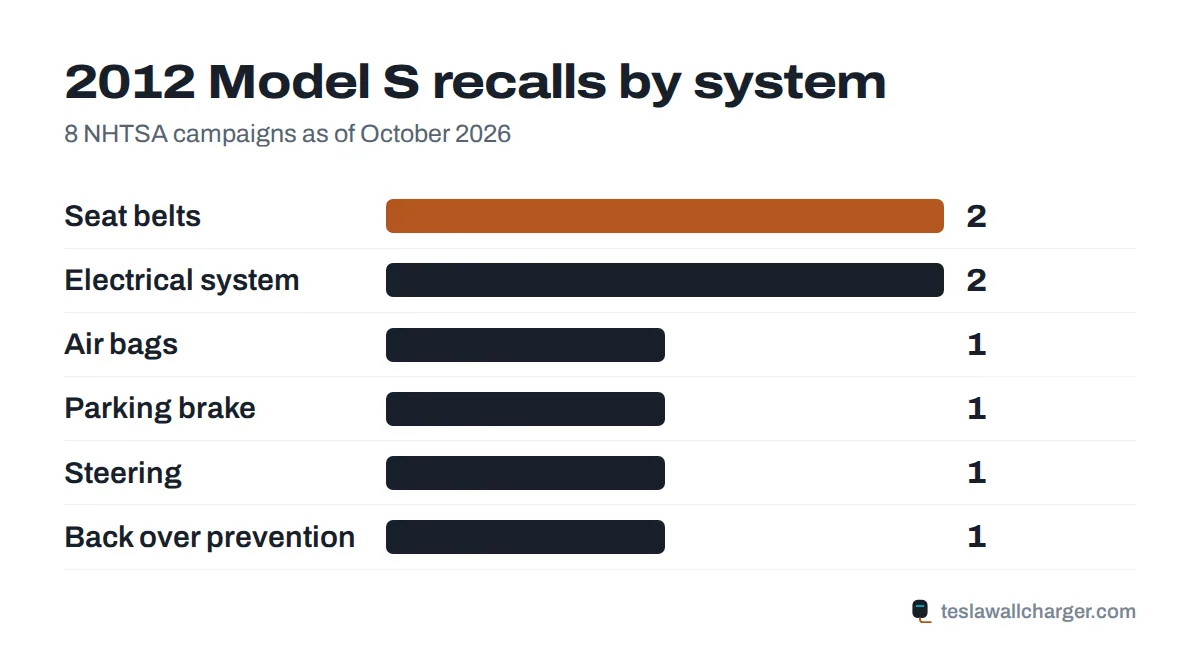
Only 59 owner complaints are on file with NHTSA for the 2012 model year, mostly electrical, followed by suspension, exterior lighting and wipers. That reflects how few 2012 cars were built, not reliability. NHTSA never published a crash-test rating for the 2012 Model S; the 2013 car was the first one rated.
Charging a 2012 Model S at home
This is where the classic car differs most from anything Tesla sells today. Every 2012 Model S has at least one onboard charger rated 40 A (9.6 kW at 240 V, sold as "10 kW"). Buyers could pay $1,500 for twin chargers, which together accept 80 A (19.2 kW, sold as "20 kW"). Plug the car into any 240 V source and the charging screen shows the maximum amps it will accept: 40 means single, 80 means dual.
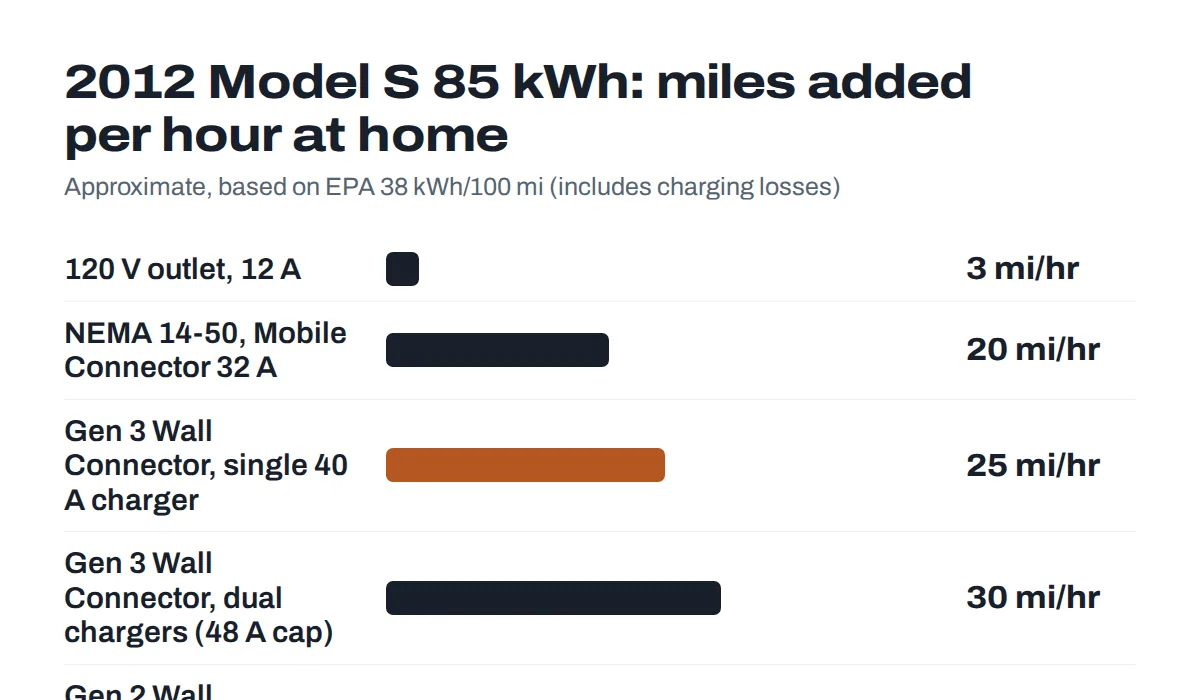
What that means in practice, using EPA's 38 kWh per 100 miles:
| Home setup | Current the car draws | Range added per hour (approx.) | Empty to full, 85 kWh |
|---|---|---|---|
| 120 V outlet | 12 A | 2 to 3 mi | days, not hours |
| NEMA 14-50, current Mobile Connector | 32 A | about 20 mi | about 15 h (scaled from EPA) |
| Gen 3 Wall Connector, single charger | 40 A | about 25 mi | about 12 h (EPA) |
| Gen 3 Wall Connector, dual chargers | 48 A | about 30 mi | about 10 h (scaled from EPA) |
| Gen 2 Wall Connector at 80 A, dual chargers | 80 A | about 50 mi | about 5 h (EPA) |
For a single-charger car, a 50 A breaker feeding a Gen 3 unit set to 40 A gives you everything the car can use. Our breaker size and amperage guide shows the 125% rule behind that pairing. A 60 A circuit lets the same unit run at 48 A for a later Tesla.
Dual-charger owners face a choice. The Gen 3 and Universal Wall Connectors on sale in October 2026 stop at 48 A. Only the older Gen 2 unit can be set to 80 A, and it needs a 100 A breaker, 3 AWG copper and, because the load is over 60 A, a readily accessible disconnect under NEC 625.43. That is a bigger, costlier job than a normal install; see what drives Wall Connector installation cost and how the Gen 2 and Gen 3 Wall Connectors differ before you pay for it. Most owners who drive under 100 miles a day are fine at 40 or 48 A overnight. Any of this work belongs with a licensed electrician and a permit.
If you would rather plug in than hardwire, our NEMA 14-50 vs Wall Connector comparison covers GFCI rules and why 14-50 outlets on EV duty can run hot.
Out on the road, a 2012 car charges at public Level 2 stations through Tesla's J1772 adapter. New Teslas come with one, but a used car may not, and Tesla sells it separately for $50. CCS fast charging is a different story: Tesla sells a CCS1 adapter ($300) but says some older Model S need a retrofit first ($380 for retrofit plus adapter on S/X, as of October 2026). Eligibility depends on the car, so check it in the Tesla app before buying the adapter. More on that in our guide to using non-Tesla charging stations.
Before you hand over money
- Read the build date on the door-pillar label and run the VIN on nhtsa.gov/recalls for open campaigns.
- Get written proof of recall 21V035 or the MCU2 upgrade, plus the LTE modem retrofit ($200 when Tesla offered it) if the car still has MCU1.
- Confirm 18V204 (steering bolts) and 17V023 (Takata) are closed, and look underneath for the titanium shield.
- Ask for drive unit replacement dates and a battery health report. Compare range at 100% with the original 265 miles.
- Check the charging screen for 40 A or 80 A so you size the home circuit correctly.
- Test every door handle, the sunroof and the screen's boot time from cold.
If that list makes a 2012 car look like hard work, compare it with the 2013 Model S, which had more battery choices and a full NHTSA crash rating, or browse every Model S model year side by side.
What 2012 Model S shoppers ask
How much range does a 2012 Tesla Model S have?
EPA rated only the 85 kWh car for the 2012 model year, at 265 miles and 89 MPGe combined. A 14-year-old pack will show less today. Ask for the range at 100% shown on the car, or a battery health report from Tesla or an EV specialist, and compare it with 265 before you agree a price.
Does the 2012 Model S have Autopilot?
No. Autopilot hardware 1 (a forward camera, radar and ultrasonic sensors) only appeared on Model S builds from around mid-September 2014. A 2012 car has none of it, and Tesla never offered a retrofit, so it will never get Autosteer or traffic-aware cruise control.
Can a 2012 Model S use a Tesla Wall Connector?
Yes. Any Tesla Wall Connector will charge it. A car with the standard single charger draws 40 A, so a Gen 3 unit on a 50 A or 60 A breaker is plenty. A car with the optional dual chargers can take 80 A, but only an older Gen 2 Wall Connector on a 100 A circuit delivers that; the current Gen 3 stops at 48 A.
Is the 2012 Model S battery still under warranty?
No. The 85 kWh pack carried an 8-year, unlimited-mile battery warranty, and Tesla added the drive unit to those terms in August 2014. Eight years from a 2012 delivery ended in 2020, so any battery or motor repair now comes out of your pocket. That is why a health check matters more on this year than any other.
What are the most common 2012 Model S problems?
The big ones are the MCU1 touchscreen failing as its 8 GB eMMC memory wears out, early drive unit replacements, door handles that would not present, corroded power-steering motor bolts (recall 18V204) and a 3G-only modem that lost cellular service in 2022. Check the service history for each of these by VIN.
Sources
- NHTSA recalls API, 2012 Tesla Model S, api.nhtsa.gov
- NHTSA PE20-010 opening resume: MCU eMMC failures, static.nhtsa.gov
- Green Car Reports: 2012 Tesla Model S prices, options, specs (Dec 20, 2011), greencarreports.com
- Engadget: Tesla adds drive unit to infinite-mile warranty (Aug 15, 2014), engadget.com
- Charged EVs: NHTSA closes Model S fire investigation; triple underbody shield (Mar 28, 2014), chargedevs.com
- Tesla support: 3G cellular network retirement and LTE upgrade, tesla.com
- TeslaTap: onboard chargers (classic Model S 40 A, optional dual 80 A), teslatap.com
- Tesla Gen 2 Wall Connector installation manual, digitalassets.tesla.com
Independent site. Not affiliated with or endorsed by Tesla, Inc. Tesla, Wall Connector and Supercharger are trademarks of Tesla, Inc.