A 2016 Tesla Model X can still work as a used seven-seat EV, but treat it as what it is: a first-year design that is now about ten years old. Before you think about range or price, check three things: the falcon wing doors, the MCU1 touchscreen fix, and the roof trim recall.
The 2016 car also has the widest spread of hardware of any Model X year. Two cars with the same badge can differ in Autopilot hardware, onboard charger and even how much of the battery you can use.
Five trims in thirteen months
Deliveries started in late September 2015 with the Signature Series, a P90D-based car priced from $132,000. Tesla then changed the lineup almost every quarter, which is why a 2016 listing can mean very different cars.
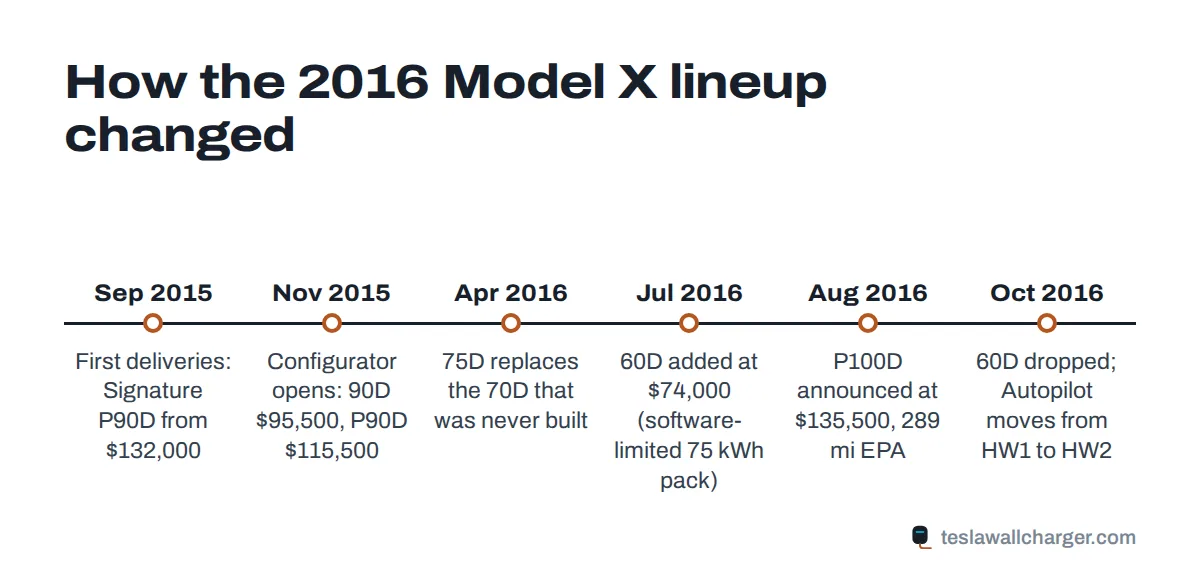
- 90D and P90D are the core 2016 cars. The P90D ran 0 to 60 mph in 3.8 seconds, or 3.2 with the $10,000 Ludicrous upgrade.
- 75D arrived in April 2016 at $83,000 after Tesla confirmed it never built the advertised 70D.
- 60D was sold only from July to October 2016. It uses a 75 kWh pack capped in software at 60 kWh; Tesla offered the extra capacity as a $9,500 paid upgrade.
- P100D was announced in August 2016 at $135,500, with a 2.9 second 0 to 60 time.
The hardware line to remember is October 2016. Cars built before it have HW1, the Mobileye-based Autopilot that cannot be upgraded. Later builds have HW2. Every 2016 car has MCU1, the original Nvidia Tegra screen computer.
Launch-year weak spots: doors, screen, trim
Falcon wing doors. Consumer Reports' October 2016 survey put the Model X near the bottom for reliability and singled out the rear doors and self-opening front doors. Tesla fixed a lot through software, but worn sensors and seals still show up on these cars. Open and close both rear doors several times, put an object in the path to confirm they stop, and look at the seals along the roof edge.
MCU1 memory wear. The eMMC memory chip in the MCU1 wears out with use. Recall 21V035000 covers it because a failed chip can take the rearview camera, defrost controls and turn signal chimes with it. Tesla replaces the daughterboard free. Separately, Tesla launched a paid MCU2 upgrade at $2,500 in 2020; it removes AM/FM and Sirius XM radio, so ask whether the car has had it.
Roof trim. Two recalls (20V710000, later replaced by 24V615000) cover roof trim that may have been bonded without primer. It can come loose at speed.
The recall list, sorted by what needs a shop visit
NHTSA lists 12 campaigns for the 2016 model year, as of October 2026. Five were fixed over the air and need nothing from you. The other seven needed a service visit, and those are the ones to confirm by VIN on NHTSA's recall lookup:
| Campaign | What it fixes | Why it matters on a used car |
|---|---|---|
| 16V192000 | Third-row seat back can move forward in a frontal crash | Only on cars with the third row |
| 17V260000 | Parking brake caliper gear can fracture | Both calipers replaced |
| 17V639000 | Left second-row seat back may not latch | Cable adjustment |
| 20V062000 | Power steering motor bolts can corrode and break | Steel bolts fitted |
| 21V035000 | MCU1 memory failure | Rear camera and defrost |
| 20V710000 / 24V615000 | Roof trim may separate | Trim tested and refitted |
- 16V192000April 6, 2016Seats, mid/rear assemblyService visit
Third-row seat back may move forward under load in a frontal crash. - 17V260000April 19, 2017Parking brakeService visit
Internal gear in the electric parking brake calipers may fracture, so the parking brake may not hold. - 17V639000October 12, 2017Seats, mid/rear assemblyService visit
Left second-row seat back may not fully latch because of misadjusted recliner cables. - 20V062000February 5, 2020Steering, electric power assist systemService visit
Aluminium bolts on the power steering assist motor may corrode and break; bolts replaced with coated steel bolts. - 20V710000November 17, 2020Structure, bodyService visit
Roof trim may have been bonded without primer and can separate (superseded by 24V615000). - 21V035000January 29, 2021Back over prevention, softwareService visit
MCU1 media control unit eMMC memory wears out, which can cause loss of the rearview camera and other functions; firmware 2020.48.48.12+ and VCM daughterboard replaced.
Show all 12 recalls
- 22V037000January 27, 2022Electrical system, adas, autonomous/self driving, softwareSoftware update
FSD (Beta) 'rolling stop' may let the vehicle go through an all-way stop without stopping; feature disabled. - 23V085000February 15, 2023Steering, automated/adaptive steeringSoftware update
FSD Beta may act unsafely around intersections and respond poorly to speed limit changes. - 23V838000December 12, 2023Electrical system, adas, autonomous/self driving, softwareSoftware update
Autosteer controls may not be sufficient to prevent driver misuse. - 24V051000January 30, 2024Electrical system, instrument cluster/panelSoftware update
Brake, Park and ABS warning lights shown in a font that is too small (FMVSS 105/135). - 24V376000May 28, 2024Seat belts, front, warning light/devicesSoftware update
Seat belt warning light and chime may not activate for an unbelted driver (FMVSS 208). - 24V615000August 15, 2024Structure, bodyService visit
Front and centre roof trim may have been bonded without primer and can separate.
Source: NHTSA recalls API. A recall only applies if your VIN is listed.
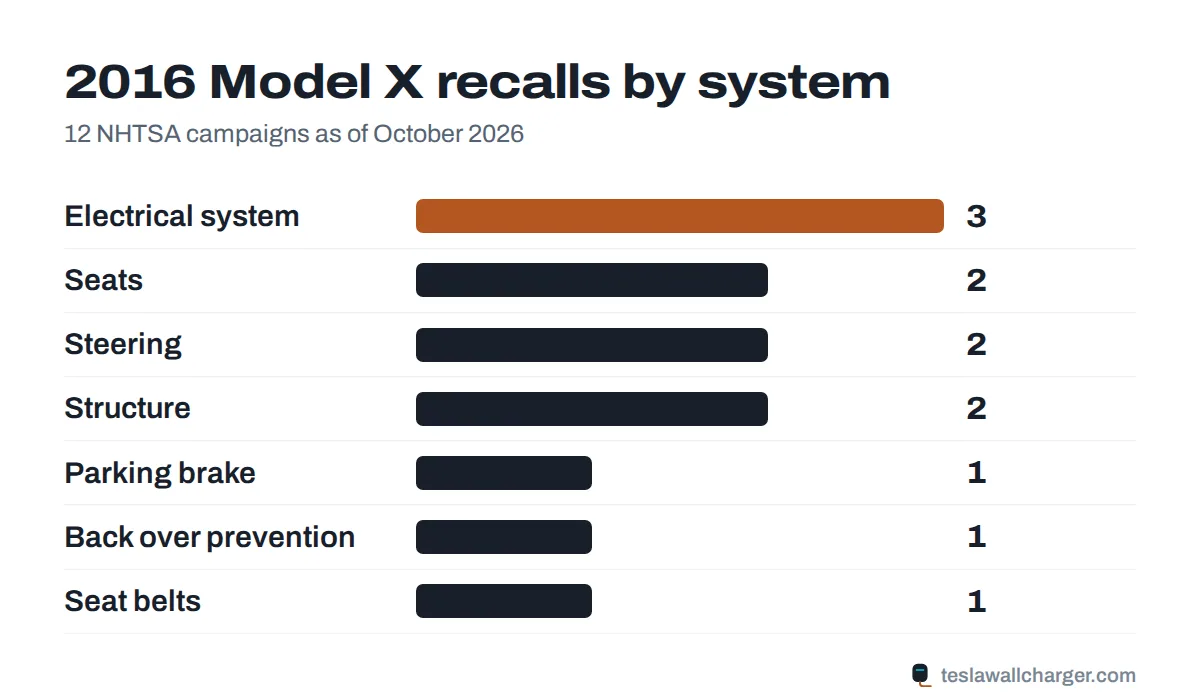
Range when new, and what is left now
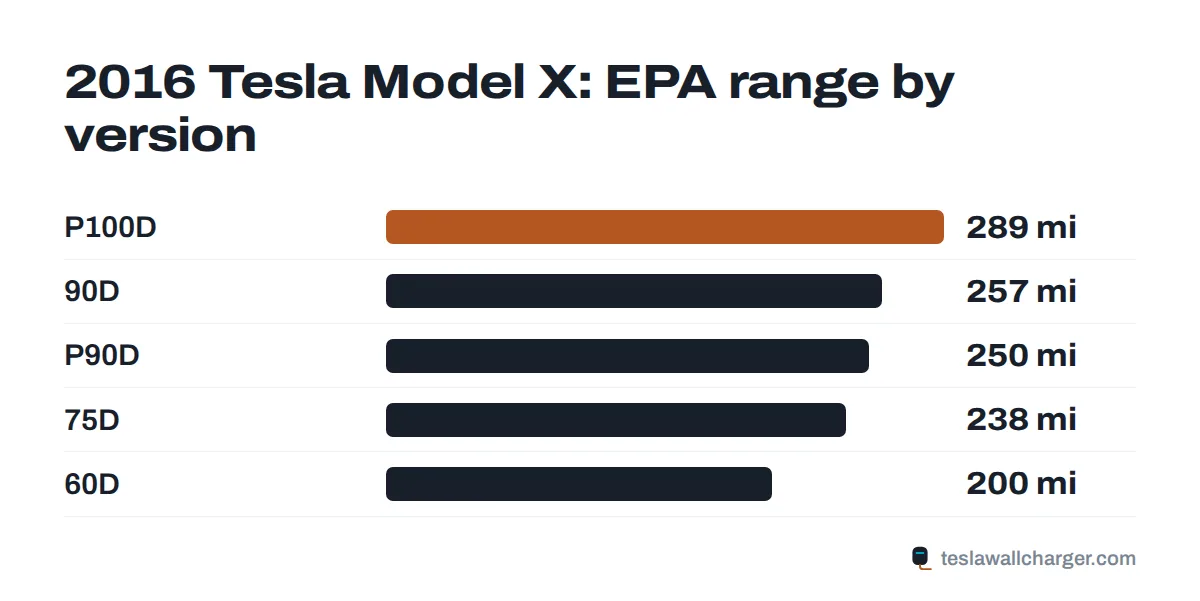
The 90D was rated at 257 miles and the P90D at 250 when new. The P100D's 289 miles made it the long-distance pick of the year. Tesla doesn't publish usable battery capacity, and the "90" and "100" are pack names, not exact usable kWh.
For an idea of loss over time, Tesla's 2022 Impact Report put Model S and X capacity loss at about 12% after 200,000 miles. A 2016 car with average mileage is well short of that distance, but heat, frequent Supercharging and long periods at 100% all add up. Ask the seller for a screenshot of the range at a 100% charge.
| Trim | EPA range | Efficiency | Home AC max | Price (USD) |
|---|---|---|---|---|
| 60D | 200 mi | 36 kWh/100 mi | 11.5 kW | $74,000 |
| 75D | 238 mi | 36 kWh/100 mi | 11.5 kW | $83,000 |
| 90D | 257 mi | 37 kWh/100 mi | 11.5 kW | $95,500 |
| P90D | 250 mi | 38 kWh/100 mi | 11.5 kW | $115,500 |
| P100D | 289 mi | 39 kWh/100 mi | n/a | $135,500 |
Home charging a 2016 Model X: 48 A, or 72 A if optioned
Every 2016 car came with a 48 A onboard charger as standard. A 72 A charger was a paid option ($1,000 to $1,500). Tap the lightning bolt on the touchscreen while plugged in to see what the car accepts.
For a 48 A car, the right setup is a Wall Connector on a 60 A two-pole breaker (48 A x 1.25 = 60 A, the NEC continuous-load rule). Tesla's published figures for the Model X:
| Breaker | Charger output | Range added per hour |
|---|---|---|
| 60 A | 48 A (11.5 kW) | about 35 mi |
| 50 A | 40 A (9.6 kW) | about 29 mi |
| 40 A | 32 A (7.7 kW) | about 23 mi |
| NEMA 14-50 outlet with Mobile Connector | 32 A | about 20 to 23 mi |
A 72 A car only benefits if it is paired with an older Gen 2 Wall Connector set to position C (90 A breaker, 72 A output). The current Gen 3 Wall Connector tops out at 48 A, so a 72 A option adds nothing on a new install. On a 60 A circuit, empty to full on a 90 kWh car takes roughly 8 to 9 hours. Our guide to wire gauge and breaker pairings explains the wiring side, and an electrician should pull the permit.
| How you charge | Speed |
|---|---|
| Wall Connector at 48 A (11.5 kW, 60 A breaker) | up to 35 mi of range per hour |
| NEMA 14-50 outlet, Mobile Connector at 32 A | about 23 mi per hour |
| Regular 120 V outlet | 2 to 3 mi per hour |
| Empty to full, largest pack (about 100 kWh) | about 9.5 hours at 11.5 kW |
Rates scale Tesla's published Wall Connector table for this model; older cars and cold batteries charge slower. Times are estimates.
Crash rating and owner complaints
NHTSA lists the 2016 Model X as not rated. Five-star results start with the 2017 Model X, which is the same body. That doesn't mean the 2016 performed worse; it means the test was not published for that year.
Owners have filed 417 complaints with NHTSA for the 2016 model year, as of October 2026. Suspension leads the list, followed by electrical faults and body structure.
417 owner complaints filed with NHTSA for the 2016 Model X. Most frequent areas (approximate order): suspension; unknown or other; electrical system; structure; forward collision avoidance; service brakes. Source: NHTSA complaints database.
Before you buy a 2016 Tesla Model X: a checklist
- Build month: before or after October 2016 (HW1 or HW2).
- Badge and actual range at 100%, so you know a 60D from a 75D.
- Charger: 48 A or 72 A on the charging screen.
- MCU recall 21V035000 and roof trim recall 24V615000 marked complete.
- Both falcon wing doors cycle cleanly, with obstacle stop working.
- CCS1 adapter eligibility in the Tesla app. Older S and X may need a retrofit ($380 with the adapter, per Tesla's shop as of October 2026) to use non-Tesla fast chargers; see CCS adapter for a Tesla.
If the car passes, compare it with the 2016 Model S sedan and the rest of the Model X years to avoid before you commit. Then budget for the electrician's installation fee, which Tesla puts at $750 to $1,500 for a typical job.
What 2016 Model X shoppers ask us
Is a 2016 Tesla Model X reliable?
Not by the standards of later years. Consumer Reports rated the early Model X much worse than average in October 2016 and called the falcon wing doors a big trouble spot. NHTSA lists 12 recall campaigns and 417 owner complaints for the 2016 model year, the most of any Model X year. A car with its recalls done and door work on record is a safer bet than a cheap one with no history.
What is the range of a 2016 Tesla Model X?
EPA ratings when new were 200 miles for the 60D, 238 for the 75D, 257 for the 90D, 250 for the P90D and 289 for the P100D. A decade on, expect less. Tesla's own fleet data puts average Model S and X capacity loss at about 12% after 200,000 miles, so a full charge on a 90D with normal mileage will show something below its original rating.
Does the 2016 Model X have Autopilot hardware 2?
Only cars built from October 2016. Earlier builds have HW1, the Mobileye-based system, which cannot be upgraded to newer Autopilot hardware. If Autopilot matters to you, check the build date on the door jamb label or ask Tesla service, and remember that every 2016 car still has the older MCU1 screen computer regardless of Autopilot hardware.
How fast does a 2016 Model X charge at home?
With the standard 48 A onboard charger, a Wall Connector on a 60 A breaker adds up to about 35 miles of range per hour, and a NEMA 14-50 outlet adds about 20 to 23. Cars with the optional 72 A charger can draw more, but only from an older Gen 2 Wall Connector on a 90 A circuit; the current Gen 3 unit stops at 48 A.
Is the battery warranty still valid on a 2016 Model X?
Almost certainly not. We could not confirm Tesla's original battery terms for 2016 cars from a primary source, but even an eight-year term, which is what Tesla offers on the Model X today, would have ended for a car delivered in 2015 or 2016. Price the car as one with no battery cover and ask for any service records on the pack.
Sources
- NHTSA recalls, 2016 Tesla Model X, api.nhtsa.gov
- NHTSA safety ratings record (2016 Model X 90D, Not Rated), api.nhtsa.gov
- Green Car Reports: Model X 75D replaces the 70D that was never built, greencarreports.com
- Autoblog: Tesla introduces Model X 60D for $74,000, autoblog.com
- Electrek: Tesla discontinues Model X 60D, electrek.co
- CleanTechnica: Model X 70D, 90D and P90D pricing (Nov 2015), cleantechnica.com
- Big Picture Big Sound: Model X options and pricing guide (72 A option), bigpicturebigsound.com
- Slashdot summary of the Consumer Reports October 2016 reliability survey, tech.slashdot.org
- InsideEVs: Tesla Autopilot hardware history, insideevs.com
- Electrek: Tesla launches $2,500 MCU upgrade for older S/X, electrek.co
- Tesla Support: Wall Connector charging speeds by model, tesla.com
- Gen 2 Wall Connector installation manual, digitalassets.tesla.com
- InsideEVs: Tesla battery degradation after 200,000 miles, insideevs.com
Independent site. Not affiliated with or endorsed by Tesla, Inc. Tesla, Wall Connector and Supercharger are trademarks of Tesla, Inc.