The 2017 Tesla Model X is the year to start looking if you want a first-generation Model X without launch-year risk. It is the first Model X with a five-star NHTSA crash rating, and it brought the 100D: 295 miles of EPA range and a 72 A onboard charger.
It is still an early car. Every 2017 has the MCU1 touchscreen computer and the original falcon wing door hardware, and Autopilot hardware changed partway through the year.
Sorting the 2017 Tesla Model X lineup
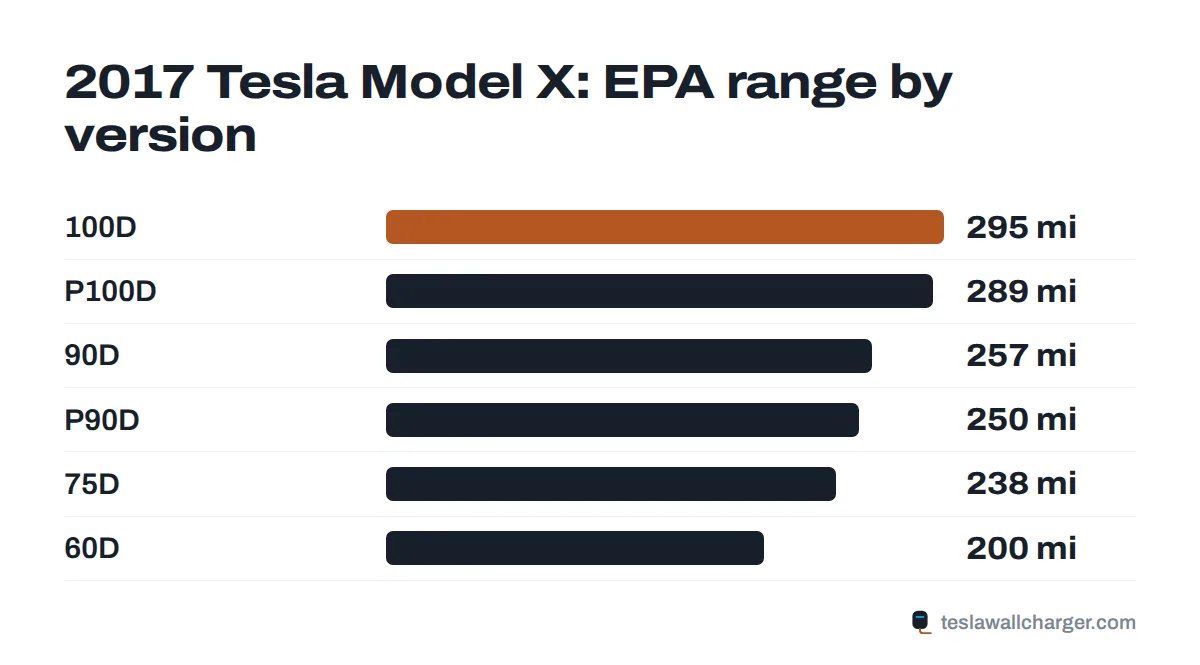
EPA and NHTSA records list six trims for 2017, but you will mostly see three. Tesla pulled the 60D from its configurator in October 2016, so a 2017-titled 60D is rare. The P90D was replaced as the performance car by the P100D.
| Trim | EPA range | Onboard charger | Price as of April 2017 |
|---|---|---|---|
| 60D | 200 mi | 48 A | Not offered |
| 75D | 238 mi | 48 A (72 A optional on early builds) | $82,500 |
| 90D | 257 mi | 48 A (72 A optional on early builds) | $93,500 |
| P90D | 250 mi | Not confirmed | Not offered |
| 100D | 295 mi | 72 A | $99,500 |
| P100D | 289 mi | 72 A | $145,000 |
Smaller changes for 2017 included 20-inch Sonic Carbon wheels in place of the Silver Helix design, and a $500 second-row center console for six-seat cars.
Why the 100D is the one to hunt for
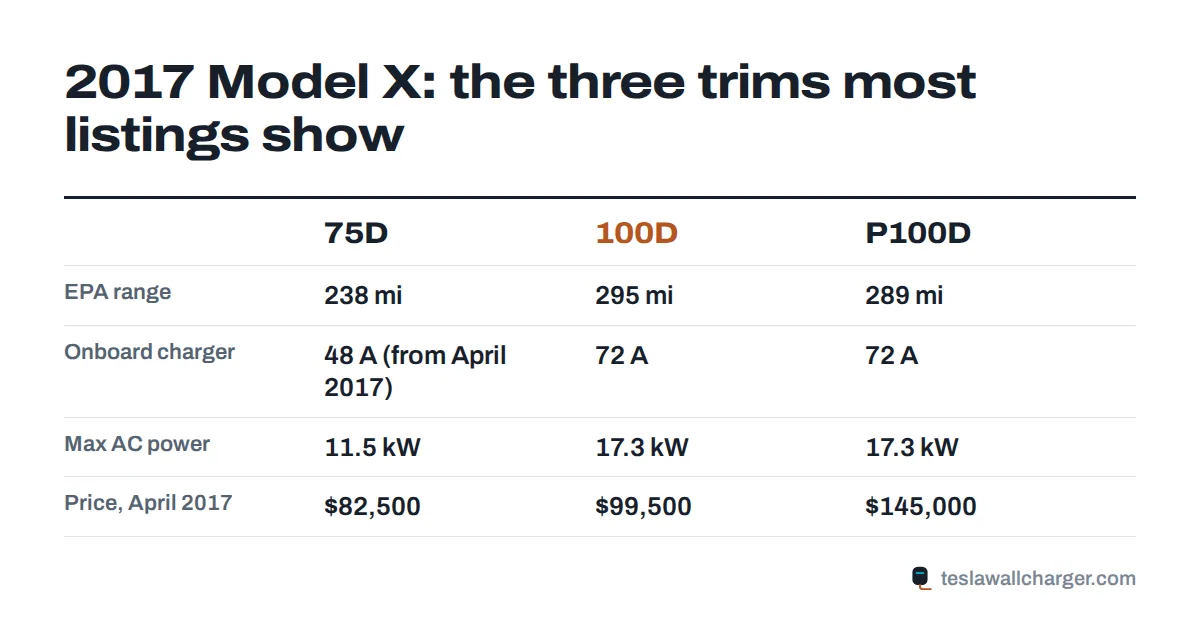
The 100D has the most range of the year and the faster charger, and it cost $45,500 less than a P100D when new. The P100D's 2.9 second 0 to 60 time is the reason to pay more. For a family hauler, the 100D does everything the P100D does, for less money, and it is rated 6 miles further.
The 75D makes sense only if the price gap is large. Its 238 miles is fine for daily use but tight for road trips on a ten-year-old pack.
HW2 or HW2.5: the August 2017 line
Autopilot hardware moved from HW2 to HW2.5 in August 2017. HW2.5 adds dashcam capability. Both run Enhanced Autopilot features, and owners who bought Full Self-Driving were offered the HW3 computer swap, so check what is fitted under Software, then Additional Vehicle Information.
The screen computer did not change. All 2017 cars have MCU1, which Tesla replaced with MCU2 in March 2018 production. If the MCU1's memory chip has failed, the rearview camera can go with it; recall 21V035000 replaces the affected board free.
Ten recalls, and the three that needed a technician
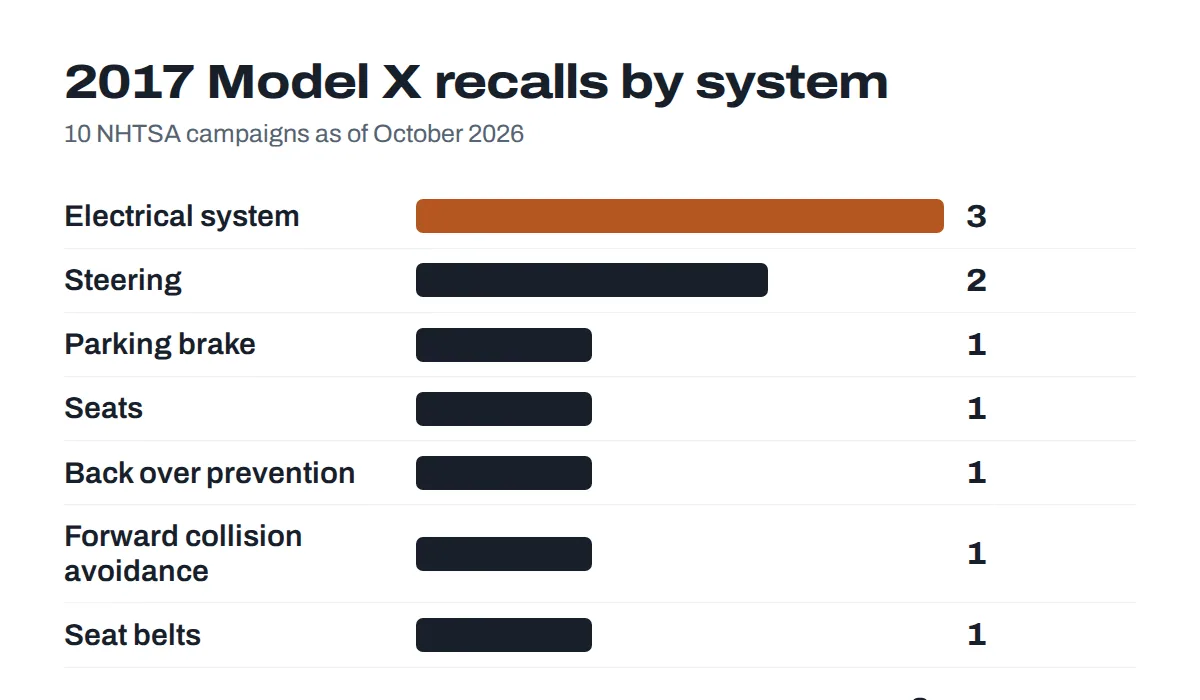
As of October 2026, NHTSA lists ten campaigns that include the 2017 Model X. Seven were software updates delivered over the air. Three needed a service visit, so check them by VIN on NHTSA's recall search:
- 17V260000: a gear inside the electric parking brake calipers can fracture, so the brake may not hold. Both calipers replaced.
- 17V639000: the left second-row seat back may not latch. Cable adjusted.
- 21V035000: MCU1 memory wear. Daughterboard replaced.
Also note 22V818000, an OTA fix for power steering assist that could drop out on rough roads or after a pothole, and 21V846000, which addressed false forward collision warnings.
- 17V260000April 19, 2017Parking brakeService visit
Internal gear in the electric parking brake calipers may fracture, so the parking brake may not hold. - 17V639000October 12, 2017Seats, mid/rear assemblyService visit
Left second-row seat back may not fully latch because of misadjusted recliner cables. - 21V035000January 29, 2021Back over prevention, softwareService visit
MCU1 media control unit eMMC memory wears out, which can cause loss of the rearview camera and other functions; firmware 2020.48.48.12+ and VCM daughterboard replaced. - 21V846000October 29, 2021Forward collision avoidance, sensing system, cameraSoftware update
Communication error may cause false forward collision warnings or unexpected automatic emergency braking. - 22V037000January 27, 2022Electrical system, adas, autonomous/self driving, softwareSoftware update
FSD (Beta) 'rolling stop' may let the vehicle go through an all-way stop without stopping; feature disabled. - 22V818000November 1, 2022Steering, electric power assist systemSoftware update
Power steering assist can be lost on rough roads or after a pothole impact; steering system recalibrated.
Show all 10 recalls
- 23V085000February 15, 2023Steering, automated/adaptive steeringSoftware update
FSD Beta may act unsafely around intersections and respond poorly to speed limit changes. - 23V838000December 12, 2023Electrical system, adas, autonomous/self driving, softwareSoftware update
Autosteer controls may not be sufficient to prevent driver misuse. - 24V051000January 30, 2024Electrical system, instrument cluster/panelSoftware update
Brake, Park and ABS warning lights shown in a font that is too small (FMVSS 105/135). - 24V376000May 28, 2024Seat belts, front, warning light/devicesSoftware update
Seat belt warning light and chime may not activate for an unbelted driver (FMVSS 208).
Source: NHTSA recalls API. A recall only applies if your VIN is listed.
Five stars from NHTSA
| NHTSA test | Rating |
|---|---|
| Overall | 5 stars |
| Frontal crash | 5 stars |
| Side crash | 5 stars |
| Rollover | 5 stars |
| Rollover risk | 9.3% |
NHTSA's 2017 records for the 90D and P100D carry the same scores: five stars overall, frontal, side and rollover, with a 9.3% rollover risk. The low center of gravity from the floor battery is why the rollover number is so good for a tall SUV.
Owners have filed 237 complaints for the 2017 model year, as of October 2026, a little over half the 2016 total. Electrical faults, forward collision avoidance and suspension lead the list.
237 owner complaints filed with NHTSA for the 2017 Model X. Most frequent areas (approximate order): electrical system; forward collision avoidance; suspension; steering; unknown or other; service brakes. Source: NHTSA complaints database.
Getting 72 A out of a 100D at home
A 72 A car can only use that rate on an older Gen 2 Wall Connector set to position C, which pairs a 90 A breaker with 72 A output (about 17.3 kW at 240 V). Tesla's current Wall Connector stops at 48 A. Our page on the 72 A-capable Gen 2 unit explains how to tell the two apart.
Here is the arithmetic for a 100D:
- At 48 A (11.5 kW): about 35 miles of range per hour, per Tesla's Wall Connector support page. Empty to full takes roughly 9 to 10 hours once charging losses are included.
- At 72 A (17.3 kW): roughly 50 miles of range per hour by our math (17.3 kW divided by the 0.33 kWh per mile implied by Tesla's 48 A figure). Empty to full takes roughly 6 to 7 hours.
Most owners never drain the pack overnight, so the 60 A circuit is the sensible choice. A 90 A circuit needs heavier wire and often a panel with spare capacity; get a licensed electrician's quote and a permit, and see our Tesla charger installation price guide for typical ranges. If you only have a dryer-style outlet, our guide to using a 240 V outlet instead covers the trade-off.
| How you charge | Speed |
|---|---|
| Wall Connector at 72 A (17.3 kW, 90 A breaker) | about 53 mi of range per hour |
| Wall Connector at 48 A (11.5 kW, 60 A breaker) | up to 35 mi of range per hour |
| NEMA 14-50 outlet, Mobile Connector at 32 A | about 23 mi per hour |
| Regular 120 V outlet | 2 to 3 mi per hour |
| Empty to full, largest pack (about 100 kWh) | about 6.5 hours at 17.3 kW |
Rates scale Tesla's published Wall Connector table for this model; older cars and cold batteries charge slower. Times are estimates.
2017 Model X quick reference
| Item | What to expect |
|---|---|
| Best trim for most buyers | 100D (295 mi, 72 A) |
| Autopilot hardware | HW2 before August 2017, HW2.5 after |
| Screen computer | MCU1 (paid MCU2 upgrade launched at $2,500 in 2020) |
| NHTSA rating | 5 stars overall |
| Recalls needing a visit | 17V260000, 17V639000, 21V035000 |
| Home circuit | 60 A breaker for a 48 A Wall Connector |
| Non-Tesla fast charging | May need Tesla's $380 S/X retrofit and CCS1 adapter |
For the years either side, read the 2016 Model X problems page and the 2018 Tesla Model X guide, or compare all of them on our Tesla Model X years hub. Charging a car of this size from empty takes a while; our guide to Tesla charging times covers every charger type.
2017 Model X questions, answered
What is the range of a 2017 Tesla Model X 100D?
The EPA rated the 2017 Model X 100D at 295 miles when new, the longest of any 2017 trim. The P100D was rated at 289 miles, the 90D at 257 and the 75D at 238. Expect less from a used car today: Tesla reports average Model S and X capacity loss of about 12% after 200,000 miles, and real range also falls in cold weather and at highway speeds.
Does the 2017 Model X have a 72 amp charger?
The 100D and P100D include a 72 A onboard charger. From April 2017 the 75D and 90D came with 48 A only; earlier 2017 builds could have the 72 A as an option. While the car is plugged in, the charging screen shows the maximum current it will accept, which is the quickest way to know for sure.
Does the 2017 Model X have HW2 or HW2.5?
Both, depending on build date. Cars built from October 2016 to August 2017 have HW2. From August 2017 Tesla fitted HW2.5, which added dashcam capability. Tesla later offered the HW3 computer swap to owners who bought Full Self-Driving, so a car with FSD may have been upgraded. Check Software, then Additional Vehicle Information, on the screen.
How safe is the 2017 Model X?
NHTSA gave the 2017 Model X five stars overall and five stars in the frontal, side and rollover tests, with a 9.3% rollover risk. That was the first Model X year NHTSA rated. The ten recall campaigns are mostly software, but confirm the parking brake caliper and second-row seat latch recalls were done by VIN.
Is a 72 amp circuit worth installing for a 2017 Model X 100D?
Usually not. At 48 A the car adds about 35 miles of range per hour, or roughly 350 miles over a ten-hour night, which covers almost any daily drive. The 72 A rate needs an older Gen 2 Wall Connector on a 90 A breaker. It only pays off if you often need a large top-up in a few hours.
Sources
- NHTSA recalls, 2017 Tesla Model X, api.nhtsa.gov
- NHTSA safety ratings, 2017 Model X 90D, api.nhtsa.gov
- Green Car Reports: 2017 Tesla Model X pricing and feature changes, greencarreports.com
- Electrek: Tesla discontinues Model X 60D, electrek.co
- InsideEVs: Tesla Autopilot hardware history, insideevs.com
- TeslaTap: MCU1 vs MCU2, teslatap.com
- Tesla Support: Wall Connector, tesla.com
- Gen 2 Wall Connector installation manual, digitalassets.tesla.com
- EPA data via MPGBuddy: 2017 Model X 100D, mpgbuddy.com
Independent site. Not affiliated with or endorsed by Tesla, Inc. Tesla, Wall Connector and Supercharger are trademarks of Tesla, Inc.