The 2019 Tesla Model X comes in two versions that look the same. Cars built from April 2019, which owners call "Raven", got a new front motor, adaptive air suspension and a jump to 325 miles of EPA range on the Long Range. Cars built before that are the familiar 75D, 100D and P100D.
If you can find a Raven car at a fair price, it is the better buy. The early cars still make sense if the discount is big enough.
What the April 2019 Raven update changed
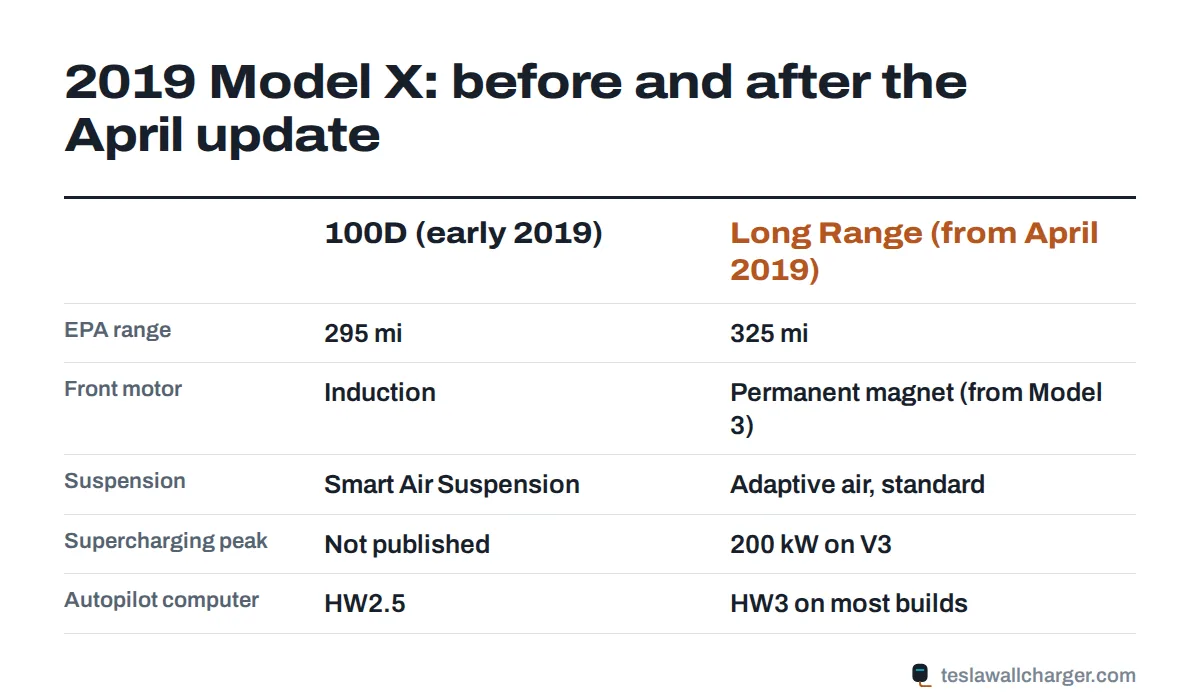
Tesla moved the permanent-magnet motor from the Model 3 to the front axle, replacing the induction motor, and made its new adaptive air suspension standard. The Long Range was rated at 325 miles against the 100D's 295. Supercharging rose to as much as 200 kW on V3 stations and 145 kW on V2, per Motor Authority's report of the launch.
The names changed too. Tesla dropped the 75D early in 2019 and replaced the battery-size badges with Standard Range, Long Range and Performance. April 2019 prices were $83,000, $93,000 and $104,000. In July 2019 the Standard Range disappeared and the Long Range fell to $84,990, with the Performance at $104,990.
Every 2019 Model X has the MCU2 screen computer. The onboard charger should be 48 A, since Tesla dropped the 72 A unit for US cars in November 2018, though a few very early 2019 builds may still have 72 A. The charging screen shows which.
How to tell a Raven car from an early 2019
- The badge in the listing. "Long Range" or "Performance" means Raven. "100D" or "P100D" means an early build.
- The software screen. Software, then Additional Vehicle Information, lists the Autopilot computer. Factory HW3 points to an April-or-later car, though owners who bought Full Self-Driving could have it retrofitted.
- Range at 100%. A healthy Long Range shows well above what any 100D can.
- The build date on the door jamb label: April 2019 or later.
Range, and the Performance asterisk
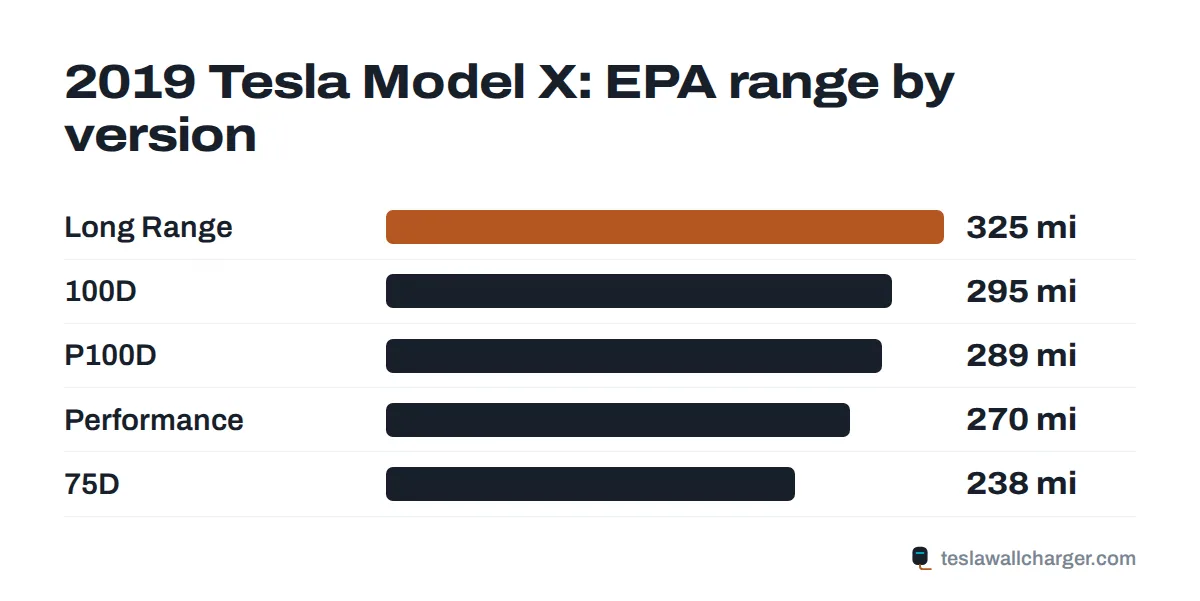
The EPA's 2019 listing for the Performance is the version on 22-inch wheels, rated at 270 miles. Tesla quoted 305 miles for the Performance in July 2019. The gap is the wheels: the big rims cost a lot of range. If range matters to you, look for a Performance on the smaller wheels or choose the Long Range.
Efficiency improved more than the range numbers suggest. The Long Range uses 35 kWh per 100 miles, against 39 for the 100D.
| Trim | EPA range | Efficiency | Home AC max | Price (USD) |
|---|---|---|---|---|
| 75D | 238 mi | 36 kWh/100 mi | 11.5 kW | n/a |
| 100D | 295 mi | 39 kWh/100 mi | 11.5 kW | n/a |
| P100D | 289 mi | 40 kWh/100 mi | 11.5 kW | n/a |
| Long Range | 325 mi | 35 kWh/100 mi | 11.5 kW | $93,000 |
| Performance | 270 mi | 43 kWh/100 mi | 11.5 kW | $104,000 |
Eight recalls, all over the air
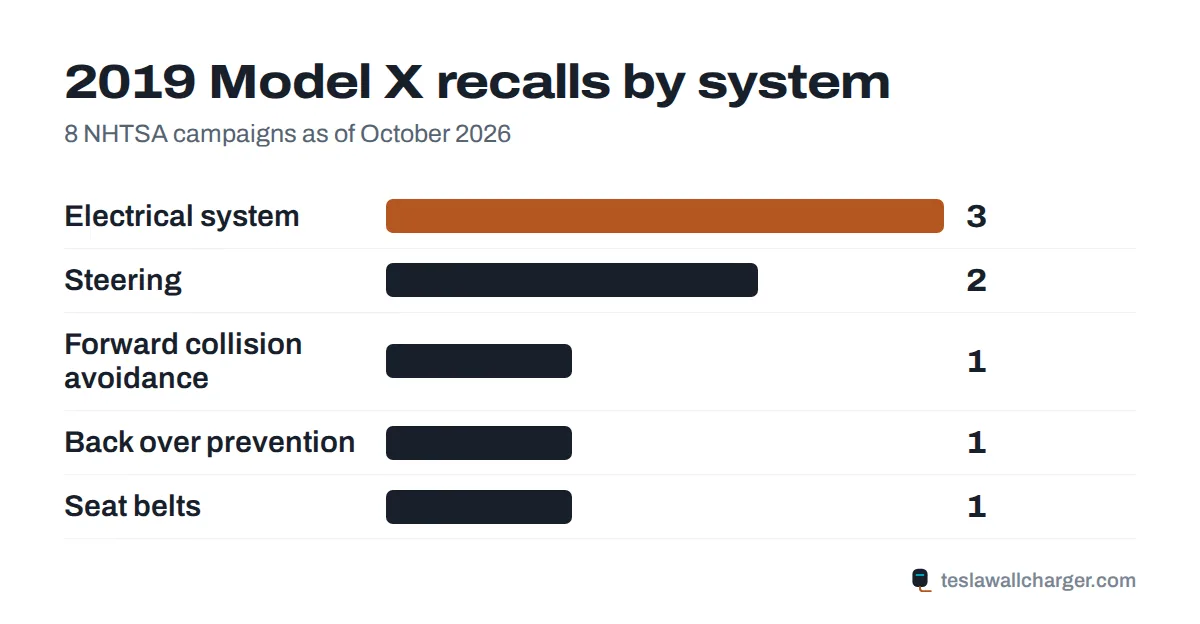
The 2019 Model X has the shortest recall list of the first-generation years: eight campaigns as of October 2026, and every one was a software fix delivered over the air. There is no MCU1 memory recall because no 2019 car has MCU1.
The ones worth knowing about are 22V818000, which recalibrated power steering assist after reports of it dropping out over potholes, and 21V846000, which addressed false forward collision warnings and unexpected braking. Any car that has been online since 2022 has both. Confirm on NHTSA's recall lookup.
- 21V846000October 29, 2021Forward collision avoidance, sensing system, cameraSoftware update
Communication error may cause false forward collision warnings or unexpected automatic emergency braking. - 22V037000January 27, 2022Electrical system, adas, autonomous/self driving, softwareSoftware update
FSD (Beta) 'rolling stop' may let the vehicle go through an all-way stop without stopping; feature disabled. - 22V169000March 18, 2022Back over prevention, display functionSoftware update
Rearview camera image may not appear quickly enough when reversing (FMVSS 111). - 22V818000November 1, 2022Steering, electric power assist systemSoftware update
Power steering assist can be lost on rough roads or after a pothole impact; steering system recalibrated. - 23V085000February 15, 2023Steering, automated/adaptive steeringSoftware update
FSD Beta may act unsafely around intersections and respond poorly to speed limit changes. - 23V838000December 12, 2023Electrical system, adas, autonomous/self driving, softwareSoftware update
Autosteer controls may not be sufficient to prevent driver misuse.
Show all 8 recalls
- 24V051000January 30, 2024Electrical system, instrument cluster/panelSoftware update
Brake, Park and ABS warning lights shown in a font that is too small (FMVSS 105/135). - 24V376000May 28, 2024Seat belts, front, warning light/devicesSoftware update
Seat belt warning light and chime may not activate for an unbelted driver (FMVSS 208).
Source: NHTSA recalls API. A recall only applies if your VIN is listed.
NHTSA kept its five-star overall rating for 2019, with five stars in every test and a 9.3% rollover risk.
| NHTSA test | Rating |
|---|---|
| Overall | 5 stars |
| Frontal crash | 5 stars |
| Side crash | 5 stars |
| Rollover | 5 stars |
| Rollover risk | 9.3% |
Owner complaints center on suspension
Owners have filed 73 complaints with NHTSA for the 2019 Model X as of October 2026, and about 23 of them involve suspension. These are owner reports, not a recall or an investigation, but they line up with the year the adaptive air suspension arrived.
On a test drive, check that the car sits level after it has been parked, that ride height changes without warnings, and that there is no clunk over sharp bumps. Edmunds also flagged uneven panel gaps, some paint and seal issues, and six-seat captain's chairs that don't fold.
73 owner complaints filed with NHTSA for the 2019 Model X. Most frequent areas (approximate order): suspension; unknown or other; electrical system; structure; vehicle speed control; steering. Source: NHTSA complaints database.
Charging: 48 A at home, up to 200 kW on the road
Nearly every 2019 Model X tops out at 48 A on AC power. The best home setup is a Wall Connector on a 60 A breaker, adding about 35 miles of range per hour. A Mobile Connector on a NEMA 14-50 outlet manages about 20 to 23, per Tesla's Mobile Connector table. See Tesla Mobile Connector vs Wall Connector for which suits a 325-mile car.
| How you charge | Speed |
|---|---|
| Wall Connector at 48 A (11.5 kW, 60 A breaker) | up to 35 mi of range per hour |
| NEMA 14-50 outlet, Mobile Connector at 32 A | about 23 mi per hour |
| Regular 120 V outlet | 2 to 3 mi per hour |
| Empty to full, largest pack (about 100 kWh) | about 9.5 hours at 11.5 kW |
Rates scale Tesla's published Wall Connector table for this model; older cars and cold batteries charge slower. Times are estimates.
For road trips, the Raven cars' 200 kW V3 peak makes a real difference over the earlier cars. Away from Tesla stations, older Model S and X may need a retrofit before they can use the CCS1 adapter; the Tesla app tells you. Our page on Electrify America and ChargePoint with a Tesla explains the adapters, and time to fully charge a Tesla covers each charger type.
Who should buy a 2019 Tesla Model X, and which one
- Road-trippers: a Raven Long Range. 325 miles and faster Supercharging.
- Speed first: a Raven Performance (2.7 seconds to 60 mph, per Tesla), ideally on the smaller wheels.
- Lowest price: an early 100D, if it is priced well below a Raven car. It still has MCU2 and a 295-mile rating.
- Skip: any 2019 with suspension warnings or uneven ride height you can't get explained.
Battery cover is worth checking too: Tesla's original 2019 terms weren't confirmed for this page, but an eight-year term from a 2019 delivery runs into 2027.
The 2020 Tesla Model X added the 351-mile Long Range Plus, and the 2018 Model X is the last year with a possible 72 A charger. For the whole picture, see the best year for the Model X.
Your 2019 Model X questions
What is a Raven Model X?
Raven is the owner-community name for the Model S and X built from April 2019. Tesla fitted the permanent-magnet front motor from the Model 3, made adaptive air suspension standard and raised Supercharging to 200 kW on V3 stations. On the Model X the Long Range was rated at 325 miles, up from 295 on the 100D it replaced.
Does the 2019 Model X have HW3?
Many do. HW3, Tesla's own Autopilot computer, first became available in April 2019, the same month as the Raven update. Earlier 2019 builds have HW2.5. Owners who bought Full Self-Driving were offered a swap to HW3, so an early car may have been upgraded. Check Software, then Additional Vehicle Information, on the touchscreen.
How fast does a 2019 Model X Supercharge?
Raven cars built from April 2019 can take up to 200 kW on V3 Superchargers and 145 kW on older V2 stations, according to Tesla's announcement at the time. Peak rates last only at low charge levels and drop as the battery fills. Tesla's sources do not give a peak figure for the early 2019 75D, 100D and P100D.
Is the 2019 Tesla Model X reliable?
It has the cleanest record of the early Model X years. NHTSA lists eight recalls, all fixed over the air, and 73 owner complaints as of October 2026. Suspension is the most common complaint area, about a third of the total, which matters because Raven cars use the then-new adaptive air suspension. Inspect for sagging corners and warning messages.
What does a 2019 Model X cost to charge at home?
The EPA rates the 2019 Long Range at 35 kWh per 100 miles. At the July 2026 US average of 18.31 cents per kWh, 1,000 miles costs about $64. The Performance on 22-inch wheels uses 43 kWh per 100 miles, which works out to about $79 for the same distance.
Sources
- NHTSA recalls, 2019 Tesla Model X, api.nhtsa.gov
- NHTSA safety ratings, 2019 Model X, api.nhtsa.gov
- Motor Authority: Tesla Model S and X now go further (April 2019), motorauthority.com
- Hagerty: Tesla adds power, range and adaptive suspension to Model X and S, hagerty.com
- Entrepreneur: Tesla drops Standard Range Model S and X (July 2019), entrepreneur.com
- Edmunds: 2019 Tesla Model X, edmunds.com
- InsideEVs: Tesla Autopilot hardware history, insideevs.com
- EPA data via MPGBuddy: 2019 Model X Long Range, mpgbuddy.com
- EPA data via MPGBuddy: 2019 Model X Performance (22-inch wheels), mpgbuddy.com
- Tesla Support: Mobile Connector, tesla.com
Independent site. Not affiliated with or endorsed by Tesla, Inc. Tesla, Wall Connector and Supercharger are trademarks of Tesla, Inc.