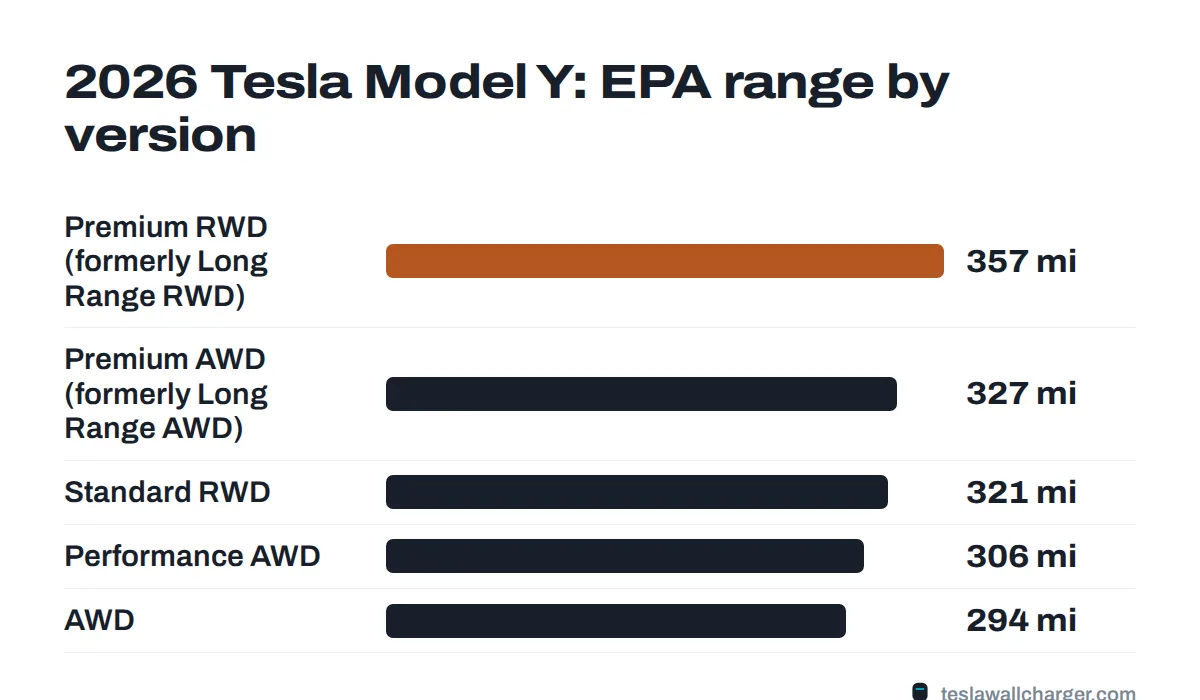
The 2026 Tesla Model Y is the "Juniper" refresh, and in the US it now comes in five trims: Standard RWD, Model Y AWD, Premium RWD, Premium AWD and Performance. EPA range runs from 294 to 357 miles. The split that matters most at home is simple: Premium and Performance charge at 48 A, while the Standard RWD and Model Y AWD stop at 32 A.
What changed with the refresh
This is the first redesign of the Model Y. Next to a 2025 Tesla Model Y, the refreshed car has:
- full-width light bars front and rear;
- a quieter cabin, with acoustic glass and revised suspension;
- an 8-inch rear touchscreen;
- ventilated front seats and a power-folding second row.
The rollout was staggered. A Long Range AWD Launch Series opened in January 2025 at $59,990 with FSD (Supervised) included, 320 miles quoted and a 4.1-second 0 to 60 time, and reached US owners from March 2025. A regular Long Range AWD (about $49,000) followed in April, and a Long Range RWD ($44,990, 357 miles EPA) was announced in May. The Performance arrived on September 30, 2025 at $57,490, with 21-inch wheels, adaptive damping and a 3.3-second 0 to 60 time.
In October 2025 Tesla added the Standard RWD at $39,990 and renamed the Long Range trims "Premium". The base Model Y AWD joined on February 3, 2026 at $41,990. In May 2026 prices rose to $45,990 for the Premium RWD, $49,990 for the Premium AWD and $57,990 for the Performance.
The six-seat Model Y L opened for US orders on July 2, 2026 as a $61,990 Premium AWD Launch Series. Its model year has not been stated, so we do not treat it as a 2026 trim here.
Five trims, two charging speeds
| Trim | EPA range | Efficiency | Home AC max | Price (USD) |
|---|---|---|---|---|
| Standard RWD | 321 mi | 24 kWh/100 mi | 7.7 kW | $39,990 |
| AWD | 294 mi | 27 kWh/100 mi | 7.7 kW | $41,990 |
| Premium RWD (formerly Long Range RWD) | 357 mi | 25 kWh/100 mi | 11.5 kW | $44,990 |
| Premium AWD (formerly Long Range AWD) | 327 mi | 27 kWh/100 mi | 11.5 kW | $48,990 |
| Performance AWD | 306 mi | 32 kWh/100 mi | 11.5 kW | $57,490 |
| Trim | EPA range | 0 to 60 mph | Home AC max |
|---|---|---|---|
| Standard RWD | 321 mi (303 on 19 in) | 6.8 s | 32 A, 7.7 kW |
| Model Y AWD | 294 mi | 4.6 s | 32 A, 7.7 kW |
| Premium RWD | 357 mi | 5.4 s | 48 A, 11.5 kW |
| Premium AWD | 327 mi | 4.6 s | 48 A, 11.5 kW |
| Performance | 306 mi | 3.3 s | 48 A, 11.5 kW |
| Trim | Supercharger peak | Battery warranty |
|---|---|---|
| Standard RWD | about 225 kW (reported) | 8 yr / 100,000 mi |
| Model Y AWD | not confirmed | 8 yr / 100,000 mi |
| Premium RWD | 250 kW | 8 yr / 120,000 mi |
| Premium AWD | 250 kW | 8 yr / 120,000 mi |
| Performance | 250 kW | 8 yr / 120,000 mi |
The Standard RWD's 225 kW Supercharging peak comes from press reports, not Tesla, and Tesla has not published one for the Model Y AWD. Warranty terms are from Tesla's warranty page. The Standard RWD on 18-inch wheels is the most efficient, at about 24 kWh per 100 miles; the Premium RWD is close behind at 25 and goes furthest.
Standard and Model Y AWD versus Premium: what you give up
The Standard RWD is a decontented refresh. Press reports list an opaque roof instead of the glass view, no rear screen, no light bars, cloth seats without ventilation, no HEPA filter, no AM/FM radio, a manual steering column, and manual mirror and second-row adjustment. Battery size is reported at about 69.5 kWh, though another estimate puts it nearer 60 kWh, so treat both as approximate.
The Model Y AWD is the cheapest way to get all-wheel drive, quick at 4.6 seconds to 60 mph, but rated at 294 miles and, per Tesla's Wall Connector page, limited to 32 A at home like the Standard RWD.
The Premium trims keep everything the refresh introduced and add vehicle-to-load: with the Gen 3 Mobile Connector and an $80 Tesla Outlet Adapter, a Premium or Performance can run two 110 V outlets at up to 20 A. Eligibility is checked by VIN.
Early-build recalls on the 2026
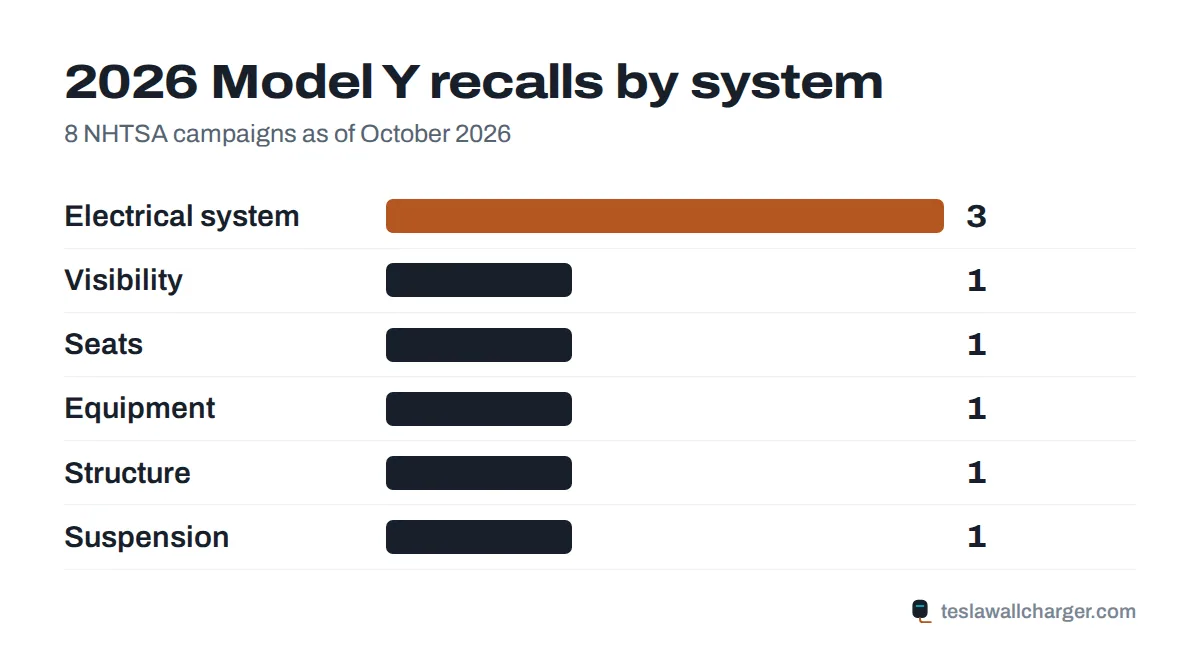
Eight campaigns as of October 2026, and none is a software fix. Seven need a service visit and one is a buyback.
- 25V359000May 30, 2025Visibility, windshield wiper/washer, linkagesService visit
Washer hose connector may block nozzles so fluid does not reach the windshield - 25V410000June 18, 2025Seats, critical fastenersService visit
Seat back fasteners may be under-tightened - 25V490000July 28, 2025Electrical system, hornService visit
Horn ground wire ring terminal may loosen, disabling the horn (steering wheel replaced) - 25V658000October 1, 2025Electrical system, wiringService visit
Wiring defect may stop reverse lights from illuminating - 25V690000October 10, 2025Electrical system, propulsion system, fuses, relays, contacts, and shuntsService visit
Battery pack contactors may fail, causing loss of drive power - 26V315000May 19, 2026Equipment, other, labelsService visit
Vehicle certification label (weight information) may not have been installed
Show all 8 recalls
- 26V445000July 7, 2026Structure, body, bumpersrepurchase
Small number of vehicles built for a foreign market lack US-required knee airbags, interior countermeasures and bumper testing; remedy is repurchase - 26V558000September 1, 2026Suspension, critical fastenersService visit
Front lateral link fasteners may be under-tightened, allowing separation from the subframe
Source: NHTSA recalls API. A recall only applies if your VIN is listed.
| Campaign | Issue | Remedy |
|---|---|---|
| 25V359000 | Washer hose connector can block the nozzles | Service |
| 25V410000 | Seat back fasteners under-tightened | Service |
| 25V490000 | Horn ground wire terminal can loosen | Steering wheel replaced |
| 25V658000 | Wiring defect can stop the reverse lights | Service |
| 25V690000 | Battery pack contactors can fail, cutting drive power | Contactors replaced |
| 26V315000 | Certification (weight) label missing | Label fitted |
| 26V445000 | A few foreign-market cars lack US knee airbags and bumper testing | Tesla repurchase |
| 26V558000 | Front lateral link fasteners under-tightened | Fasteners tightened or replaced |
The two to look for on a used or demo car are 25V690000, because a failed contactor means loss of drive power, and 26V558000, which was only filed in September 2026. Run the VIN through NHTSA's recall search as well, to rule out 26V445000.
| NHTSA test | Rating |
|---|---|
| Overall | 5 stars |
| Frontal crash | 5 stars |
| Side crash | 5 stars |
| Rollover | 5 stars |
| Rollover risk | 8.6% |
NHTSA rates the 2026 AWD at five stars overall, frontal, side and rollover, with an 8.6% rollover risk; the RWD scores the same with 8.9%. Its ratings API shows about 397 owner complaints, but the complaint file was too large for us to sort by system.
Wall Connector setup for each trim
| How you charge | Speed |
|---|---|
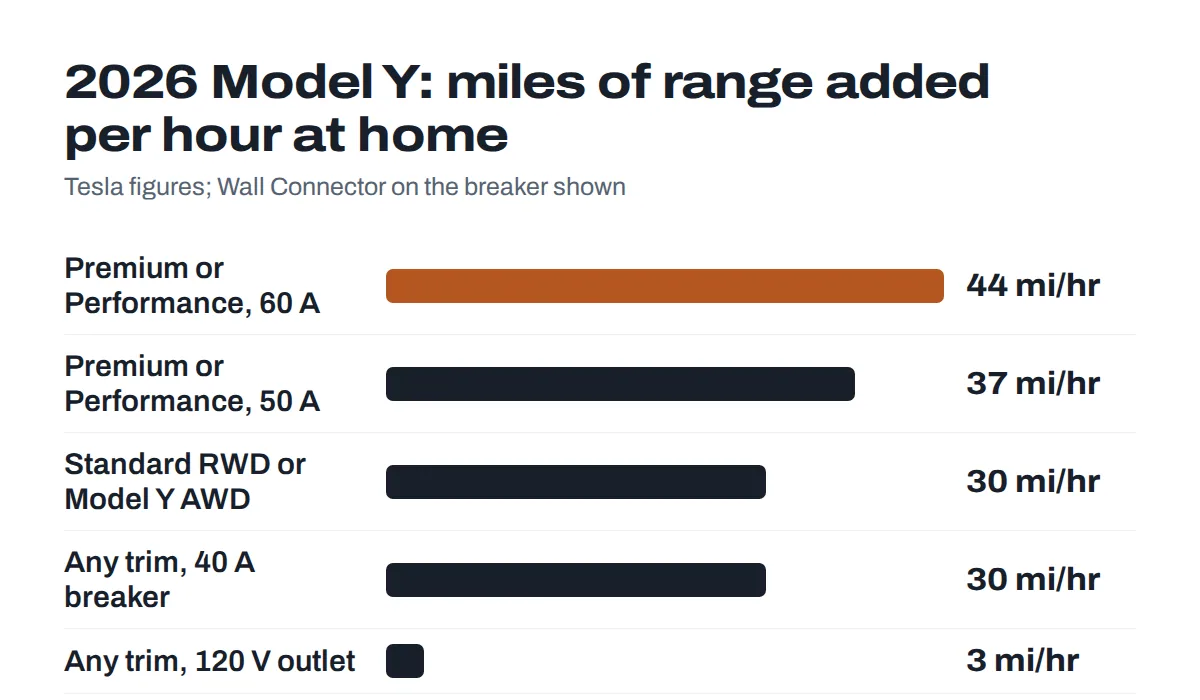
| Wall Connector at 48 A (11.5 kW, 60 A breaker) | up to 44 mi of range per hour |
| Wall Connector at 32 A (7.7 kW, 40 A breaker) | up to 29 mi of range per hour |
| NEMA 14-50 outlet, Mobile Connector at 32 A | about 30 mi per hour |
| Regular 120 V outlet | 2 to 3 mi per hour |
| Empty to full, largest pack (about 79 kWh) | about 7.5 hours at 11.5 kW |
Rates scale Tesla's published Wall Connector table for this model; older cars and cold batteries charge slower. Times are estimates.
The onboard charger should decide your circuit:
- Premium RWD, Premium AWD, Performance. A Wall Connector on a 60 A breaker gives the full 48 A, up to 44 miles per hour, and roughly 7.5 to 8 hours from empty to full on an estimated 79 kWh pack. Tesla's manual calls for at least 6 AWG, 90 C THWN-2 copper with a 75 C-rated breaker at that setting.
- Standard RWD and Model Y AWD. They take 32 A, which a 40 A breaker supplies in full. That is up to 30 miles per hour; a Standard RWD needs roughly 8.5 to 10 hours from empty, depending on which battery estimate is right. Paying for a 60 A run makes sense only if a faster car will share the garage later.
Our page on sizing the breaker for a Wall Connector covers the 125% rule behind those pairings, and a licensed electrician should confirm panel capacity and pull the permit. Tesla's own estimate for the installation labor is $750 to $1,500 before the $585 Wall Connector (out of stock on Tesla's shop as of October 2026). New cars come with a J1772 adapter but no Mobile Connector, so a NEMA 14-50 outlet with the Mobile Connector is the other route at 32 A.
Running cost at the July 2026 US average of 18.31 cents per kWh: about $4.39 per 100 miles for a Standard RWD (24 kWh), $4.58 for a Premium RWD (25 kWh) and $5.86 for a Performance (32 kWh). See time to fully charge a Tesla for Supercharger and 120 V times.
Before you buy a used or demo 2026
- Read the trim from the VIN and the Tesla app, not the listing title. "Long Range" and "Premium" are the same cars.
- If you need 48 A charging, rule out the Standard RWD and Model Y AWD.
- Check 25V690000 and 26V558000 are completed; ask about the other service recalls.
- On an early Launch Series car, confirm FSD (Supervised) is attached to the car and whether it transfers to you.
- For vehicle-to-load, check eligibility by VIN before you count on it.
If the refresh features do not matter to you, the original design is cheaper; our best and worst Model Y years page compares every year, and the Model 3 for 2026 shares the Standard and Premium naming.
Questions about the 2026 Model Y lineup
What is the difference between the Model Y Standard and Premium?
The Standard RWD, launched in October 2025 at $39,990, drops the light bars, glass roof view, rear touchscreen, ventilated seats, HEPA filter and AM/FM radio, and uses cloth seats and a manual steering column. It also charges at 32 A at home instead of 48 A. The Premium trims, formerly called Long Range, keep the full refresh equipment and the 120,000-mile battery warranty.
How far can a 2026 Model Y go on a charge?
EPA ratings run from 357 miles for the Premium RWD down to 294 for the Model Y AWD. The Premium AWD is rated at 327, the Standard RWD at 321 on 18-inch wheels (303 on 19-inch wheels) and the Performance at 306. Real range falls in winter and at sustained highway speed.
Is the 2026 Model Y the Juniper?
Yes. In the US, Juniper is the 2026 model year, including the Launch Series cars delivered from March 2025. The tenth character of the VIN is T on a 2026 and S on a 2025. A 2025 Model Y is the original design without the full-width light bars, so the VIN and the front end settle any doubt.
What breaker does a 2026 Model Y need for home charging?
For a Premium or Performance, a Wall Connector on a 60 A breaker gives the full 48 A and up to 44 miles per hour. For a Standard RWD or Model Y AWD, which accept 32 A, a 40 A breaker already delivers their maximum of about 30 miles per hour. Choose 60 A only if you expect a faster-charging car later.
Can a 2026 Model Y power appliances?
Premium and Performance Model Y support vehicle-to-load with the Gen 3 Mobile Connector and Tesla's $80 Outlet Adapter, giving two 110 V outlets at up to 20 A, about 2,400 W. Eligibility is checked by VIN, so confirm the specific car in the Tesla app or with Tesla before you rely on it for tools or camping.
Sources
- NHTSA recalls, 2026 Tesla Model Y, api.nhtsa.gov
- NHTSA 5-Star Safety Ratings, 2026 Model Y AWD 2nd Release, api.nhtsa.gov
- InsideEVs: Model Y Launch Series arrives in the US, insideevs.com
- Electrek (2025-09-30): Model Y Performance US launch, electrek.co
- Motor1: Model Y Standard pricing and range, motor1.com
- EVwire (2025-10-09): what Tesla removed for the Standard trims, evwire.com
- Electrek (2026-02-03): Tesla launches new Model Y AWD at $41,990, electrek.co
- Edmunds (2026-07-25): 2026 Tesla Model Y pricing guide, edmunds.com
- Tesla support: Wall Connector (charging rates by model), tesla.com
- Not a Tesla App (2026-09-03): V2L for Model Y Premium, notateslaapp.com
- Tesla vehicle warranty, tesla.com
Independent site. Not affiliated with or endorsed by Tesla, Inc. Tesla, Wall Connector and Supercharger are trademarks of Tesla, Inc.