The 2020 Tesla Model Y is the launch-year car: Fremont-built, sold only as a Long Range AWD (316 miles EPA) or Performance, and first delivered on March 13, 2020. It is now the least expensive used Model Y, and it carries 24 NHTSA recall campaigns, the longest list of any Model Y year.
Most of those recalls were software fixes sent over the air. Seven were not, and those seven are why a launch-year car needs a closer look than a later one.
What early 2020 builds are missing
Tesla kept changing the car while it was building it. The planned Standard Range RWD (about 230 miles) was cancelled in July 2020, the same month prices dropped from $52,990 to $49,990 for the Long Range and from $60,990 to $59,990 for the Performance. Then, in the last weeks of the year, the hardware improved:
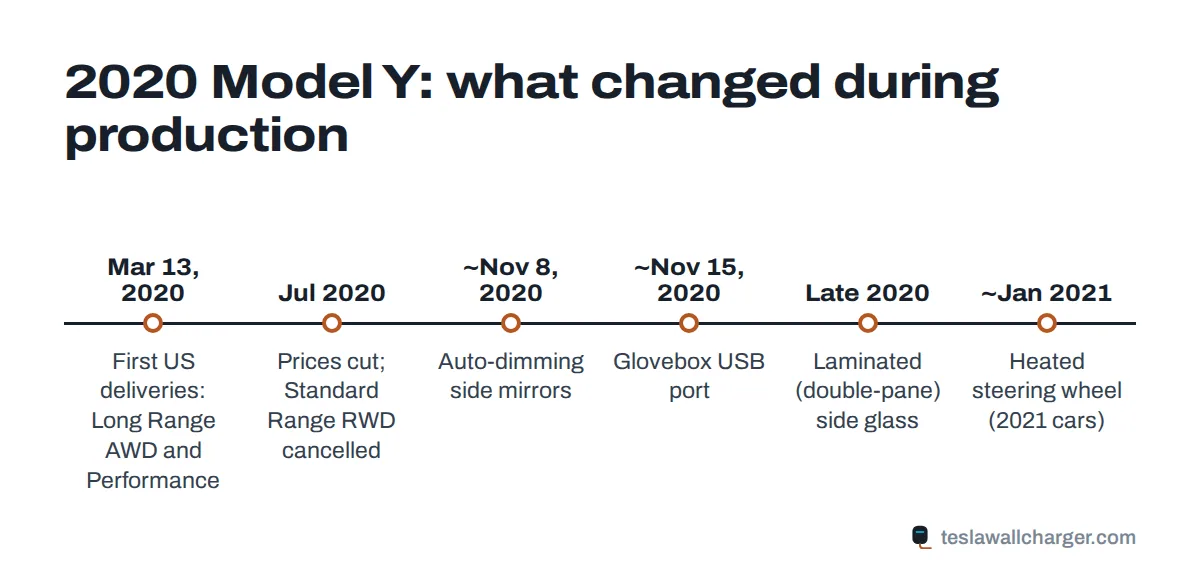
- Side glass. Early cars have single-pane side windows. Laminated glass, which is there to cut wind and road noise, arrived on late-2020 builds.
- Mirrors and USB. Auto-dimming side mirrors came in from about November 8, 2020 and a glovebox USB port from about November 15.
- Heated steering wheel. Not offered on any 2020 build; it arrived around January 2021.
What every 2020 car does have is the heat pump. The Model Y was the first Tesla with one (the "Octovalve" system), and it is standard. The car also has forward radar, ultrasonic parking sensors, an Intel Atom media computer and the Hardware 3 Autopilot computer. Confirm the last two under Controls > Software > Additional Vehicle Information.
If a seller describes a 2020 as "fully loaded", ask for the build date. A December 2020 car and an April 2020 car are not the same purchase.
The seven recalls that needed a service visit
Here is the full campaign list, rechecked about once a week:
- 20V609000September 30, 2020Exterior lightingSoftware update
Software error can stop trailer brake lights from illuminating - 20V709000November 17, 2020Suspension, front, control armService visit
Under-tightened bolts may let the front upper control arm detach from the steering knuckle - 21V387000May 25, 2021Service brakes, hydraulic, foundation components, disc, caliperService visit
Loose brake caliper bolts may let the caliper contact the wheel rim - 21V388000May 25, 2021Seat belts, rear/other, retractorService visit
Second-row seat belt retractor fasteners may not be properly attached - 21V389000May 25, 2021Seat beltsService visit
Front shoulder belt fasteners at the B-pillar may not be properly attached - 21V835000October 25, 2021Suspension, critical fastenersService visit
Front lateral link fasteners may loosen, letting the link separate from the subframe
Show all 24 recalls
- 21V846000October 29, 2021Forward collision avoidance, sensing system, cameraSoftware update
Software communication error may cause false forward collision warnings or unexpected automatic emergency braking - 21V912000November 21, 2021SuspensionService visit
Front and rear suspension knuckles may fracture, separating suspension links - 22V037000January 27, 2022Electrical system, adas, autonomous/self driving, softwareSoftware update
FSD Beta 'rolling stop' function may let the car roll through all-way stops - 22V045000February 1, 2022Electrical system, softwareSoftware update
Seat belt chime may not sound when an unbelted driver starts the car - 22V050000February 2, 2022Electrical system, softwareSoftware update
Software error in the heat pump (expansion valve) can reduce windshield defrosting performance - 22V063000February 4, 2022Electrical system, softwareSoftware update
Boombox sounds may mask Pedestrian Warning System sounds (superseded by 22V235000) - 22V235000April 12, 2022Electrical system, softwareSoftware update
Boombox sounds may mask Pedestrian Warning System sounds, including in Summon modes (supersedes 22V063000) - 22V702000September 19, 2022Visibility, power window devices and controlsSoftware update
Window automatic reversal may not react correctly after detecting an obstruction (pinch risk) - 22V844000November 15, 2022Exterior lighting, tail lightsSoftware update
One or both taillights may intermittently fail to illuminate - 23V085000February 15, 2023Steering, automated/adaptive steeringSoftware update
FSD Beta may act unsafely at intersections and respond poorly to speed limit changes - 23V838000December 12, 2023Electrical system, adas, autonomous/self driving, softwareSoftware update
Autosteer driver-engagement controls may not be sufficient to prevent misuse (Autopilot recall tied to NHTSA EA22-002) - 24V051000January 30, 2024Electrical system, instrument cluster/panelSoftware update
Brake, park and ABS warning lights shown in a font size below the FMVSS minimum - 24V153000February 27, 2024Forward collision avoidance, warnings, external/pedestrian alertSoftware update
A factory reset could mute Pedestrian Warning System sounds - 24V376000May 28, 2024Seat belts, front, warning light/devicesSoftware update
Seat belt warning light and chime may not activate for an unbelted driver - 24V554000July 24, 2024Latches/locks/linkages, hood, latchSoftware update
Hood latch may not detect an unlatched hood, so the hood could open while driving - 24V935000December 17, 2024Tires, pressure monitoring and regulating systemsSoftware update
Tire pressure warning light may not stay lit between drive cycles - 26V283000May 5, 2026Back over prevention, softwareSoftware update
Rearview camera image may be delayed when shifting into reverse (software 2026.8.6) - 26V507000August 5, 2026Exterior lighting, headlightsService visit
Low beam headlights may be too bright, exceeding maximum light output (headlights replaced)
Source: NHTSA recalls API. A recall only applies if your VIN is listed.
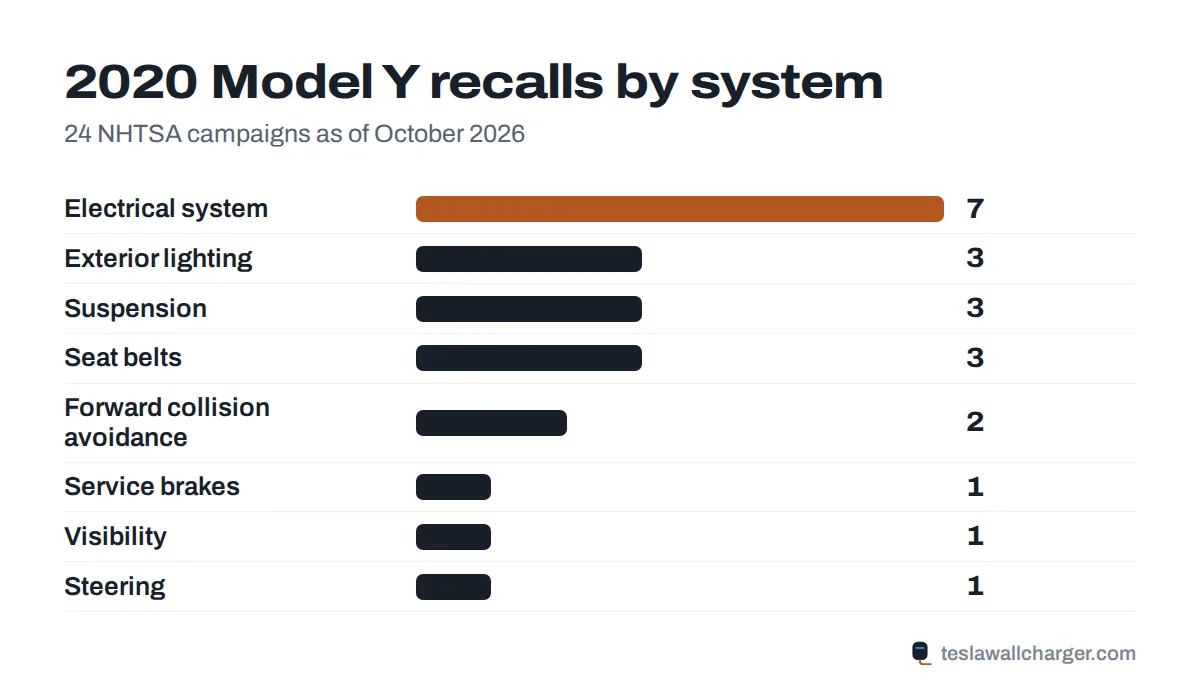
Seventeen of the 24 were fixed by over-the-air updates and are almost certainly installed on any car that has been online. The ones that matter to a used buyer are the hands-on repairs:
| Campaign | What could go wrong | Fix |
|---|---|---|
| 20V709000 | Front upper control arm bolts under-tightened | Bolts checked and torqued |
| 21V387000 | Loose brake caliper bolts could let the caliper hit the wheel | Bolts inspected |
| 21V388000 | Second-row seat belt retractor fasteners not attached | Fasteners fixed |
| 21V389000 | Front shoulder belt fasteners at the B-pillar | Fasteners fixed |
| 21V835000 | Front lateral link fasteners could loosen | Fasteners replaced |
| 21V912000 | Suspension knuckles could fracture | Inspection and parts |
| 26V507000 | Low-beam headlights too bright (August 2026) | Headlights replaced |
That last one is recent, so many 2020 cars on sale this fall will still have it open. Run the VIN through NHTSA's recall lookup and ask Tesla service to print the completed-campaign history.
Problems owners still report
NHTSA holds 272 owner complaints for this year. The approximate tally of the most common areas is below; forward collision avoidance leads it.
272 owner complaints filed with NHTSA for the 2020 Model Y. Most frequent areas (approximate order): forward collision avoidance; unknown or other; electrical system; steering; suspension; lane departure. Source: NHTSA complaints database.
Phantom braking. NHTSA's PE22-002 probe covers 2021 and 2022 cars, not 2020, yet complaints about unexpected automatic emergency braking still top the 2020 list. Test it on a highway with traffic-aware cruise control engaged.
Cold-weather heat loss. In the winter of 2021 to 2022, owners in sub-zero weather reported no cabin heat. Tesla blamed a frozen intake flap that led sensors to shut off the coolant pump, replaced parts on some cars, and pushed a software fix. Recall 22V050000 (heat pump valve software, OTA) covers the defrost side. If you live somewhere cold, ask whether the car had heat pump work.
FSD probe. NHTSA's PE24031, opened October 2024, looks at FSD (Supervised) crashes in sun glare, fog and dust on 2020 to 2024 Model Y. It only matters if the car has FSD.
Crash ratings are not a worry: NHTSA gives the 2020 Model Y AWD five stars overall, frontal, side and rollover, with a 7.9% rollover risk.
Range, specs and the battery warranty clock
| Trim | EPA range | Efficiency | Home AC max | Price (USD) |
|---|---|---|---|---|
| Long Range AWD | 316 mi | 28 kWh/100 mi | 11.5 kW | $52,990 |
| Performance AWD | 315 mi | 28 kWh/100 mi | 11.5 kW | $60,990 |
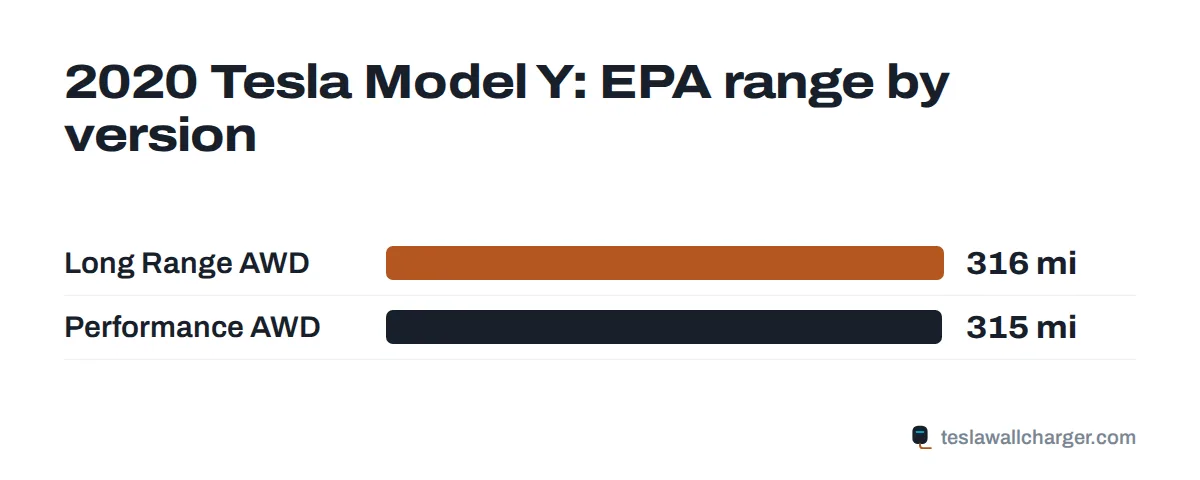
Both trims use Panasonic 2170 NCA cells and a pack of roughly 75 kWh (Tesla does not publish usable capacity, so treat that as approximate). The Long Range was quoted at 4.8 seconds to 60 mph and the Performance at 3.5 seconds. The Performance gives up very little EPA range on standard wheels (315 miles), but on its 21-inch wheels the rating drops to 291 miles.
The bigger number for a 2020 buyer is the warranty date. Tesla's warranty terms cover the battery and drive unit for 8 years or 120,000 miles from the day the car was first delivered. Spring 2020 deliveries lose that cover in spring 2028. Price the car as if you will own it past that point, and look up how long a Tesla battery lasts in real use before deciding how much remaining life you are paying for.
Charging a 2020 Model Y at home
Both trims have an 11.5 kW onboard charger, so they take the full 48 A from a Wall Connector on a 60 A circuit. That works out to up to 44 miles of range per hour, or roughly 7 hours from empty to full (75 kWh, plus about 10% charging losses, divided by 11.5 kW).
| How you charge | Speed |
|---|---|
| Wall Connector at 48 A (11.5 kW, 60 A breaker) | up to 44 mi of range per hour |
| NEMA 14-50 outlet, Mobile Connector at 32 A | about 30 mi per hour |
| Regular 120 V outlet | 2 to 3 mi per hour |
| Empty to full, largest pack (about 75 kWh) | about 7 hours at 11.5 kW |
Rates scale Tesla's published Wall Connector table for this model; older cars and cold batteries charge slower. Times are estimates.
For a 48 A setup, Tesla's manual calls for 6 AWG, 90 C THWN-2 copper when the breaker is 75 C-rated, and 4 AWG with a 60 C breaker. Have a licensed electrician pick the wire, pull the permit and do the work; our guide to breaker ratings for Tesla chargers explains the 125% rule behind the 60 A number. Tesla puts typical Wall Connector installation cost at $750 to $1,500 before hardware, and the federal 30C credit no longer applies to chargers placed in service after June 30, 2026.
If your daily driving is modest, a 240 V 14-50 outlet with a Mobile Connector (32 A) is enough. Used 2020 cars were sold with a Mobile Connector in the box, so ask whether the seller still has it.
What it costs to run. The EPA figure works out to about 28 kWh per 100 miles. At the July 2026 US average of 18.31 cents per kWh (EIA), that is about $5.13 per 100 miles. Drive 12,000 miles a year on home power and you would spend about $615. Your own rate decides the real number; our page on Tesla electricity costs shows how to work it out for your utility.
Pre-purchase checklist for a launch-year car
- Get the build or delivery date. Late 2020 builds have laminated glass and auto-dimming mirrors.
- Confirm 20V709000, 21V387000 to 21V389000, 21V835000, 21V912000 and 26V507000 are closed.
- Drive on a highway with cruise control on and note any sudden braking.
- In cold climates, run the heat on a cold morning and ask about heat pump repairs.
- Read the 100% range estimate and compare it with 316 miles (Long Range).
- Work out the warranty end date from the original delivery date.
- Plan home charging around 48 A if you want the car's full speed.
If the price gap to a 2021 car is small, the 2021 Tesla Model Y adds the heated wheel and a slightly higher range rating. The Model Y years overview compares every year side by side.
Questions about the 2020 Model Y
Is the 2020 Tesla Model Y reliable?
Its drivetrain and battery have held up well, but build quality on early cars was uneven. That shows in the recall list: seven of the 24 campaigns needed a service visit, most of them for loose or weak suspension, seat belt and brake caliper fasteners. A car with every recall closed and a clean service history is a reasonable buy. A car with open suspension recalls is not, until they are done.
What is the real range of a 2020 Model Y?
The EPA rated the Long Range AWD at 316 miles and the Performance at 315 miles, or 291 miles on its 21-inch wheels. After six years expect less. Tesla's own reports put average Model 3 and Model Y capacity loss at about 15% after 200,000 miles, so a low-mileage car usually loses far less. Check the full-charge estimate in the car.
Does a 2020 Model Y have radar and parking sensors?
Yes to both as hardware. Every 2020 Model Y was built with forward radar and ultrasonic parking sensors. A 2022 software update moved radar-equipped cars to camera-only operation, so the radar no longer does anything, but the parking sensors still work. The Autopilot computer on US cars of this age is Hardware 3, which you can confirm in the software information screen.
Can a 2020 Model Y use the new Wall Connector?
Yes. The current Gen 3 Wall Connector uses the same Tesla (NACS) plug and charges a 2020 Long Range or Performance at its full 48 A, or 11.5 kW, on a 60 A breaker. As of October 2026 Tesla lists it at $585, often out of stock. Older Gen 2 units work too; the car simply takes no more than 48 A.
How long is the battery warranty on a 2020 Model Y?
Tesla covers the battery and drive unit for 8 years or 120,000 miles on Long Range and Performance cars, with at least 70% capacity retained. The clock starts on the original in-service date, not the date you buy it, so a car delivered in mid-2020 is covered only until mid-2028. Ask the seller for the original delivery date.
Sources
- NHTSA recalls, 2020 Tesla Model Y, api.nhtsa.gov
- NHTSA 5-Star Safety Ratings, 2020 Model Y AWD, api.nhtsa.gov
- InsideEVs: Model Y EPA range and efficiency ratings, insideevs.com
- Electrek (2020-11-19): Model Y gets 2021 Model 3 refresh features, electrek.co
- Motor Authority (2020-07-13): Tesla cuts Model Y pricing, motorauthority.com
- The Drive: Tesla heat pumps failing in extreme cold, thedrive.com
- NHTSA ODI PE22-002 (phantom braking), static.nhtsa.gov
- Tesla support: Wall Connector, tesla.com
- Tesla vehicle warranty, tesla.com
- EIA Electric Power Monthly, residential price, eia.gov
Independent site. Not affiliated with or endorsed by Tesla, Inc. Tesla, Wall Connector and Supercharger are trademarks of Tesla, Inc.